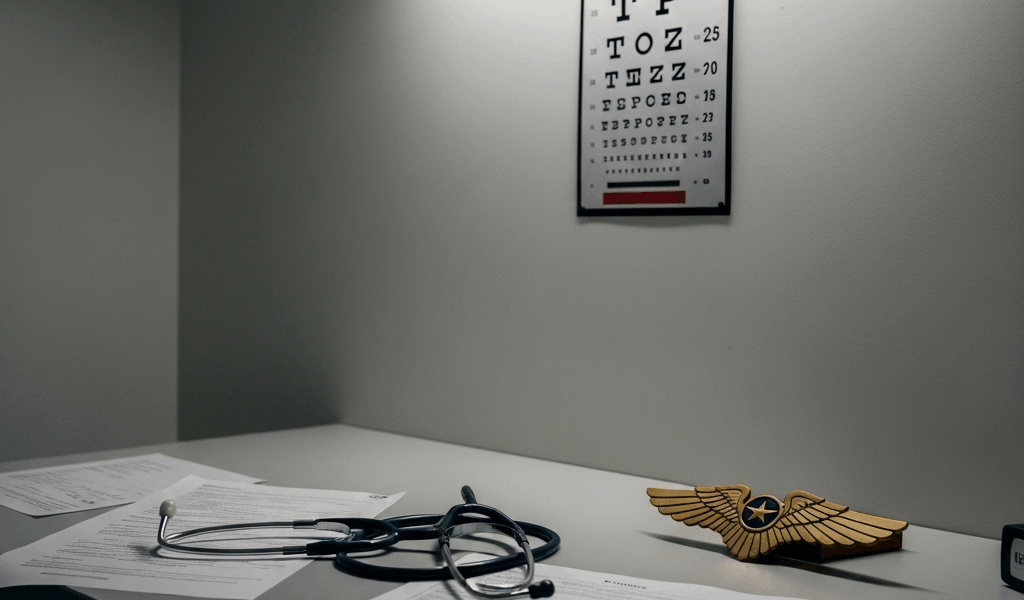
The Flight Surgeon Eval Is Not a Regular Physical
I learned this the hard way. Back when I was considering military aviation, I assumed passing my annual civilian physical meant I’d sail through the flight surgeon evaluation. I was wrong — the military operates under a completely different standard. Significantly more rigorous than anything your local physician is checking.
Your civilian doctor wants to know if you’re healthy enough to live your normal life. A flight surgeon wants to know if you’re healthy enough to eject at 30,000 feet, survive high G-forces, and make split-second decisions while experiencing spatial disorientation. Those aren’t even close to the same bar.
Here’s what caught me off guard: the flight surgeon exam at Military Entrance Processing Station (MEPS) isn’t just about your current health status. It’s predictive. They’re looking for anything that might deteriorate, regress, or become a liability in a high-stress cockpit environment. Vision that’s acceptable for driving? Not acceptable for identifying a target at distance. Blood pressure that’s borderline normal? Not acceptable when you’re under sustained combat stress.
The threshold is stricter because the stakes are higher. You’re not just responsible for yourself—you’re responsible for millions of dollars in equipment and potentially your crew. That context changes everything about what disqualifies you.
Top 5 Medical Disqualifiers That Surprise Pilot Candidates
1. Hypertension — Even the Mild Kind
This one catches people off guard constantly. The military uses a 140/90 mmHg ceiling for initial pilot qualification. Your civilian doctor might not even flag blood pressure at 138/88 as a problem. The flight surgeon will. I’ve seen candidates fail at MEPS because their BP read 141/89 on exam day — just one point over the limit.
Here’s what makes it worse: white coat syndrome is real. Stress during the actual exam can push your numbers higher than your baseline. If you’re borderline, you’re vulnerable to a bad exam day.
2. Uncorrected Refractive Error Beyond Established Margins
The military allows corrected vision down to 20/40 in each eye (correctable to 20/20). But here’s the catch — your refractive error correction itself has limits. Spherical equivalent cannot exceed ±8.00 diopters. Astigmatism cannot exceed ±3.00 diopters. If your prescription falls outside those ranges, you’re disqualified, even if glasses correct you to 20/20.
Many candidates don’t even know their diopter measurement. You need that number before MEPS. Get a formal refraction test from an optometrist, not just an eye exam at the chain store.
3. Undisclosed or Active Mental Health History
Withholding mental health treatment is an automatic disqualification. This includes therapy, counseling, or medication for anxiety, depression, ADHD, or any psychiatric condition. The flight surgeon will ask directly, and you’ll sign a statement confirming you’ve answered truthfully. Lying on that form is a federal offense with real consequences.
Here’s what surprises people: mild ADHD you were treated for in high school can trigger a disqualification, even if you’re not on medication now. The history is the disqualifier, not necessarily the current condition. That said — some conditions can be waived. But you have to disclose them first. Honesty opens the door to a waiver. Dishonesty closes it permanently.
4. Orthopedic Issues From Previous Injuries
Old sports injuries, previous fractures, or chronic joint problems that don’t bother you in daily life can become a problem in the cockpit. The flight surgeon is thinking about your long-term capacity to withstand ejection forces, sustained G-loading, and the physical demands of emergency procedures.
A previous ACL tear you fully recovered from? Still worth disclosing and documenting with imaging. Limited range of motion in a shoulder from an old dislocation? Better to bring it up proactively with surgical records than have the flight surgeon discover it during the physical exam and question why you didn’t mention it.
5. Inner Ear or Balance Dysfunction
Anything affecting your vestibular system — history of vertigo, chronic balance issues, or even past ear infections with lasting effects — can disqualify you. The flight surgeon performs specific balance tests during the exam. If you fail the Dix-Hallpike maneuver or similar vestibular assessments, that’s a hard stop.
This is especially tricky because many candidates don’t realize a past inner ear issue could still show up on testing years later. You need recent, clean vestibular testing to prove current function.
How to Prepare Your Medical Records Before MEPS
Probably should have opened with this section, honestly. Preparation is where most candidates lose the battle.
Audit Everything First
Pull your complete medical record from every provider you’ve seen in the last ten years. Yes, ten years. Obtain actual records — not just a summary. You need dates, diagnoses, test results, and provider notes. Request them 4-6 weeks before your MEPS appointment. Clinics take forever to compile full records.
As someone who worked with three different healthcare systems before my evaluation, I learned that different providers had different documentation standards. One clinic’s records were sparse. Another had detailed progress notes going back years. You need all of it to identify potential red flags before the flight surgeon sees them.
Get Certified Vision and Hearing Tests
Don’t rely on your last eye exam from the mall optical store. Get a formal refraction and visual acuity test from an ophthalmologist or optometrist, and explicitly ask them to document your spherical equivalent and astigmatism in diopters. Request the full report, not just your new glasses prescription.
Hearing assessment too. Audiometric testing should be performed in a sound-proof booth and reported in decibels (dB) across frequencies. The military requires normal hearing for pilot candidates — no exceptions here.
Disclose Everything in Writing Before the Exam
Once you’ve reviewed your records and identified anything potentially problematic — even minor things — send a written summary to your recruiter and request guidance before MEPS. Include dates, diagnoses, treatment, and current status. This accomplishes two things: it gives the flight surgeon advance notice (reducing the surprise factor and the appearance of hiding something), and it gives you a chance to gather supporting documentation or waivers if needed.
Include a signed statement acknowledging what you’ve disclosed. This becomes part of your file and demonstrates transparency.
Address Chronic Conditions Proactively
If you have a condition that’s controlled but medicated — hypertension, asthma, seasonal allergies — get current medical documentation showing it’s stable. For hypertension specifically, keep a personal log of home BP readings for two weeks before MEPS. Document the monitor model and time of day. If your readings are consistently under 140/90, that’s evidence supporting your qualification.
Timeline: Submit your medical disclosure 3-4 weeks before MEPS. Allow the recruiter time to coordinate with the flight surgeon. Arrive at MEPS with two copies of all relevant documentation in a folder, organized by date.
The Post-Eval Appeal Process If You Get Disqualified
A “not medically qualified” (NMQ) determination at MEPS isn’t necessarily final — but the path forward depends on the specific disqualifier.
Some conditions can be waived. Others cannot. The flight surgeon’s evaluation triggers either a waiver request (where they’ll ask for additional documentation and may reconsider) or an immediate disqualification with no waiver option. The specific condition determines which bucket you’re in.
If a waiver is possible, your recruiter initiates a request with supporting medical evidence. You might be asked to get a specialist evaluation, additional imaging, or a detailed statement from your civilian physician. The timeline for a waiver decision can extend 2-6 months. Approval rates vary by branch and condition — some waivers are approved regularly, others are rarely approved.
If no waiver is available for your disqualifier, you can request a formal appeal with the Air Force Surgeon General’s office (or equivalent in your branch), but this is a high bar. You’re essentially asking them to overturn the flight surgeon’s medical judgment. This rarely succeeds unless there’s a clear factual error in the evaluation.
Your recruiter’s role is crucial here. They’ll tell you whether a waiver is realistic for your condition. Don’t assume. Ask directly, and ask for historical approval rates if possible.
Red Flags During the Exam You Can Control
Beyond the medical facts, your presentation during the exam matters more than people realize. I’ve heard from flight surgeons that they sometimes have to make borderline calls — and when they do, a candidate’s demeanor influences the decision.
Elevated Stress Blood Pressure
Your BP will be checked multiple times during MEPS. If your first reading is 142/91 but your second is 138/88, that matters. Hydrate well, eat breakfast, get sleep the night before, and ask to re-check after sitting quietly for five minutes if your initial reading is borderline. This is a reasonable request and shows good judgment.
Transparency About Medical History
When the flight surgeon asks about past illnesses, injuries, or medical treatment, answer fully and calmly. Hesitation or vague answers raise suspicion. If you can’t remember an exact date, say so — don’t guess. Admit when you need to verify something from your records. That’s credible.
Defensive Attitude
If the flight surgeon asks a follow-up question about your medical history, answer it straight. Don’t get defensive or argue that something shouldn’t matter. Their job is to assess risk. Your job is to provide information clearly and accept their professional judgment.
Follow Up in Writing
If you feel the flight surgeon misunderstood something or didn’t have complete information, send a follow-up email to your recruiter within 24 hours. Keep it factual and brief: “During my exam on [date], I realized I didn’t mention [specific detail]. Here’s the documentation: [attachment].” This creates a written record and gives them a chance to update your file before the final determination.
The flight surgeon exam isn’t just a medical event — it’s also a communication test. Pass both and you’re halfway to wings.



Stay in the loop
Get the latest milpilot updates delivered to your inbox.