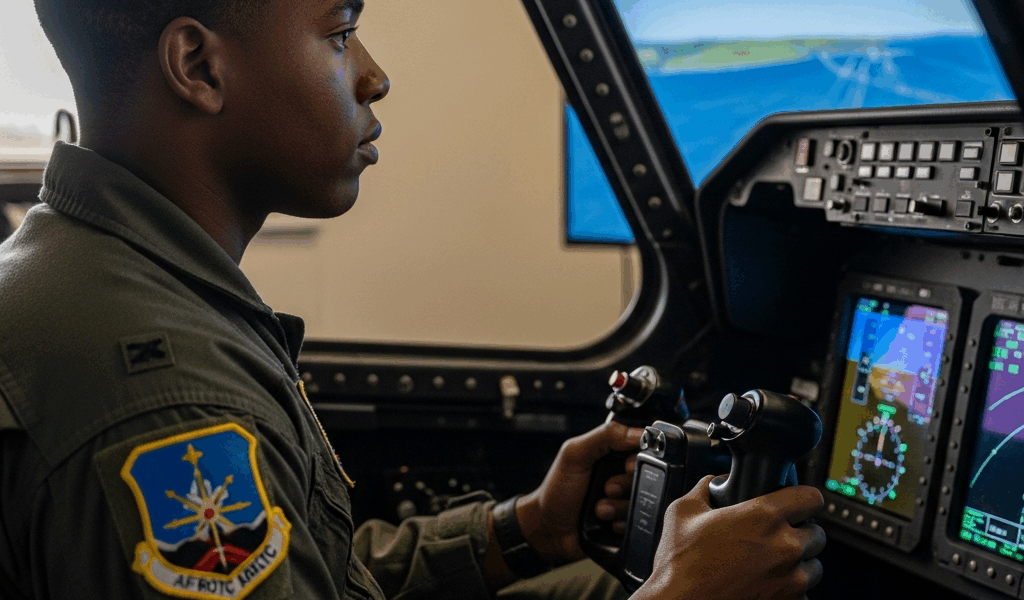
How do you get a pilot slot through AFROTC?
An Air Force ROTC cadet competes for a pilot categorization through the AFROTC rated-selection process. A competitive record combines:
- a strong Pilot Candidate Selection Method score
- sustained performance and commander ranking
- solid college grades
- qualifying fitness results
- completion of Field Training and program requirements
- medical and age eligibility
- accurate, on-time preferences and records in the AFROTC personnel system
No public score guarantees selection. Available pilot allocations, applicant quality and Air Force requirements change by fiscal year. Headquarters AFROTC also issues annual board instructions that can change deadlines, factors or weights, so the detachment cadre and current message are controlling sources.
The goal is not to chase an unsupported “70% selection rate.” It is to become qualified, improve every scored factor still under your control and submit a clean record before the annual cutoff.
AFROTC pilot selection at a glance
| Factor | What it represents | What a cadet can do |
|---|---|---|
| PCSM | AFOQT Pilot composite, TBAS performance and credited flight experience | Prepare for testing, follow retest rules and ensure flight hours are recorded before cutoff |
| Commander ranking / RSS | Relative assessment within the commissioning class | Perform consistently in academics, leadership, training and professionalism |
| College GPA | Academic performance | Protect cumulative grades; do not assume a particular major earns an automatic adjustment |
| Fitness assessment | Current qualifying AFROTC/Air Force fitness result | Train consistently and follow the current 2026 test rules |
| Field Training | Completion and, when used, performance data | Prepare for leadership, followership and military-performance evaluation |
| Preferences and eligibility | Rated choices, age, medical, security and commissioning status | Review records early and correct errors through cadre |
Published AFROTC instructions have historically made PCSM the largest pilot-specific factor and allowed Headquarters AFROTC to set other factor weights. Detachment or annual guidance may show a particular year’s exact model. Do not use a decade-old table as if its percentages are permanent.
When does the AFROTC rated board happen?
The original article said the board normally meets in the fall of AS400 year. That is not a reliable planning assumption.
AFROTC detachments commonly prepare rated applicants during the junior/AS300 cycle, with data locks and selection activity governed by the annual Headquarters AFROTC schedule. University AFROTC guidance describes submitting the required information during junior year and a rated board in the spring. Dates can move.
Cadets should ask cadre for five exact dates:
- AFOQT completion deadline
- TBAS completion deadline
- flight-hour documentation cutoff
- rated preference and eligibility-data lock
- expected result-release window
Work backward from the first deadline, not from an online article. Testing appointments can fill, score corrections take time and a last-minute retest may miss the board.
What is the PCSM score?
The Pilot Candidate Selection Method is a 1–99 score used to estimate success in Air Force pilot training. Current official material describes it as combining:
- AFOQT Pilot composite performance
- Test of Basic Aviation Skills results
- credited flight experience
The Air Force does not publish a simple formula that lets applicants calculate the result themselves. The official PCSM site reports the score of record and can display how additional flight-hour brackets would affect it.
A higher score strengthens a package, but labels such as “80 is competitive” or “below 60 cannot win” are not official cutoffs. Board results depend on the complete record and annual competition.
The flight-hour cap is not 201.5 hours
The original page used an obsolete claim that PCSM credit continued to 201.5 hours. Current Department of the Air Force testing guidance states that PCSM uses civilian flying hours up to a maximum of 41 hours. Older official guides used different caps, including 60 hours, so the current manual and PCSM record should control.
That does not mean every applicant needs 41 hours or a private pilot certificate. Flight time can improve PCSM and help confirm aviation interest, but it is expensive and should not come at the cost of grades, fitness or ROTC performance.
Before paying for hours solely for a board:
- check the current PCSM hour brackets
- confirm which flight and approved-device time can be credited
- keep logbook documentation
- ensure cadre enter the hours before the annual cutoff
- compare the projected score change with the cost
Civilian training is not a substitute for the Air Force syllabus.
AFOQT rules cadets need to know
The original article said an applicant could take the AFOQT twice and that the second result replaced the first. Current accession guidance says:
- retesting is authorized after at least 90 days
- three administrations are permitted, although the third requires the specified waiver
- an automatically calculated superscore may be used under current policy
- pilot applicants must meet the applicable Pilot composite minimum
Policies and waiver authorities can change, so cadets should verify the current DAFMAN and detachment instructions before scheduling.
For a subtest-by-subtest preparation plan and the current retest rules, see our AFOQT Pilot-section guide.
Prepare for the tested skills
Use official sample material first. The AFOQT is timed, and performance can improve through familiarity with instructions, pacing and the underlying math, verbal, aviation and instrument concepts.
A useful study plan:
- Take an official diagnostic under timed conditions.
- Identify weak subtests that contribute to the Pilot composite or commissioning minimums.
- Review concepts rather than memorizing leaked questions.
- Practice table reading and instrument interpretation accurately under time.
- Retest only when preparation and the board calendar support it.
Do not promise that one commercial book, a fixed eight-week schedule or a particular joystick will produce a score. The official material and current test rules take priority.
What does the TBAS measure?
The TBAS is a computer-based battery used with the AFOQT and flight experience to produce PCSM. It evaluates psychomotor and cognitive abilities relevant to pilot training, including multitasking and tracking tasks.
Cadets should obtain the current scheduling and retest rules from an authorized testing location. Do not download questionable software, copied test content or tools claiming to reproduce scored items. Familiarization should stay within official policy.
After testing:
- confirm the score appears on the official PCSM site
- verify identity information and flight hours
- save documentation
- notify cadre promptly if a record is missing or incorrect
Commander ranking is built over time
The detachment commander ranks cadets relative to the fiscal-year commissioning class. AFROTC converts that position and class size into a Relative Standing Score for selection processing.
This is a national board input derived from local performance—not a separate local pilot-slot quota. The original article incorrectly suggested applicants primarily compete only inside the detachment before a national review.
Cadets improve the underlying record by consistently demonstrating:
- dependable attendance and preparation
- military bearing and integrity
- effective leadership and followership
- accountability after mistakes
- academic and fitness discipline
- useful contribution without performative “visibility”
- respect toward peers and cadre
There is no responsible last-minute tactic for commander ranking. Ask for specific feedback early enough to act on it, then improve the behavior being evaluated.
Does college major affect pilot selection?
Do not assume a board quietly adds points for engineering or discounts another major as “easy.” Detachment guidance describing the rated order of merit says college major is not itself considered as a selection factor.
GPA still matters. A technical degree may affect a cadet’s workload and Air Force career options, but it should not be marketed as an unpublished GPA conversion. Choose a degree that supports academic success and a viable career, then protect the cumulative GPA.
There is also no universal “3.2 competitive cutoff.” The Air Force pilot career page lists a 2.5 GPA as a general officer-pilot qualification reference, but AFROTC program standing, scholarships, enrollment allocations and rated competition can impose different practical constraints. Minimum eligibility is not the same as a competitive board record.
Fitness requirements changed in 2026
The original page described only push-ups, sit-ups and a 1.5-mile run and gave unsupported sex-specific “Excellent” targets.
The Department of the Air Force transitioned to updated physical-fitness requirements in 2026. Official testing resumed July 1 after a diagnostic transition period. Current options and scoring must be checked against the applicable AFROTC and Air Force instructions; published Air Force material includes updated strength, core and body-composition components.
For rated selection, the useful advice is durable:
- pass every required assessment
- train consistently rather than for one board date
- know the exact event options and scoring tables in force
- address injuries through proper medical and cadre channels
- verify the score recorded in the personnel system
Do not train to an invented nine-minute run requirement or imply that eight semester scores are necessarily averaged into the rated order of merit.
Medical and age qualification
Air Force pilot applicants must meet strict medical standards and begin pilot training before reaching the applicable age limit, absent an approved exception.
The Air Force recruiting page currently states that pilot training must begin before the applicant’s 33rd birthday. The date that matters is entering training—not merely commissioning or receiving a slot.
Medical eligibility is more detailed than eyesight alone. It can include vision, color vision, depth perception, hearing, anthropometrics, medical history and other standards. A DoDMERB qualification for AFROTC is not automatically the same as final Flying Class I qualification.
Review the separate guides to the current Air Force pilot age limit and military pilot vision requirements before relying on a forum answer.
Cadets should:
- answer medical forms accurately
- avoid self-diagnosing waiver outcomes
- preserve relevant records
- follow detachment instructions for the rated physical
- allow time for additional evaluation or waiver processing
How competitive is an AFROTC pilot slot?
There is no current public national selection rate that supports the original article’s confident 60–70% claim. It also mixed annual AFROTC commissions, total Air Force pilot production and commissioning sources without a cited dataset.
A selection rate can mislead even when accurate:
- eligibility filters may remove people before the board
- applicant self-selection changes the pool
- available allocations change
- pilot, RPA, CSO and ABM numbers differ
- rated preferences affect categorization
- a prior year’s average says little about a specific current record
Use any statistic only when Headquarters AFROTC identifies the fiscal year, number eligible, number considered and number selected for pilot specifically. Otherwise describe the process as competitive and focus on controllable factors.
How to build the strongest package
First year
- Learn AFROTC academic, fitness and conduct requirements.
- Build sustainable study and training routines.
- Explore aviation without taking on unaffordable flight debt.
- Ask how rated categorization works at the detachment.
Sophomore year
- Prepare deliberately for the AFOQT.
- Complete testing early enough to preserve a lawful retest option.
- Seek direct performance feedback before Field Training.
- Maintain records of any creditable flight experience.
Junior/rated-board cycle
- Complete TBAS and verify PCSM.
- Confirm every WINGS/record field with cadre before data lock.
- Review medical and age timing.
- Rank rated preferences honestly and understand the service consequences.
- Keep grades and fitness strong after submission.
Before accepting categorization
- Understand that pilot training carries a substantial active-duty service commitment after earning aeronautical wings.
- Review the current Air Force UPT pipeline so the training sequence is not a surprise.
- Confirm the consequences of declining or losing a rated categorization under the contract and policies that apply to you.
- Do not rely on later cross-training as a backup plan.
What if you are not selected for pilot?
Other rated fields—Combat Systems Officer, Air Battle Manager and Remotely Piloted Aircraft pilot—are distinct careers, not guaranteed stepping-stones to a manned pilot slot. Volunteer only after understanding their missions, training and commitments.
The original article suggested that a CSO could routinely submit a pilot retraining request every year and that an AFROTC graduate could simply “apply again through OTS.” Both are misleading:
- Crossflow opportunities depend on active-duty policy, year group, release from the current career field, age, medical qualification and a competitive board. They may not be offered on a predictable schedule.
- OTS is another commissioning source for civilians or eligible enlisted applicants, not a do-over commissioning route for an officer who already commissioned through AFROTC.
If not selected, review the official result and available options with cadre. Those could include another valid AFROTC process if authorized, accepting a different career field, or pursuing Guard/Reserve unit hiring later if eligible. None is guaranteed.
Frequently asked questions
What PCSM score guarantees an AFROTC pilot slot?
None. Higher is better, but selection uses the complete order of merit and the number of allocations available that year.
Do you need a private pilot certificate?
No general AFROTC rule requires a private pilot certificate for pilot categorization. Credited flight experience can affect PCSM, but the current hour cap and cost should be checked before purchasing training solely for the board.
Is AFROTC pilot selection local or national?
Headquarters AFROTC performs national categorization. Commander ranking is a local relative assessment converted into a national-board factor.
Can you retake the AFOQT?
Current accession guidance allows retesting after the required interval and permits three administrations with the specified waiver for the third. Confirm the current policy and board deadline through cadre.
Does an engineering major receive extra pilot-selection points?
Do not assume so. Published detachment guidance says major is not itself a rated-board factor; cumulative GPA is.
When should you take the AFOQT and TBAS?
Early enough to receive scores, correct records and preserve an authorized retest before the annual data lock. Ask the detachment for exact dates.
Bottom line
An AFROTC pilot slot is won through a national categorization process, not an uncited selection-rate shortcut. PCSM, commander ranking, academics, fitness, Field Training and eligibility all matter, with annual instructions controlling the exact board.
Start early, use official test material, verify every recorded score and flight hour, seek honest performance feedback and keep a viable career plan that does not depend on a guaranteed crossflow later.



Stay in the loop
Get the latest milpilot updates delivered to your inbox.