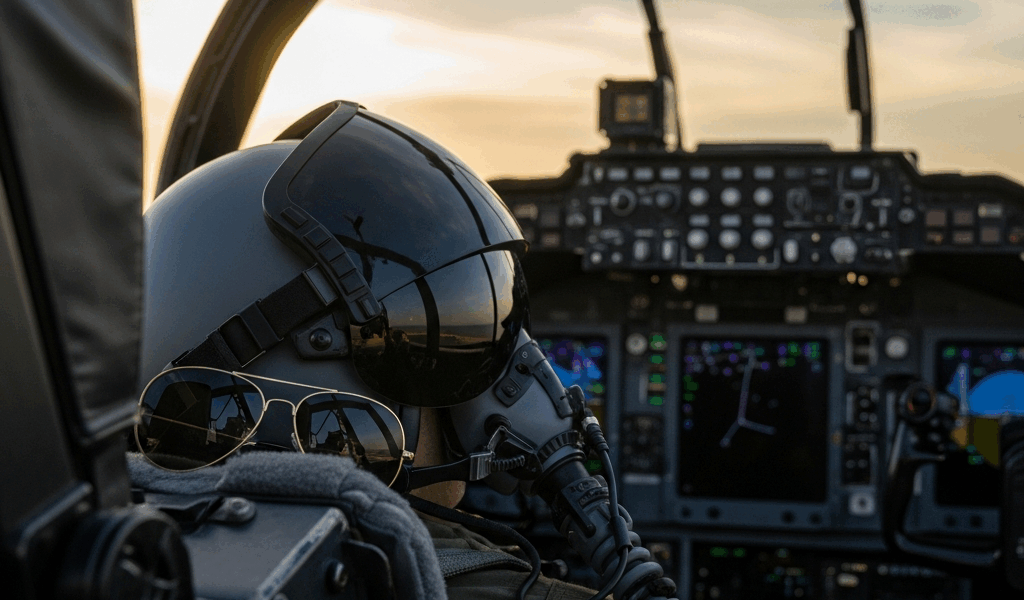
Yes. Navy pilots and student naval aviators can wear prescription glasses when their vision meets the applicable naval aviation standard. Needing glasses is not, by itself, a disqualifier. What matters is your measured visual acuity, refraction, color vision, depth perception, eye health and whether any condition outside the standard is waiverable.
Quick answer: If your eyesight corrects to the required level and you pass the rest of the aviation eye examination, glasses may be used. Do not self-screen from an old forum post or a civilian prescription: NAMI applies a complete Student Naval Aviator examination.
Can Navy pilots wear glasses?
Yes. The current Navy Aeromedical Reference and Waiver Guide includes standards for both applicants and designated aviation personnel. It does not impose a blanket ban on corrective lenses. The guide is maintained by the Naval Aerospace Medical Institute (NAMI) and supplements the Navy Manual of the Medical Department.
The important distinction is between:
- Uncorrected vision: what you can read without glasses or contacts.
- Corrected vision: what you can read with the prescribed correction.
- Refraction: the optical prescription measured during the examination.
- Other visual functions: including color vision, depth perception, ocular alignment and corneal health.
A candidate can therefore wear glasses and still fail for a separate eye condition. Conversely, a strong glasses prescription is not enough information to determine qualification by itself.
Navy student pilot vision standards at a glance
NAMI’s current guide lists Student Naval Aviator applicant standards and the required examination methods. The published table includes 20/20 corrected distant visual acuity for SNA applicants, limits on hyperopic spherical refraction, and specific color-vision, depth-perception and corneal-screening requirements. The exact result must be recorded by the examining military optometry or aviation-medicine team.
| Question | Practical answer |
|---|---|
| Can an applicant wear glasses? | Yes, if the complete aviation eye examination meets the applicable standard. |
| Must vision correct to 20/20? | NAMI’s SNA applicant table requires 20/20 corrected distant acuity. |
| Does a civilian eye exam decide qualification? | No. The Navy requires its aviation examination and NAMI review process. |
| Are color vision and depth perception tested? | Yes. These are separate requirements; glasses do not correct every visual function. |
| Can LASIK or PRK be acceptable? | Potentially, after required documentation, stability and review. The procedure is not an automatic qualification. |
Glasses versus a medical waiver
Wearing glasses does not automatically mean you need a waiver. A waiver is considered when a measured condition falls outside the accession standard but naval aviation policy permits individual review. NAMI—not a recruiter, civilian optometrist or online calculator—determines the aeromedical disposition.
The Navy’s official ARWG page explains that flight physicals requiring endorsement are submitted through the Aeromedical Electronic Resource Office by medical personnel. Applicants should work through their officer recruiter and examination facility rather than contacting NAMI to obtain an informal pre-clearance.
For the waiver-specific process, see our Navy pilot vision-waiver guide.
Can Navy fighter pilots wear glasses?
There is no reliable public rule stating that an otherwise qualified naval aviator is barred from a fighter assignment merely because corrective glasses are worn. Aircraft assignment depends on training performance, medical qualification, service needs and available slots. Do not treat claims about different glasses rules for individual aircraft as official unless a current Navy source or flight surgeon provides them.
Operational equipment, helmet fit and approved corrective devices are handled through the aviation-medicine and life-support system. Candidates should not buy supposedly “flight-approved” frames as a way to establish eligibility.
What about contact lenses?
Contact-lens use and qualification are separate questions. A person may meet the visual standard with correction, but the use of a particular lens during flight is governed by current medical and operational guidance. Bring your complete prescription and lens history to the examination and follow the direction of the examining clinic.
What about LASIK or PRK?
Corneal refractive surgery can be compatible with naval aviation, but the surgery type, pre-operative prescription, post-operative stability, complications and documentation all matter. Do not schedule surgery solely from an online summary. Review the current NAMI corneal refractive surgery section and coordinate with a Navy officer recruiter before the procedure.
Our comparison of LASIK and PRK for military pilot applicants explains the questions to ask before treatment.
How to verify your eligibility
- Get a current comprehensive civilian eye examination so you know your prescription and eye-health history.
- Tell your Navy officer recruiter about glasses, contacts, surgery and diagnosed eye conditions.
- Complete the required military aviation physical and optometry examination.
- Provide requested records, especially pre- and post-operative records for refractive surgery.
- Wait for the formal medical determination before making career or surgery decisions.
Frequently asked questions
Can you be a pilot with glasses in the Navy?
Yes. Glasses alone do not disqualify a Navy pilot applicant. You must meet the full Student Naval Aviator vision and medical standards with the required correction.
Can naval aviators wear glasses while flying?
Corrective eyewear can be used by qualified personnel, subject to current aviation-medicine and equipment requirements.
Can you be a Navy fighter pilot with glasses?
Glasses are not a publicly stated automatic bar to fighters. You must remain medically qualified, complete training and compete for an assignment.
Does 20/20 vision guarantee pilot qualification?
No. Corrected acuity is only one part of the exam. Refraction, color vision, depth perception, alignment, corneal health and the rest of the flight physical also matter.
Official sources
- Naval Aerospace Medical Institute: Aeromedical Reference and Waiver Guide
- Navy Aeromedical Reference and Waiver Guide (complete PDF)
- MyNavyHR Program Authorization 106: Pilot and NFO
Standards and waiver policies can change. The current NAMI guide and your formal aviation medical determination control.



Stay in the loop
Get the latest milpilot updates delivered to your inbox.