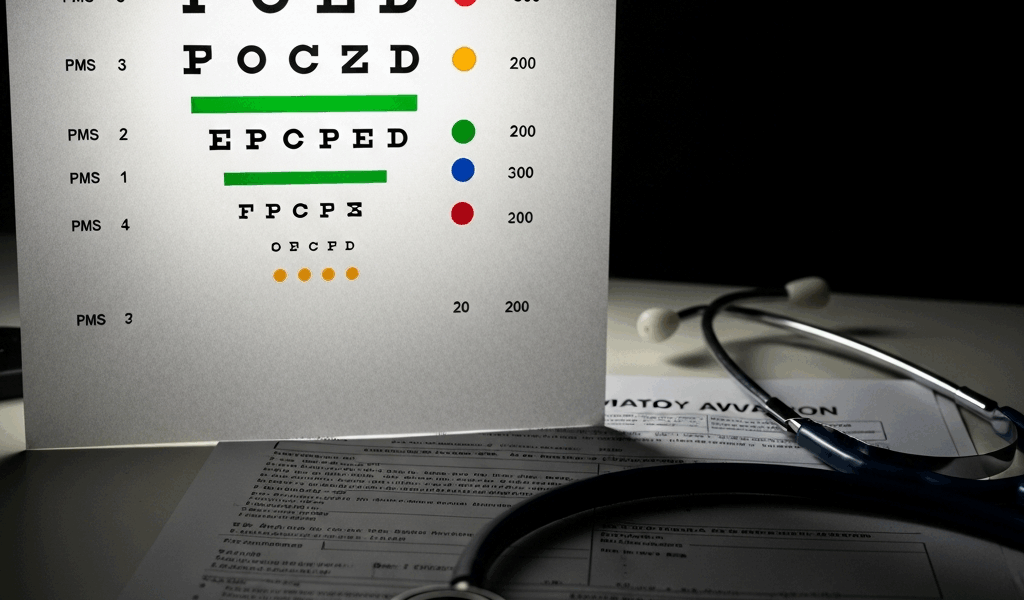
Is Color Blindness an Automatic Pilot Disqualification
Color blindness has gotten complicated with all the conflicting information flying around. The answer isn’t yes or no — it’s “depends,” and I know that’s frustrating, but it’s honest.
Here’s what actually matters: your severity, the specific type you have, which branch you’re joining, and what aircraft you want to fly. Red-green color blindness — affecting roughly 8% of men — has real waiver pathways now. Blue-yellow color blindness sits in murkier territory. Monochromacy, or complete color blindness? That’s effectively a career-ender across all branches, full stop.
I learned this firsthand when a friend’s nephew got rejected from the Air Force pilot pipeline, only to discover months later that he might have qualified for Navy flight training instead. Different branches have genuinely different thresholds — something nobody warned him about.
The U.S. military has moved away from blanket disqualifications for mild to moderate red-green color deficiency. The Air Force, Navy, Army Aviation, and Coast Guard all have formal waiver procedures now. Are they easy? No. They require dual testing, aerospace physiologist review, and patience. But success rates exist, and they’re climbing.
Color Vision Testing Standards by Service Branch
Air Force Standards and Testing
The Air Force uses three primary tests during your flight surgeon evaluation: the Ishihara plate test, the Hardy-Rand-Rittler (HRR) test, and the Farnsworth D-15 desaturation test.
Those colored dot circles — the Ishihara test — screen you first. Scoring below 10 on the 11-plate version flags you for secondary testing. But here’s what people miss: failing Ishihara doesn’t end your evaluation. It just means you move forward to HRR and Farnsworth D-15.
The HRR test uses larger symbols in different colors. The Air Force allows some deficiency here — specifically, missing up to 4 caps (the movable color pieces) on the Farnsworth D-15 keeps you potentially waiverable. Miss 5 or more? You’re looking at likely denial.
Timeline for Air Force waiver approval runs 60–90 days, assuming your local flight surgeon doesn’t flat-out recommend denial.
Navy and Marine Corps Standards
The Navy is arguably the most lenient of the branches, at least historically. They use the same three tests but interpret them differently — sometimes more favorably. A Navy flight surgeon might recommend waiver consideration for performance that an Air Force surgeon would recommend against.
Navy policy allows waivers in naval aviation (jets, helicopters, maritime patrol) if you hit certain criteria: normal Ishihara performance on retesting, 4 or fewer Farnsworth D-15 errors, and passage of an on-demand color recognition test during actual flight training. That last part — proving competency in-aircraft — is unique to Navy policy and actually works in your favor.
Marine Corps aviation follows Navy medical standards since they share one medical system. F/A-18 pilots, CH-53E pilots, and V-22 pilots all go through the identical waiver process.
Army Aviation Standards
Army Aviation — helicopters, not fixed-wing — has historically been slightly more permissive than Air Force standards, though the gap has narrowed over the past decade. They use Ishihara, HRR, and Farnsworth D-15, with similar error thresholds to the Air Force.
The Army also employs the Dvorine color blindness test as a secondary option. Different states and bases have different equipment — worth asking about during your initial contact.
Coast Guard Standards
The Coast Guard has the smallest pilot pipeline and the least public documentation on color blindness waivers. They generally align with Navy policy since many flight surgeons in the Coast Guard trained under Navy protocols. HC-130 and MH-65 pilots have gotten waivers for mild color deficiency, but don’t count on it as your Plan A.
Aircraft Types That Have Higher Color Vision Standards
Operational need shapes everything. Certain platforms genuinely require better color vision than others.
Fighters require the tightest standards. Frustrated by cockpit complexity, Air Force engineers packed F-16, F-22, F-35, F/A-18, and F-15 cabins with color-coded systems, threat warning displays, and tactical overlays that rely on color differentiation. The Air Force treats fighter waivers cautiously. You can find pilots flying fighters with color blindness waivers — but it’s rare and usually requires near-normal performance on all three tests.
The F-35 introduced new color display systems that made fighter cockpits even more color-dependent. This aircraft effectively closed some waiver pathways that existed for earlier platforms.
Transport aircraft are more flexible. C-130 Hercules pilots, C-17 pilots, and KC-135 tanker pilots operate in environments where color vision is less mission-critical. Instrument flying and radio communication dominate the workload. I know of multiple C-130 pilots who obtained waivers and had successful 20-year careers. Waiver approval rates for transport? Genuinely higher.
Helicopters fall in between. UH-60 Black Hawk pilots, CH-47 Chinook pilots, and AH-64 Apache pilots work with color-coded systems, but mission profiles often rely on other cues — terrain recognition, FLIR systems, GPS data. Army Aviation has successfully waivered pilots for attack and heavy-lift helicopters.
Helicopter sea combat (HSC) and maritime patrol pilots operate within Navy standards — marginally more permissive than Air Force standards for these specific platforms.
How to Request a Medical Waiver for Color Blindness
Requesting a waiver isn’t like submitting a form online. It’s a process that requires strategy.
Step 1 — Get Dual Testing
If your initial flight surgeon evaluation flags color blindness concerns, request immediate retesting with a civilian neuro-ophthalmologist or optometrist specializing in aviation medicine. This isn’t extra bureaucracy — it’s your strongest move.
Why? Aviation-specific civilian optometrists often handle borderline cases and provide detailed written documentation that strengthens your case. It creates a record of consistency. Two independent professionals saying similar things carries weight.
Cost runs $200–500 for a civilian evaluation. Schedule this within 2 weeks of your military evaluation.
Step 2 — Request Aerospace Physiologist Review
Your branch has aerospace physiologists — specialists trained in waiver medicine specifically. Ask your flight surgeon to submit your case for aerospace physiologist review. This person sits above your flight surgeon in the approval chain.
Probably should have opened with this section, honestly. Most candidates don’t know this level exists, so they never ask for it.
The aerospace physiologist reviews all your testing data, your civilian evaluation, and complete medical history. They make the recommendation: approve waiver, deny waiver, or request additional testing.
Step 3 — Prepare Your Package
Your package should include:
- Original flight surgeon report with all three test results
- Civilian neuro-ophthalmology or optometry evaluation — written report, not a summary
- Copy of your military entrance physical showing baseline vision status
- Letter explaining your flying history, if any (Officer Candidate School, Civil Air Patrol, or commercial hours)
- Aircraft-specific justification if applicable — for transport aviation, emphasize the mission profile
This package goes to your branch’s medical waiver authority. Air Force routes through Air Force Medical Support Agency. Navy goes to Naval Aerospace Medical Institute (NAMI). Army Aviation routes through U.S. Army Aeromedical Center.
Step 4 — Timeline and Outcomes
Approval timeline: 45–120 days after complete package submission. Longer if they request additional testing.
Realistic approval odds: 35–50% for mild red-green deficiency; 10–25% for moderate; nearly zero for blue-yellow or complete monochromacy. These aren’t official numbers — they’re based on what I’ve actually seen candidates report back. Success depends heavily on how well your civilian evaluation supports the military assessment.
What to Expect During Your Flight Surgeon Evaluation
Walking into a flight surgeon’s office for color vision testing feels higher-stakes than it should. Here’s what actually happens.
Initial Conversation
The flight surgeon asks about color blindness family history, when you first suspected issues, what specific colors give you trouble, and whether you’ve worked around color-dependent systems. They’re building context, not interrogating you. Be honest. If you’ve never noticed color blindness until the Ishihara test, say that.
Formal Testing
You’ll sit in controlled lighting — this matters, actually. Test results vary with room light. The Ishihara plates come out first. You name the numbers you see in each plate. The HRR test follows — similar principle, different format. Then the Farnsworth D-15, where you physically arrange color caps in order of hue. The whole process takes 15–20 minutes.
Most people get nervous and second-guess their answers. Don’t. Your first instinct is more reliable than overthinking under pressure.
The Interpretation Conversation
Once testing is complete, the flight surgeon explains what they’re seeing. They might say: “You showed mild red-green deficiency on Ishihara but near-normal performance on D-15. That’s actually a good combination for a waiver request.” Or they might say the opposite. Listen carefully. Ask directly if they recommend waiver submission or denial.
This moment determines your next move. If they recommend waiver submission, you pursue dual testing. If they recommend denial, you can still request aerospace physiologist review — but your odds drop significantly.
Documentation and Timeline
You’ll receive a formal flight surgeon report. Request a copy immediately — don’t wait for it to be mailed. Ask for it in person or by email within 24 hours. You’ll need it for your waiver package.
The flight surgeon should give you a timeline: “You’ll hear from the aerospace physiologist within 60 days.” If they don’t specify, ask directly.
Color blindness doesn’t close the door on military aviation. It does require strategy, dual testing, and honest conversation with your flight surgeon. The process is real, the pathways exist, and people successfully navigate them every single year.


Stay in the loop
Get the latest milpilot updates delivered to your inbox.