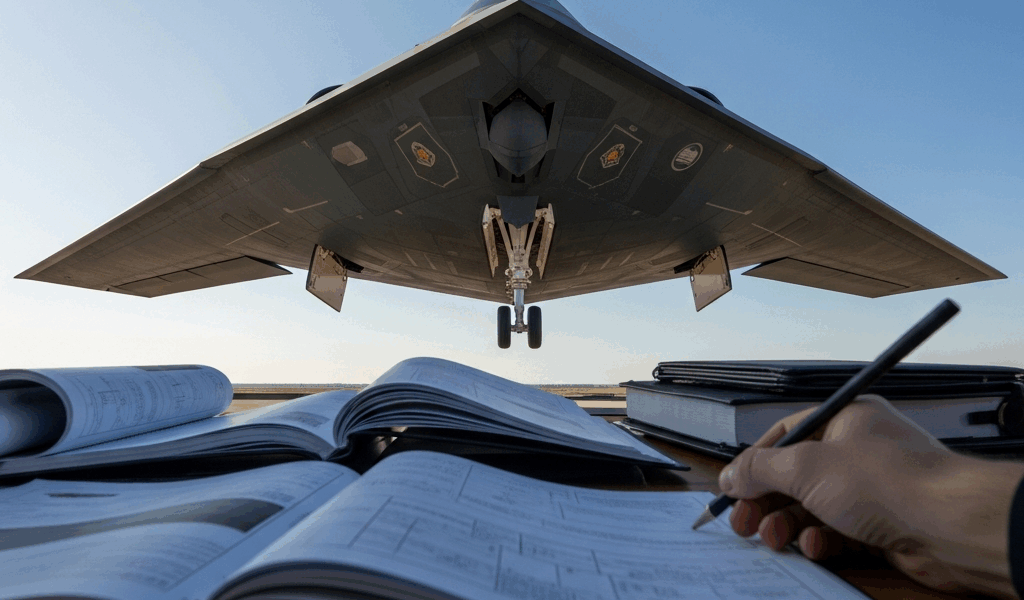
A B-2 pilot is a U.S. Air Force rated officer qualified to fly the Northrop Grumman B-2 Spirit stealth bomber. “B-2” is the aircraft designation; it is not an AFOQT score, pilot certificate level, or separate entry-level job. A person does not apply from civilian life directly to a guaranteed B-2 cockpit. The documented path starts with becoming an Air Force officer, qualifying for pilot training, earning pilot wings, and then receiving and completing aircraft-specific training after an assignment decision.
The Air Force does not publish a permanent B-2 selection score, acceptance rate, annual board schedule, or minimum AFOQT percentile unique to the aircraft. Treat websites that promise a particular score, flight-hour total, or guaranteed route with caution.
What “B-2 pilot” means
The Air Force B-2 Spirit fact sheet describes a two-person crew: a pilot in the left seat and a mission commander in the right seat. Both are qualified aircrew positions; “mission commander” is not a civilian applicant’s shortcut around pilot training.
The term can be confused with unrelated uses of “B2,” including a CEFR language-proficiency level. In U.S. military aviation, writing the hyphen—B-2 pilot—makes clear that the subject is the Spirit bomber.
The public pathway to a B-2 assignment
- Become eligible for a commission. Air Force pilots are officers. Commissioning routes include the U.S. Air Force Academy, AFROTC, and Officer Training School. Each route has its own admission and service requirements.
- Qualify for pilot training. Applicants must meet the current education, medical, age, testing, background, and commissioning requirements for their route. The official Air Force pilot career page is the appropriate starting point because standards and waiver policies can change.
- Complete Undergraduate Pilot Training. The Air Force says its pilots begin with UPT. Students are evaluated throughout training and eventually receive an aircraft assignment based on Air Force needs, available positions, qualifications, and performance. Preferences matter, but no applicant can contract for a B-2 slot through a general public application.
- Receive a B-2 assignment. An assignment is a personnel decision, not simply a test-score threshold. Public sources do not provide a universal ranking formula for B-2 assignments.
- Complete B-2-specific qualification training. Assigned pilots must complete the formal academics, simulator events, flight training, evaluations, and unit qualification required by the current syllabus before serving as mission-ready crew members.
Where B-2 pilots train and serve
Whiteman Air Force Base, Missouri, is the B-2’s operating hub. The 13th Bomb Squadron fact sheet identifies the squadron’s B-2 formal training role. Exact course length, event counts, and training flow can change, and some operational details are not appropriate for public release. That is why a responsible guide should not invent a fixed number of simulator hours, flights, or months.
B-2 crews also deploy and operate away from home station when directed. A deployment location does not necessarily mean there is a separate permanent B-2 training pipeline at that location.
What makes an officer competitive?
Public Air Force recruiting material supports several broad conclusions: a candidate must first qualify as an officer and pilot, complete training successfully, remain medically qualified, and be eligible for the required background investigation and access. Beyond that, the Air Force has not published a checklist that guarantees a B-2 assignment.
Performance, professionalism, judgment, teamwork, instructor recommendations, available aircraft assignments, and the needs of the Air Force can all affect rated assignments. But assigning made-up weights to those factors would be misleading. The most useful actions are the same ones that support any competitive pilot assignment:
- Use an official recruiter or commissioning program for current eligibility and waiver questions.
- Prepare seriously for required aptitude testing without assuming an unofficial “B-2 cutoff.”
- Meet flight-physical standards and disclose medical history accurately.
- Perform consistently in academics, flying, military duties, and crew environments.
- State aircraft preferences honestly while understanding that assignments follow service needs and available slots.
- Protect clearance eligibility through truthful reporting and responsible personal conduct.
AFOQT scores and B-2 selection
The AFOQT is part of officer and rated-candidate qualification, but there is no publicly documented B-2-only percentile such as “92 or higher.” A high score can strengthen an application for pilot training; it does not reserve a specific aircraft. Current minimums, superscoring rules, retest rules, and program requirements should be confirmed through official Air Force guidance for the applicant’s commissioning route.
Likewise, anecdotes about a supposedly typical B-2 selectee cannot establish a selection standard. Aircraft availability and Air Force staffing needs vary from class to class.
Medical and security requirements
Pilot applicants must meet an Air Force flying-class medical standard. Vision is only one part of that evaluation, and an online article cannot determine whether a condition is qualifying or waiverable. Candidates should use current Air Force medical channels and provide complete records rather than self-disqualifying from an outdated list.
B-2 work also involves sensitive information. The government—not the applicant or a website—determines clearance eligibility and access. There is no responsible basis for claiming that a routine credit issue, foreign travel, divorce, or a single performance phrase automatically creates a permanent B-2 disqualification. Applicants must answer security forms fully and work with the designated security office when questions arise.
How long does becoming a B-2 pilot take?
There is no single honest countdown. The total includes commissioning, the wait for training, UPT, assignment timing, aircraft-specific training, and unit qualification. Class dates, syllabus changes, medical holds, and aircraft availability can alter the sequence. Someone starting college is measuring the path in years, while an already-rated Air Force pilot considered for reassignment is at a different point entirely.
For the broader sequence, see our guide to Air Force pilot age limits and waivers and our sourced explanation of the current Air Force pilot-training timeline.
Can a civilian apply directly to fly the B-2?
No direct-to-B-2 public application exists. A civilian can pursue an officer commissioning route and compete for pilot training. Aircraft assignment comes later. A recruiter can explain current active-duty, Air Force Reserve, and Air National Guard opportunities, but candidates should ask whether a vacancy is for pilot training generally or for a specific unit rather than assuming the aircraft is guaranteed.
Can an existing Air Force pilot move to the B-2?
Rated officers can receive new assignments as Air Force requirements and personnel processes allow. The timing, eligibility, and application mechanism are not a fixed public cycle that an outside website can promise. An active officer should use the current assignment team, chain of command, and official personnel systems—not a generic online “selection board calendar.”
Bottom line
To become a B-2 pilot, first become a qualified Air Force officer and pilot. Perform well in the training pipeline, remain medically and professionally eligible, express the preference, and understand that the Air Force assigns aircraft according to qualifications, performance, openings, and service needs. No published score or résumé formula guarantees the B-2, and any claim to know a universal acceptance rate should be treated as speculation unless the Air Force releases the underlying data.
Source note: This guide uses public Air Force recruiting and unit information. It deliberately omits invented interviews, unofficial cutoffs, speculative selection rates, and operational details that are not supported by public official sources.

Stay in the loop
Get the latest milpilot updates delivered to your inbox.