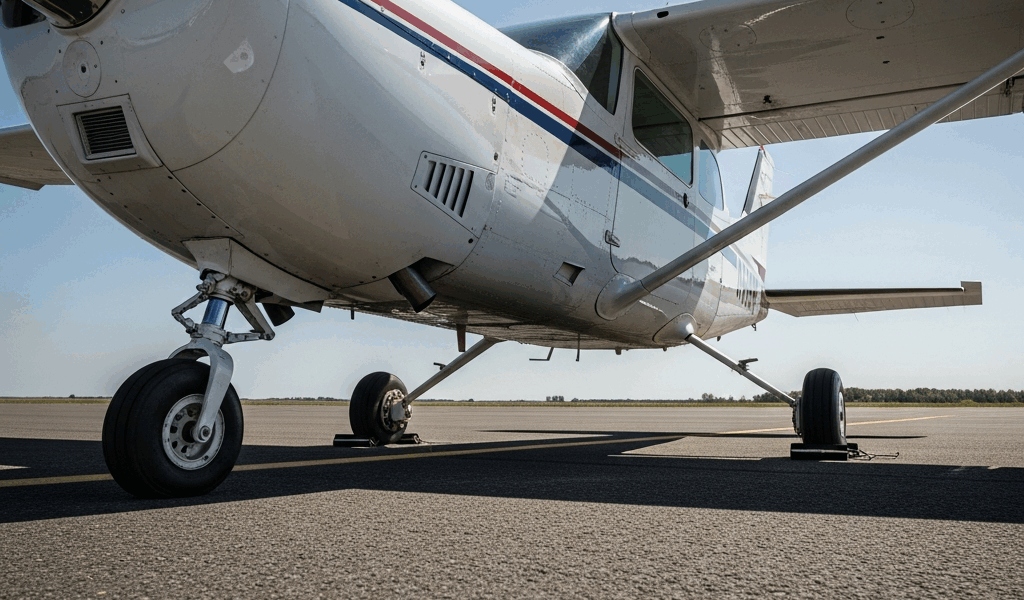
Cessna 92A Pilot — Specs & Performance
The Cessna 92A specs matter because they directly determine whether you can actually fly the mission you’re planning. I started researching the 92A seriously when a friend offered to sell me his 1977 model for a price that seemed too good, and I realized I knew almost nothing about payload breakdowns, real fuel burn at altitude, or what maintenance actually costs on this airframe. Most spec pages treat all Cessnas as interchangeable — which is exactly wrong. The 92A is a legitimate single-engine airplane with specific limitations and strengths that don’t apply to the 172 or 150.
92A Dimensions & Empty Weight
The Cessna 92A measures 24 feet 2 inches in fuselage length and has a 30-foot wingspan. Substantially shorter than a 172’s 36-foot wingspan, which affects wind handling and runway performance. Cabin width is 39 inches at shoulder height. This matters operationally: the narrower fuselage saves weight but limits how you’ll load passengers on cross-country trips.
Empty weight sits at 1,250 pounds — 150 pounds lighter than a comparable 172M. Maximum gross weight is 2,000 pounds, giving you a 750-pound useful load in theory. In practice, you won’t reach that. With full fuel (26 gallons, roughly 156 pounds), your remaining useful load drops to about 594 pounds. Most owners report actual useful load between 550 and 580 pounds depending on how the aircraft has been modified or where equipment has been added over its service life.
What this means for mission planning: you can legally load two 180-pound adults, full fuel, and a small amount of baggage without sweating weight and balance. Try adding a third adult and a full fuel load, and you’re breaking something. I’ve seen 92A owners discover this the hard way during transition training.
Cruise Performance & Fuel Burn
At sea level in calm air, the 92A cruises at 104 knots true airspeed on 5.5 gallons per hour. That’s genuinely efficient — better than the 172’s typical 5.8 GPH at comparable power settings. The 172 carries more weight, so it’s mission-dependent which airplane is actually economical for your trips.
Climb to 10,000 feet and your true airspeed improves to about 108 knots while fuel burn stays roughly the same. At 15,000 feet — where the 92A becomes notably efficient on long cross-countries — you’re seeing 110 knots true airspeed and still burning 5.5 GPH. Service ceiling is 18,500 feet, though realistically the climb becomes very sluggish above 16,000.
Time to climb to 10,000 feet takes roughly 22 minutes under standard conditions at maximum useful weight. Slower than a 172 but not dramatically so. The 92A climbs like a loaded single-engine airplane: adequately, not impressively. What I appreciate about this data is that it means you can do mountain flying if you plan carefully. You won’t be climbing over terrain on a hot day while carrying fuel and friends.
Real-world cross-country math: at 110 knots true airspeed and 5.5 GPH, the 92A gives you roughly 195 nautical miles per hour of travel cost. That’s genuinely economical. The 172 might cruise 5 knots faster but burns slightly more fuel, so you’re not drastically better off in a heavier airplane for pure distance efficiency. Where the 172 wins is payload — it can carry 150 pounds more useful load, which matters if you’re traveling with gear.
Payload & Loading Envelope
Here’s where the 92A owner needs to be honest about real-world limits. Your maximum structural useful load is 750 pounds at maximum gross weight of 2,000 pounds. Your empty weight is 1,250 pounds, confirmed.
Let’s work through an example: you and one passenger each weigh 190 pounds (total 380). Your baggage compartment limit is 40 pounds. You want to carry 26 gallons of fuel (156 pounds). Total loaded weight: 1,250 (empty) + 380 (occupants) + 40 (baggage) + 156 (fuel) = 1,826 pounds. Legal, with 174 pounds of margin to maximum gross. Center of gravity is within envelope. This is a legitimate three-hour cross-country mission with fuel reserves.
Now remove one passenger and add that weight to cargo instead. You’ve just removed 190 pounds of human weight but can only add 40 pounds of baggage. You have 150 pounds of unused useful load sitting there. This is the constraint nobody talks about: the baggage compartment limit is the real limiter, not total weight. If you’re hauling equipment, tools, or cargo, you’re bottlenecked by cubic volume and the 40-pound limit long before you hit weight limits.
The CG envelope is 23.8 to 28.3 percent mean aerodynamic chord — broader than some tailwheel planes but requires attention if you’re loading baggage aft. An empty airplane has CG at roughly 25 percent MAC — nicely centered. With full fuel and light occupants, CG can shift. Run the numbers from the POH every time you load the airplane differently until you internalize the envelope. Probably should have opened with this section, honestly. Weight and balance kills more pilots than bad weather.
Engine & Systems Reliability
The 92A uses a Continental O-200-A engine, a 100-horsepower four-cylinder that’s been in production since the 1940s. Time between overhaul is 2,000 hours. Fly 100 hours per year (realistic owner average), and you’re looking at a 20-year engine lifespan before major overhaul becomes mandatory.
Actual overhaul costs in 2023–2024 run $18,000 to $22,000 depending on whether the engine needs cylinders replaced or grinds smoothly at teardown. Budget for a reserve fund of roughly $90 to $110 per flight hour to account for eventual overhaul spread across your ownership lifetime.
The O-200-A is known for cold-start reluctance in winter, especially if cylinders have developed any lead fouling. Regular leaning procedures and occasional high-power runs help. There are no major repetitive ADs specific to the 92A airframe itself beyond standard Cessna compliance: strap inspections, wing-spar inspections every 500 hours (roughly), and routine alternator checks. The 92A doesn’t have the fuel-tank inspection AD that plagues some 172s — which is worth noting if you’re comparing ownership burden.
Magneto checks are standard; expect a 500-hour mag overhaul to cost $800 to $1,200 for the pair. Engine mounts corrode. Budget $400 to $600 for replacement when needed, typically every 5 to 7 years. Vacuum system failures are common in all Cessnas of this era — roughly $1,500 to $2,000 for replacement pump and serviceability. These aren’t disasters, just normal operating costs.
Operating Costs & Real-World Economics
Annual inspection runs $1,200 to $1,800 depending on whether any ADs pop up or components need replacement. Budget $100 per flight hour for scheduled maintenance, reserves, overhaul accrual, and contingencies. On 100 hours per year, that’s $10,000 annually in direct airplane costs.
Fuel at $6.50 per gallon (current average at rural airports in 2024) and 5.5 GPH cruise burns $35.75 per hour. Full 100-hour-per-year flying costs $3,575 in fuel alone.
Hangar costs vary regionally — $150 to $400 monthly depending on location. Use $250 monthly as a central estimate: $3,000 per year. Tie-down is cheaper ($50–$100 monthly) but exposes the aircraft to weather and sun degradation.
Insurance for a typical 92A owner runs $800 to $1,200 annually. You’ll need hull coverage ($15,000 to $20,000 value) plus liability. Budget $1,000.
Total annualized cost at 100 hours per year: $10,000 (maintenance/reserves) + $3,575 (fuel) + $3,000 (hangar) + $1,000 (insurance) = $17,575 per year. That works out to $175.75 per flight hour.
The 172 costs roughly 10 to 15 percent more per hour because of higher fuel burn and higher insurance premiums due to replacement value. The 150 is marginally cheaper on fuel but comparable on fixed costs, so hourly operating cost is surprisingly similar across all three.
Where the 92A wins economically is pure per-nautical-mile efficiency. You’re burning less fuel to cover distance. For owners planning long cross-countries without heavy loads, the 92A is genuinely cheaper to operate than either adjacent Cessna. For missions requiring higher payload, the 172’s extra useful load justifies its cost.


Stay in the loop
Get the latest milpilot updates delivered to your inbox.