What the Military Depth Perception Test Actually Measures
As someone who’s spent years around military medical evaluation processes, I can tell you that most candidates show up to their depth perception test with zero understanding of what’s actually being measured. They assume it’s about seeing 3D movies or noticing how far away a car is. It’s not.
The military tests stereoacuity — your brain’s ability to detect tiny differences in where each eye sees an object. This is different from gross depth perception, which relies on monocular cues like shadows and perspective. Stereoacuity is the high-resolution version. It’s what separates “I can see that’s far away” from “I can detect millimeter-level spatial differences at 200 feet.”
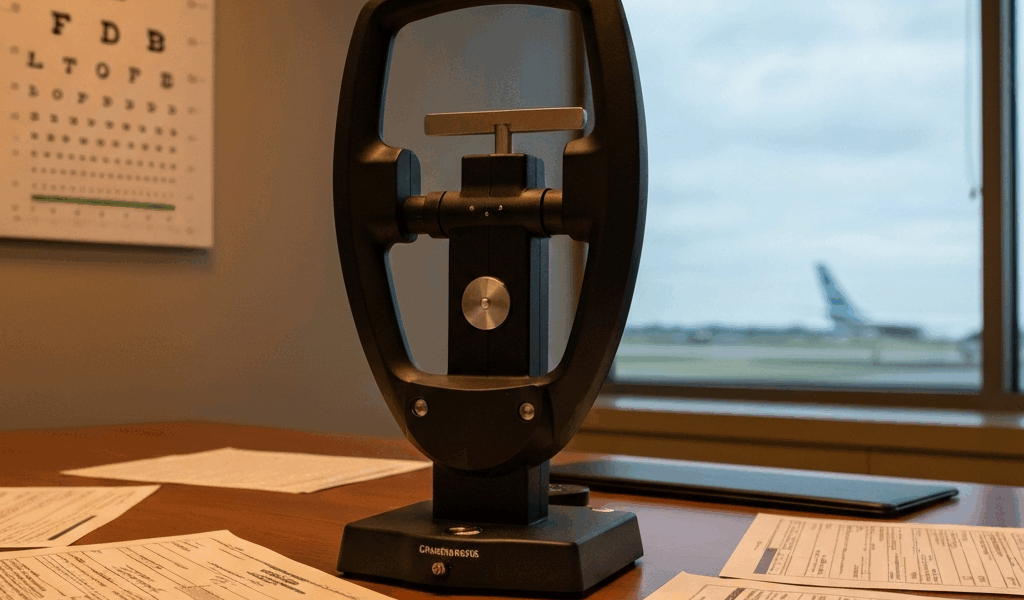
Flight surgeons typically use the Randot Stereotest or a similar polarized stereotest. You sit in front of a device, wear special glasses, and identify which shapes appear to pop out at you in 3D. The test measures your threshold in seconds of arc — basically the smallest angular difference your eyes can detect and process as depth.
The military standard is usually 40 seconds of arc (arcsec) or better. Some boards require 20 arcsec. This matters because it’s the difference between passing and a disqualification letter. A pilot candidate failing at 60 arcsec isn’t “almost there” — they’re 50 percent outside the threshold. That’s a clinical fail, not a borderline case.
Why so strict? During formation flying, at night, on instruments, during carrier operations — your brain needs to process spatial relationships instantly. A pilot with degraded stereoacuity might misjudge wingman spacing by feet when flying 200 knots at altitude. That’s why waiver approval rates sit somewhere between 2-5 percent across branches. The military doesn’t compromise on this particular metric without extraordinary justification.
Why Military Pilots Fail Depth Perception Tests
Probably should have opened with this section, honestly. Candidates often blame themselves when depth perception failures show up, but most failures have identifiable medical causes.
Amblyopia — lazy eye — is the most common culprit. If one eye didn’t receive clear focus during childhood, that eye’s visual cortex didn’t develop normal acuity pathways. The civilian world mostly ignores amblyopia past age six because reading and driving don’t require perfect binocular function. The military doesn’t have that luxury. A pilot with moderate amblyopia will fail stereoacuity testing every time. The good news: if you had lazy eye treatment as a kid, you already know this is coming. The bad news: nothing reverses it.
Strabismus history creates similar problems — if your eyes didn’t track together smoothly in childhood, the brain’s stereoscopic pathways didn’t mature normally. Even if surgery corrected the eye alignment years ago, the neural wiring underneath often didn’t catch up. Flight surgeons see this constantly. A candidate who had successful strabismus correction at age five, never had another eye problem, then fails stereoacuity at twenty-two. It happens more than you’d think.
Ocular dominance imbalance shows up more than people realize. Your dominant eye typically sees slightly sharper than your non-dominant eye. That’s normal. But if the gap widens — maybe your dominant eye is 20/20 and your non-dominant eye is 20/50 — stereoacuity tanks. The brain can’t fuse the images properly when the contrast in sharpness is too extreme. Refractive surgery sometimes exacerbates this if not planned carefully.
Post-LASIK accommodation issues create a specific failure pattern. Some surgeons undercorrect or overcorrect the non-dominant eye to maintain near-vision reading ability — called monovision LASIK. That’s fine for a dentist. For a pilot, it destroys stereoacuity. Your brain gets conflicting focus cues from each eye, and the fusion mechanism collapses. I’ve seen candidates fail depth perception six months after surgery that felt perfect otherwise.
Nerve-related disorders matter too. Multiple sclerosis or early-stage diabetes can degrade stereoacuity before other vision problems appear. Graves’ disease, thyroid eye disease — these can throw off eye alignment enough to fail testing. These aren’t lifestyle failures. They’re medical realities that show up unexpectedly.
Here’s what actually matters: some depth perception failures are temporary or correctable. Amblyopia and strabismus history? Permanent at this point. Monovision LASIK? Potentially correctable with a touch-up procedure. Accommodation issues? Sometimes fixable with time or minor surgical adjustment. Ocular dominance imbalance? That depends on the root cause.
Can You Waive a Depth Perception Failure
Yes. Rarely. But yes.
Waivers happen. I’ve seen them approved. Navy and Marine Corps appear slightly more flexible than Air Force on depth perception specifically — naval aviation has more pilots in non-fighter tracks where the operational demand is marginally lower. That said, “more flexible” means approval rates around 5-7 percent instead of 2 percent. You’re still talking about long odds.
The waiver authority — whether that’s a medical board, the flight surgeon’s commander, or a higher-level aviation medicine official depending on your branch — evaluates specific evidence. They’re not swayed by “I really want this” or “My grandfather was a pilot.” They want operational data.
What actually moves the needle: simulator performance that proves you can handle spatial tasks at pilot-level precision. If you spent time in a full-motion flight simulator and demonstrated formation flying capability, visual tracking, and spatial judgment at standard without compromising safety, that’s relevant. Not definitive, but relevant. Video evidence from simulator runs, instructor evaluations, time-logged metrics — these matter.
Operational history matters too. If you’re already a qualified pilot in a lower-demand aircraft and you’re seeking to transition, your track record carries weight. An undergraduate pilot training student with zero flight time failing depth perception? Waiver odds approach zero. A combat veteran with 200 hours in a transport or liaison aircraft asking to upgrade? Slightly better odds.
Flight pipeline position affects everything. Early screening — like OCS medical, NROTC flight physical, or basic undergraduate pilot training entry — waivers are nearly impossible. You’re one of 200 candidates; they can afford to disqualify. Mid-career retraining or upgrade requests? More negotiable. You’ve already proven you’re operationally viable.
Branch culture matters. I’d estimate Navy and Marine Corps approves maybe 1-2 depth perception waivers per year across all pilot pipelines. Air Force approves similar or fewer. Space Force and National Guard have different evaluation authorities and sometimes more flexibility, though data is limited. Army aviation operates on different medical standards entirely — I’ve seen more Army waivers, but Army pilot training is also smaller and operates on different operational requirements.
Steps to Request a Waiver and What to Expect
Start here: Get a second opinion from a civilian optometrist or ophthalmologist who understands military standards. The flight surgeon’s testing stands — don’t try to refute it — but a detailed civilian evaluation showing what your specific stereoacuity deficit is, potential correctable factors, and your medical history creates documentation that supports your case.
Bring that evaluation to your flight surgeon. Discuss it directly. Not to argue about the failed test, but to understand. Is this a permanent neurological limitation? Could any correction — glasses prescription adjustment, lens type change, surgical intervention — plausibly restore function? Is your case medically similar to past cases they’ve seen? Good flight surgeons maintain institutional knowledge about waiver successes and patterns.
The formal package submission process varies by branch, but the timeline is consistent: 4-8 weeks for initial review, another 4-8 weeks for waiver authority decision if it advances. Some packages stall at the local level. Others jump directly to headquarters aviation medicine.
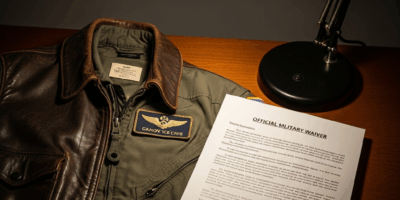
Package contents follow a standard pattern. Clinical summary of the failed test, flight surgeon’s recommendation — this matters tremendously — civilian eye evaluation, any simulator data if available, your flight history or training performance in other domains, and a personal statement explaining why you believe you’re operationally ready despite the test failure. Don’t make it emotional. Make it factual.
Contact your waiver authority through your medical officer or flight surgeon. Never contact them directly. The chain of command processes these requests formally. Going around that chain flags your package as high-risk and doesn’t help approval odds.
Realistic timeline: Initial decision within 6-10 weeks. If denied, the reasoning will be documented but often brief. If approved, congratulations — you’re in maybe the 3 percent club.
Alternative Paths if Waiver Is Denied
The waiver denial is a hard outcome, and I won’t soften it. If you were pursuing pilot designations specifically, this ends that path. That sucks. It’s also the reality.
Non-pilot aviation tracks exist. Weapons Systems Officer (WSO) in fighters, electronic warfare officer, combat systems officer in transport aircraft — these roles don’t carry identical depth perception standards in all branches. Some do; some don’t. Intelligence officer, mission specialist, navigator tracks have different medical criteria. The jump from pilot to WSO is real demotion in prestige and earning potential, but operationally meaningful and respected. Talk to your flight surgeon about whether your specific depth perception deficit disqualifies other aircrew positions.
Ground-based military specialties in your chosen branch still open doors. Engineering, operations, command — a failed flight physical doesn’t disqualify you from other officer roles.
If your depth perception failure is potentially correctable — like moderate monovision LASIK overcorrection — ask about timing for reapplication. Some candidates have obtained LASIK touch-ups specifically to rebalance their vision and attempted retesting 6-12 months later. Success rate? Maybe 20-30 percent. But if your failure reason is surgical, not neurological, it’s worth discussing with your ophthalmologist and flight surgeon.
Reapplication timing matters strategically. Some candidates waive disqualifications for one board cycle, correct the underlying issue if possible, and reapply. This requires medical documentation that the problem was addressable and addressed. If it’s neurological — amblyopia, strabismus history, nerve disorder — reapplication won’t change the outcome. If it’s refractive or post-surgical, timing could matter.
The hard truth: depth perception disqualification is rarely reversible in the pilot path. But military service has many roles. Choosing to pursue those roles isn’t settling — it’s adapting to medical reality and still contributing to something bigger than yourself.

Stay in the loop
Get the latest milpilot updates delivered to your inbox.