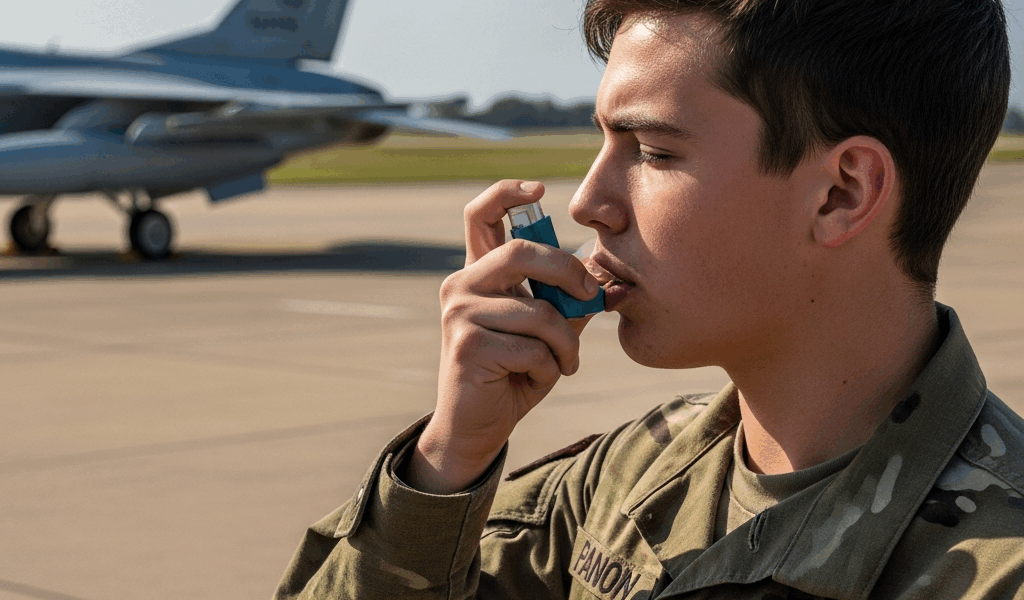
The honest answer is: maybe — and the rule that made headlines in late 2024 probably does not mean what you think it means for flying. Yes, the Air Force loosened its asthma policy. No, that change was about enlisting, not about strapping into a cockpit. Aviation standards are a separate, stricter world, and if you want to be a military pilot, that is the bar you actually have to clear.
So let us separate the two cleanly, because conflating them is how people end up disappointed. A mild case of childhood asthma you outgrew years ago is a very different conversation from active, medicated asthma today. The first might be workable with a waiver. The second will almost certainly keep you out of a flying slot, even if it no longer keeps you out of the service entirely.
What the November 2024 waiver actually changed
Under the old policy, any history of asthma — at any age, any severity — was disqualifying for service. That blanket rule is gone. The Department of the Air Force signed off on the change in August 2024 and implemented it on November 1, 2024.
Here is the actual standard: applicants with diagnosed asthma can now join provided they do not require daily preventive medication and their rescue inhaler use is kept to a minimum. Recruits with mild asthma who rarely reach for an inhaler are eligible, but they receive an assignment limitation code at the start of service. That code keeps them out of certain deployment locations where a physician is not readily available. It is a real opening for general enlistment — and it is a meaningful one. But read it again: nothing in there says “pilot.”
What counts as mild — and what the limitation code costs you
“Mild” is doing a lot of work in that policy, so it helps to be specific. In practice it means you are not on a daily controller medication — no inhaled steroid you take every morning to keep symptoms down — and you reach for a rescue inhaler rarely, if ever. Exercise-induced symptoms sit in a gray area and get judged case by case. Someone wheezing through a workout and puffing albuterol weekly is not the profile this rule was written for.
The assignment limitation code is the part recruits underestimate. It is not a formality — it is a flag on your record that keeps you out of deployments and locations where a physician is not readily on hand. That quietly closes off some career fields and overseas assignments before you ever pick one. For a future pilot it matters doubly, because flying is exactly the kind of high-stakes, far-from-a-clinic duty that a limitation code is designed to fence off. The same code that lets you enlist can be the thing standing between you and a cockpit.
Why pilots face a much higher bar
Flight duties are not the same as ground duties, and the medicine reflects that. The Navy’s Aeromedical Reference and Waiver Guide is blunt on this point: any history of asthma, even a mild case, can disqualify a candidate for aviation training and duties. The other services apply similar caution to flying status, even where general enlistment has relaxed.
The reasoning is physiological, not bureaucratic. Pilots breathe at altitude, often on supplemental oxygen, and the cockpit environment can change pressure fast. Add sustained G-forces, the physical stress of ejection, and the simple fact that there is no pulling over at 25,000 feet, and a sudden bronchospasm stops being a personal health issue and becomes a flight-safety and mission-risk issue. An attack on the ground is manageable. An attack in the air, alone, in a single-seat aircraft, is a different category of problem entirely.
Does the branch you choose matter?
For enlistment, yes — the Air Force and Space Force are the services that publicly relaxed the asthma rule, so they are the most forgiving front door. For flying, not really. Every service guards aviation medical standards tightly, and the relaxation that made news was an accessions story, not an aviation one. You cannot branch-shop your way into a cockpit by picking whichever service looks most lenient on paper.
The Navy simply documents its position most explicitly through the Aeromedical Reference and Waiver Guide, which is why it gets quoted so often. The Army and Air Force apply comparable scrutiny to flying status even when their general enlistment standards differ. The practical read: choose your branch for the flying career you want and the aircraft you want to fly, not because you think one will wave your asthma through. On the aviation side, they all want the same thing — evidence the condition is genuinely gone.
Childhood asthma versus current asthma
This is the distinction that decides most cases. Military aviation medicine has long treated asthma that resolved early in childhood differently from asthma that persists. A diagnosis you genuinely outgrew — with no symptoms, no medication, and no treatment after roughly age 13 — is the version that has a path forward. Ongoing asthma, current inhaler use, or recent flare-ups put you in the hard category.
The tool that often settles the question is a methacholine challenge test. It deliberately provokes the airways to see whether they overreact the way asthmatic airways do. Pass it cleanly and you have objective evidence that your airways behave normally now, which is exactly the kind of proof a waiver authority wants. Fail it and the paper trail says your asthma is still active, regardless of how you feel day to day.
How to build a waiver case
If your asthma is genuinely behind you, the goal is to prove it on paper. A strong waiver package usually includes pulmonary function tests, a clean methacholine challenge, letters from a pulmonologist or allergist, and documentation showing a symptom-free, medication-free stretch — ideally years, not months. The longer and cleaner the record, the stronger the case.

Start with a flight surgeon or an aviation medical examiner before you do anything else. They know which tests the waiver authority will actually accept and how your specific history reads against current standards. Do not hide a childhood diagnosis hoping it stays buried — a discovered omission on a medical history is far more damaging to a flying career than a manageable, well-documented condition. Lay it out, build the evidence, and let the system evaluate it.
The bottom line: the 2024 change opened the door to the military for a lot of people with mild asthma, and that is genuinely good news. But the cockpit door is separate and heavier. If your asthma is active, expect aviation to be off the table for now. If you truly outgrew it as a kid, you have a real shot — go build the medical record that proves it. This is a policy overview, not medical advice, and the standards do shift, so confirm your case with a flight surgeon.
For the full list of medical and non-medical showstoppers, see what disqualifies you from military pilot training, and for the eye side of the flight physical, read our guide to military pilot vision requirements by branch.




Stay in the loop
Get the latest milpilot updates delivered to your inbox.