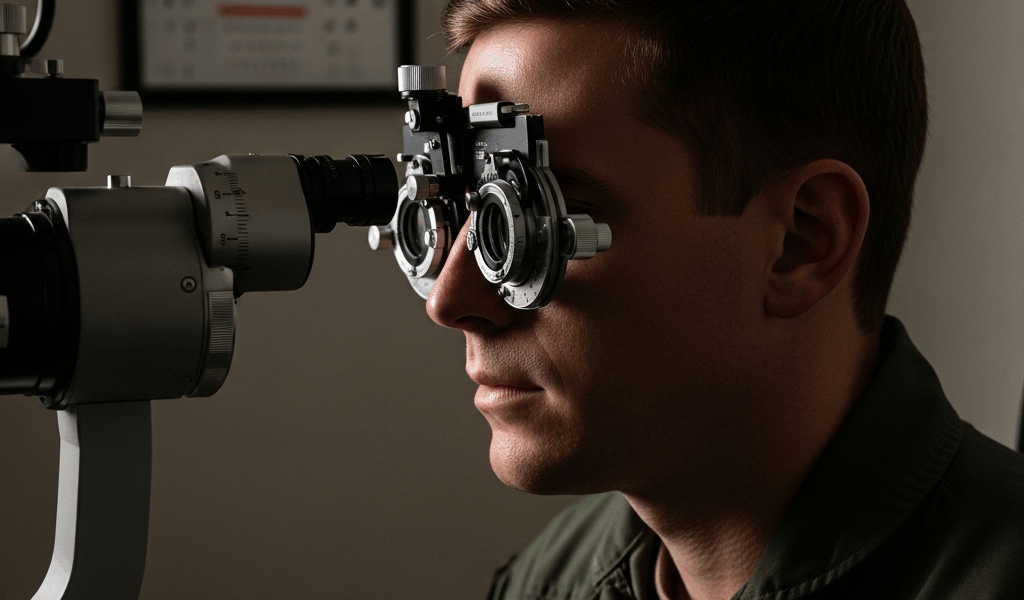
You do not need naturally perfect 20/20 eyesight to become a military pilot. You do need to meet the applicant aviation standard for the service and program you are entering.
That distinction matters because:
- uncorrected and corrected acuity are different measurements;
- refractive error is not the same thing as an eye-chart result;
- applicants face stricter standards than many already-designated aviators;
- color vision, depth perception and eye health are tested separately;
- corrective surgery can require documentation or waiver review; and
- the Air Force, Army, naval services and Coast Guard do not use one common pilot standard.
An optometrist can describe your eyes. Only the applicable military aeromedical authority can determine whether you are qualified or whether a waiver is available.
Pilot vision standards: careful comparison
| Service/path | Public applicant acuity standard | Other required evaluation |
|---|---|---|
| Air Force pilot applicant | Distance no worse than 20/70 in each eye, correctable to 20/20; current recruiting guidance also lists near acuity requirements | Normal color vision plus applicable refraction, astigmatism, depth-perception and eye-health standards |
| Navy Student Naval Aviator | Uncorrected distance and near no worse than 20/40 in each eye, correctable to 20/20 | Refractive limits, color vision, depth perception, ocular alignment and healthy eye examination |
| Marine aviation applicant | Uses naval aviation applicant medical processing and Student Naval Aviator standards for the pilot pipeline | NAMI/BUMED adjudication and Marine accession requirements |
| Army initial-entry aviator/Class 1 | Uncorrected distance no worse than 20/50 in either eye, correctable to 20/20; near vision must meet the Class 1 standard | Refraction, color vision, depth perception, ocular alignment and eye-health standards |
| Coast Guard aviation | Coast Guard Aviation Medicine Manual and current program guidance control | Accession path, applicant/designated status and Coast Guard aeromedical adjudication matter |
This table is a planning summary, not a self-qualification tool. A prescription alone does not reveal all the values used in a military cycloplegic refraction or aviation eye examination.
Air Force pilot vision requirements
The Air Force recruiting site currently summarizes pilot vision eligibility as:
- distance acuity no worse than 20/70 in each eye;
- distance correctable to 20/20;
- normal color vision; and
- compliance with additional refraction and astigmatism requirements.
The same public site contains inconsistent near-vision shorthand in different sections—one says 20/20 uncorrected while another says 20/30. Older AFI 48-123 material lists Flying Class I near acuity of 20/30 uncorrected and 20/20 corrected. Applicants should therefore use the current Air Force Medical Standards Directory and the examining facility’s Flying Class I requirements for an actual determination.
The important practical points are:
- Glasses do not automatically disqualify an applicant.
- Correcting to 20/20 does not automatically qualify an applicant.
- Color vision, depth perception, refraction and ocular health can independently affect the result.
- A general MEPS physical or AFROTC DoDMERB qualification is not the final Flying Class I certification.
Applicants should not schedule refractive surgery merely because a recruiting webpage says it “may” be disqualifying. Obtain current aviation-specific guidance first.
Navy pilot vision requirements
The Navy’s March 2026 Aeromedical Reference and Waiver Guide lists the Student Naval Aviator applicant standard.
For distance and near visual acuity:
- uncorrected acuity must not be worse than 20/40 in each eye; and
- each eye must correct to 20/20.
The guide also lists refractive limits:
- total myopia not greater than -1.50 diopters in any meridian;
- total hyperopia not greater than +3.00 diopters in any meridian; and
- astigmatism not greater than -1.00 diopter.
Those values are measured and recorded under the Navy’s examination instructions; they are not necessarily interchangeable with the abbreviated numbers on an eyeglass prescription.
The Student Naval Aviator examination also includes slit-lamp and dilated-fundus evaluation, color vision, depth perception and other Class I standards.
Navy standards distinguish applicants from already-designated Naval Aviators. The designated-aviator chart permits different uncorrected acuity and refraction. A fleet pilot’s retention standard cannot be used to qualify a new applicant.
Marine Corps pilot vision requirements
Marine aviators train through the naval aviation system. A Marine pilot applicant therefore undergoes naval aviation medical qualification, including NAMI processing, rather than a separate invented “Marine pilot eyesight chart.”
The current Student Naval Aviator standard is the appropriate public planning reference for acuity, refraction, color vision and depth perception. Marine accession and aviation-contract requirements still apply separately.
Do not assume:
- a Navy waiver outcome guarantees a Marine aviation contract;
- general Marine commissioning medical qualification equals pilot qualification; or
- the standard for a Naval Flight Officer is the same as the Student Naval Aviator standard.
The Officer Selection Officer and naval aviation medical chain should confirm the applicant’s required examination and submission.
Army pilot vision requirements
Army Aviation uses a Class 1 flying-duty medical standard for initial-entry aviators.
Army recruiting and Fort Novosel material summarize the distance-acuity requirement as:
- uncorrected distance vision no worse than 20/50 in either eye; and
- each eye correctable to 20/20.
AR 40-501 also lists Class 1 refractive boundaries in its published standard:
- hyperopia no greater than +3.00 diopters in any meridian;
- myopia no greater than -1.50 diopters in any meridian; and
- astigmatism no greater than plus or minus 1.00 diopter of cylinder.
Use the published Army Class 1 boundary above rather than narrower figures repeated in older summaries.
Army applicants also undergo color-vision, stereoscopic-depth-perception, ocular-alignment and eye-health evaluation. USAREC notes that an aeromedical refractive-error exception-to-policy process exists and directs applicants to current LASIK/PRK information.
The Class 1 physical must be reviewed through the Army aeromedical process. A civilian optometrist saying “you should be fine” is not an Army qualification.
Coast Guard pilot vision requirements
The Coast Guard does not present most civilian applicants with a guaranteed pilot contract at initial accession. Many first commission through the Academy, Officer Candidate School or another officer program and later compete for flight training. Prior military aviators may use a different direct-commission route.
The Coast Guard Aviation Medicine Program identifies the Aviation Medicine Manual, CIM 6410, as the source for flight-physical procedures, standards and waivers. Coast Guard aviation examinations and waiver submissions use the Aeromedical Electronic Resource Office.
Because applicant status and accession path matter, publishing one unsupported universal Coast Guard number—such as “20/200 uncorrected for everyone”—would be misleading. A Coast Guard candidate should confirm:
- the commissioning or direct-commission program;
- whether the physical is for an applicant or designated aviator;
- the current vision class and standard;
- whether naval, Coast Guard or another referenced standard applies; and
- the Coast Guard waiver authority for any disqualifying finding.
Use the current Coast Guard Aviation Medicine Manual or an Aviation Medical Officer, not a generic military comparison table, for an individual decision.
Can military pilots wear glasses or contacts?
Glasses are compatible with many pilot applicants when uncorrected vision, corrected vision, refraction and the rest of the eye examination meet the applicable standard.
Contact-lens policies can differ among:
- wearing contacts during an examination;
- using contacts during training or flight duty;
- the type of lens;
- the applicant versus designated-aviator standard; and
- requirements to carry backup spectacles.
Do not wear or remove contacts for an arbitrary number of days based on a blog. Follow the examining clinic’s written preparation instructions. Different lens types can require different removal periods before refraction or corneal measurements.
Bring current glasses and prescription information when instructed. Do not attempt to memorize an eye chart or use tinted lenses during color-vision testing.
Color-vision requirements
Military aviation requires reliable color discrimination, but the accepted tests and passing rules are service-specific.
Do not reduce military color qualification to one universal perfect-score rule or assume a historical lantern test is a routine second chance for every applicant.
Examples of why that is unsafe:
- The Navy’s current guide describes PIP and approved computerized color-vision testing; FALANT criteria in the designated chart apply to certain members designated before a historical date.
- Army standards specify their own PIP and computerized-test criteria.
- Air Force applicants must meet the current normal-color-vision standard using Air Force-approved testing.
A failed screening test should be handled through the examining facility. Do not self-administer online color tests as a qualification decision, and do not buy “color-correcting” contacts to influence a military exam.
Whether an alternative test or waiver is allowed depends on the service, aviation class and current policy. Avoid categorical claims such as “every color deficiency is permanently non-waiverable” unless the governing service document says so for that applicant class and diagnosis.
Depth-perception requirements
An applicant can have 20/20 acuity in both eyes and still fail stereoscopic-depth-perception testing. The tests assess binocular function, not merely the sharpness of each eye.
Performance can be affected by:
- incorrect test setup or instructions;
- an outdated prescription;
- ocular misalignment;
- amblyopia or suppression;
- unequal refractive error;
- fatigue or test familiarity; and
- an underlying binocular-vision disorder.
A failed screening does not authorize a website to declare someone permanently disqualified. The proper next step is the service’s examination and referral process.
For a detailed workflow, link to MilPilot’s separate depth-perception guide after that page receives its own standards review. The broad guide should remain the hub; the depth-perception page should address test failure and evaluation without duplicating every branch’s full acuity table.
LASIK, PRK and SMILE
The safest rule is: do not choose refractive surgery for military aviation until the relevant service medical authority confirms the current policy and documentation requirements.
There is no single joint policy making one procedure, recovery period or definition of stable refraction correct for every service and applicant class.
Current naval aeromedical guidance includes a dedicated Corneal Refractive Surgery section and a May 2026 worksheet. Air Force and Army authorities maintain their own standards and exception/waiver processes. The Coast Guard Aviation Medicine Program maintains service policy and aeromedical letters.
Before surgery, ask for written answers to:
- Is this procedure permitted for a pilot applicant in my service?
- What pre-operative refraction limits apply?
- Is a waiver or exception required?
- What operative report, follow-up examinations and corneal imaging are required?
- What minimum recovery and stability period applies?
- Must the procedure occur before or after a selection milestone?
- Who makes the final aeromedical determination?
A civilian surgeon’s statement that a procedure is “military approved” is not sufficient.
What happens during the aviation eye examination?
The precise protocol varies, but an applicant examination can include:
- uncorrected and corrected distance acuity;
- uncorrected and corrected near acuity;
- manifest and cycloplegic refraction;
- color-vision testing;
- stereoscopic-depth-perception testing;
- ocular alignment, motility and phoria measurements;
- visual fields;
- slit-lamp examination;
- dilated retinal examination;
- intraocular pressure; and
- corneal topography or other testing when indicated.
Appointment length depends on the facility, testing and any required referrals.
Bring requested records, including operative reports and follow-up measurements for prior eye surgery. Answer medical-history questions accurately.
Applicant standards versus retention standards
One of the most common sources of misinformation is quoting the rule for an experienced pilot and applying it to a new applicant.
Services can use different standards for:
- an applicant entering aviation training;
- a student already in training;
- a designated pilot completing a periodic examination;
- a pilot with a new medical condition;
- a flight officer or combat systems officer;
- aircrew or remotely piloted aircraft personnel; and
- interservice transfers.
A waiver that retains an experienced aviator does not prove a new applicant with the same diagnosis will receive a waiver. The operational risk, training investment and governing medical class differ.
How aviation medical waivers work
A medical waiver is a formal risk decision made by the authorized service—not a second opinion that erases a diagnosis.
The process usually requires:
- an examination documenting the finding;
- specialist evaluation or additional testing when required;
- an aeromedical summary and supporting records;
- command or program routing; and
- adjudication by the applicable waiver authority.
Approval can depend on diagnosis, severity, stability, treatment, aviation class, mission and service needs. Public waiver guidance helps clinicians prepare a case; it is not an approval-rate calculator.
Remove claims that one service is “more liberal,” another is slower, or a particular defect has “effectively zero” chance unless a current service dataset supports that comparison.
What applicants should do
- Identify the exact service and aviation program before comparing standards.
- Obtain a complete civilian eye examination if you need to understand your current health, but do not present it as military qualification.
- Keep prescriptions, imaging and surgical records.
- Tell the recruiter or program manager about prior surgery and diagnoses early.
- Follow the official clinic’s contact-lens and appointment instructions.
- Do not undergo elective surgery solely to meet a presumed requirement.
- Do not conceal a condition or attempt to manipulate testing.
- Ask which document, version and aviation class control the determination.
Frequently asked questions
Do military pilots need 20/20 uncorrected vision?
No. The public applicant standards for the Air Force, Navy and Army allow some uncorrected acuity below 20/20 when each eye corrects to the required level and all other standards are met.
Can you become a fighter pilot with glasses?
Potentially. The applicant must first meet the service’s pilot vision and medical standards, then complete selection and training. Fighter assignment does not create a separate shortcut around pilot medical qualification.
Does 20/20 corrected vision guarantee eligibility?
No. Refraction, astigmatism, color vision, depth perception, ocular alignment and eye health are evaluated separately.
Is LASIK automatically disqualifying?
Not under every current military aviation policy, but procedure type, pre-operative refraction, outcome, stability, documentation and program rules matter. Confirm the current service-specific policy before surgery.
Can color blindness be waived?
The answer depends on the service, applicant class, diagnosis and current testing/waiver policy. Do not rely on consumer color tests or historical FALANT advice.
Can a failed depth-perception test be retaken?
The examining service determines whether repeat testing, referral or an alternative approved test is appropriate. A failure should be evaluated, not self-diagnosed.
Is the DoDMERB exam the pilot physical?
No. DoDMERB can determine qualification for a commissioning program, but pilot candidates undergo the service’s aviation-specific medical certification.

Stay in the loop
Get the latest milpilot updates delivered to your inbox.