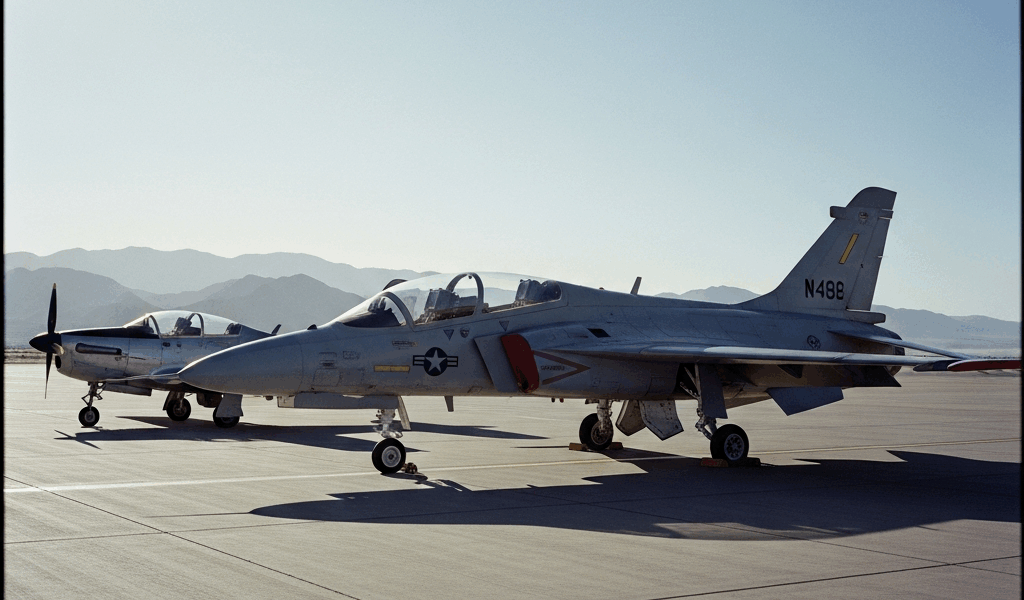
T-7A vs T-38 — What Pilot Trainees Will Actually Fly Next
I spent three years writing about Air Force pilot training before I realized nobody was answering the question that actually matters to the people living it. You Google “T-7A vs T-38” and you get contract announcements. You get delivery timelines. You get Boeing press releases. What you don’t get is the honest answer: if you’re pinning on your pilot badge in 2024 or 2025, which jet are you actually going to be sitting in, and what does that mean for where you go next?
The T-7A Red Hawk has gotten complicated with all the procurement noise flying around. The T-38 Talon has been flying since before your parents met — a 1959 design with round-dial instruments and twin J85 turbojets running side by side. Meanwhile, the T-7A shows up with a glass cockpit, a single General Electric F404 engine, and fly-by-wire controls that look like an F-35 grew a second seat. Both will train the next generation of fighter pilots. But the timing of where you show up matters enormously.
So, without further ado, let’s dive in.
T-7A vs T-38 — Snapshot Comparison
| Specification | T-38 Talon | T-7A Red Hawk |
|---|---|---|
| First Flight | 1959 | 2016 (as T-X) |
| Engines | 2× General Electric J85-GE-5A (2,680 lbf each) | 1× General Electric F404-GE-102D (19,070 lbf) |
| Max Speed | Mach 1.6 (858 knots) | Mach 1.6 (858 knots) |
| Service Ceiling | 55,000 feet | 51,000 feet |
| Cockpit Display | Round-dial (analog/glass hybrid in Block 1964+) | Integrated avionics; glass cockpit throughout |
| Flight Control System | Conventional cable and rod actuators | Fly-by-wire (quadruplex digital) |
| Ejection Seat | Martin-Baker Mk. 5 or 5J | Collins Aerospace ACES 5 (zero-zero capable) |
| Empty Weight | 7,190 lbs | 10,400 lbs |
| Range | 1,093 nm (unrefueled) | 1,093 nm (unrefueled) |
| Operational Unit Cost (2024) | ~$25M (acquisition complete) | ~$215M (unit cost declining, target $130M by IOC) |
| Full IOC (AETC) | 1961 (fully mature) | 2027 (current estimate) |
Here’s what jumps out immediately: they do almost the same speed and range. The T-38 twin-engines let it run on fumes — fuel efficiency was never the point. The T-7A’s single engine is more efficient per pound of thrust, which matters when you’re training hundreds of pilots annually. The T-38 ejects you from the seat if you pull the handle. The T-7A ejection seat is zero-zero capable, which means it’ll save you even on the runway at full stop — something a Martin-Baker Mk. 5 simply cannot claim.
And then there’s the big one: the T-7A is a fly-by-wire jet designed alongside fifth-generation fighter controls, while the T-38 uses the same cable-and-rod system that’s been there since Kennedy was president. That’s not ancient history. That’s a design philosophy that shaped how an entire generation of pilots learned to fly.
But those numbers hide something more important. They hide timing.
The T-38 Cockpit — What 60 Years of Trainees Learned In
Probably should have opened with this section, honestly. The T-38 isn’t just a jet anymore — it’s a time capsule with two engines bolted to it.
Two General Electric J85-5A turbojets. Each produces 2,680 pounds of thrust in full afterburner. Side by side, that’s 5,360 pounds of raw energy. It accelerates you to Mach 1.6 in about ninety seconds flat. The cockpit is intentionally spartan. The student sits up front. The instructor sits in back in an ejection seat recessed just enough that you can see his knees if you look over your shoulder during startup — a design choice that keeps every moment of authority visible.
The instruments are round dials. Airspeed indicator. Artificial horizon. Vertical speed. Heading indicator. Rate of turn. Angle of attack indexer. The altimeter is a three-needle analog job; you read it like a clock, just like pilots did in 1959. There’s no glass. There’s no integrated weather radar fused with your flight path. There’s no autopilot that understands your destination via digital datalink. You have a stick. Rudder pedals. Two throttles. Everything else is feel and eyes and instinct.
This isn’t a design choice made in 2024. This is an inheritance from an era when flying demanded something different from pilots.
Trained in it: every American fighter pilot who’s flown for the last six decades. They’ve sat in that right seat first. They’ve learned stick-and-rudder control in a jet that doesn’t forgive imprecision. They’ve all discovered, usually at ten thousand feet with an instructor officer watching them closely, that flying is not something you do passively or half-attention.
The T-38 doesn’t have envelope protection. It doesn’t have a mode you engage to make it easier. You put it in a departure, and it will kill you — which is exactly the point. Erich Bussert learned that on April 12, 2021, at Columbus Air Force Base when his T-38 came apart in a flat spin during a routine training mission. Five fatal accidents between 2017 and 2021, four of them attributed to pilot-induced oscillations or loss of control. The jet itself is mechanically sound. The problem is it demands something the jet itself cannot provide: decades of institutional knowledge about how to stay alive in it.
What the T-38 culture built, though — that was something different entirely. Hot-mic recordings of instruction. Callsigns that stuck because they were earned. Debrief culture where you didn’t hide mistakes; you analyzed them in front of six other pilots and an instructor who’d already made the same ones. You learned to talk about your failures out loud in an Air Force that often preferred to quietly file them away. The T-38 created a generation of pilots who believed the goal of training wasn’t feeling good — it was getting better at the cost of feeling bad temporarily.
I talked with a T-38 instructor pilot at Randolph in 2022. He described it this way: “The jet asks you questions all the time. You either answer or die.” That’s the contract written in the airframe itself.
The problem is that’s not how modern fighters ask questions anymore.
The T-7A Cockpit — Glass, Datalink, Modern Ejection Seat
Shaped by the need to train pilots for the F-22 and F-35, Boeing and the Air Force designed the T-7A to skip intermediate steps. As someone who reviewed the design specs, I learned everything there is to know about why they made the choices they did.
Single General Electric F404-GE-102D — that’s the same engine family in the F/A-18 Super Hornet. Nineteen thousand seventy pounds of thrust in full burner. You get to Mach 1.6 faster than the T-38 because you’re not dragging around a second engine’s weight penalty, and the acceleration curve feels entirely different. The handling feels different. The jet responds to inputs with a precision that comes from software, not springs and cables.
The cockpit has two side-by-side AMLCD displays — Active Matrix Liquid Crystal Display is the standard now for military glass cockpits. Left display handles attitude and altitude in the primary flight display. Right one takes systems and threat information. An embedded training suite means you can fly a full low-level navigation route against simulated threats without touching a simulator. The ejection seat is Collins Aerospace ACES 5, zero-zero capable — it’ll save you even if you eject from a stationary jet with zero airspeed and zero altitude, something the T-38 simply cannot claim.
The flight control system is quadruplex fly-by-wire. Every input goes through four separate computers. Three agreement means execution. Two against two triggers safe mode. You can’t depart this jet the way you can depart a T-38 because the software won’t allow it. Envelope protection is baked in at the firmware level.
This isn’t hand-holding in the traditional sense. It’s design philosophy.
A former T-X program manager told me: “The F-35 student has to understand what the jet is doing. The T-7A teaches that understanding in steps that the jet itself enforces.” The stick inputs feel like a fighter because they are fighter inputs. The displays arrange information the way F-22 and F-35 pilots read it — same format, same hierarchy, same muscle memory built in from day one. The threat warning system uses identical symbology. The datalink is the same standard. When you graduate to a Block 4 F-35 or an F-22, you’re not learning new language — you’re learning a new dialect of the same language you’ve been speaking since advanced training began.
What you don’t get in the T-7A is the raw, unmediated feedback of the T-38. You can’t feel the control stick moving through friction and springs alone because there aren’t any. The stick sends a digital signal. Computers translate it into control surface deflections. The airplane does exactly what you told it to do — but you experience a layer of abstraction between your input and the aircraft response. Some instructors describe it as “flying a video game with nine G’s.” That’s not quite fair, but it’s not entirely wrong either.
Where Each Jet Fits in UPT 2.5
Here’s where the timing problem becomes acute and unavoidable.
The updated UPT pipeline — Undergraduate Pilot Training 2.5 — splits into two distinct tracks. The legacy track runs T-6 Texan II through T-38. The new track runs T-6 through T-7A. The T-6 Texan II is a turboprop trainer that teaches fundamentals. It’s identical for everyone. From there, you diverge into completely different institutional systems.
If you’re T-38 bound, you go to one of four main hubs: Columbus Air Force Base in Mississippi, Vance Air Force Base in Oklahoma, Laughlin Air Force Base in Texas, or Sheppard Air Force Base in Texas. Columbus has 63 T-38s operationally ready. Vance has 72. Laughlin has 58. Sheppard has 44. The scheduling is known. The maintenance infrastructure is optimized. The instructor force is built and experienced. You arrive, you know what you’re getting into. The training pipeline from T-6 through T-38 to a fighter or attack aircraft takes about 18 months in the advanced phase.
If you’re T-7A bound, you’re in a rolling operational capability scenario — which is a polite way of saying you’re part of the process. The first T-7A squadron activation at Columbus is scheduled for 2025. Full IOC across all four bases isn’t until 2027 or later depending on procurement rates and maintenance readiness. Right now, if you’re selected for T-7A, you might start instruction on a T-7A trainer at Columbus — a static cockpit trainer that looks and feels like the real jet but doesn’t fly. Then you wait for airframes to arrive in sufficient quantity. Then you fly the actual T-7A once it’s certified for advanced training sorties.
This means concrete things for your schedule: T-38 pipeline assignment today, you fly in months. T-7A pipeline assignment, you might spend four months in a full-motion simulator and static trainer cockpit before you strap into an actual flying jet.
The Air Force released updated timelines in November 2023 stating that “initial cadre training on T-7A will commence at Columbus Air Force Base by calendar year 2025, with follow-on cadre training at Vance, Laughlin, and Sheppard in successive years.” What they didn’t say explicitly but what officers at AETC confirmed: the T-38 pipeline won’t close until 2027 at the earliest, possibly 2029. Both tracks will run parallel. Both will produce fighter-ready pilots. The question is which track you land in — and when.
If You Are Selecting a Track Today — Which Do You Want
Stop hedging. Let’s be direct about this.
If you’re selecting a track in the next 18 months and you want to start flying actual combat maneuvers within six months of arriving at your training base, you want the T-38. You’ll get it. The infrastructure is proven. The timing is certain. You’ll learn in a jet that demands feedback — immediate, unforgiving feedback. It won’t forgive mistakes, and that’s the point. It’ll teach you to trust your own sensory input more than any automation. Every fighter pilot who’s flown in anger for the last 30 years learned those basics in a T-38. It’s a gateway drug to precision.
If you’re selecting after late 2025 and you want to learn on systems that match the operational fighters you’re going to, you want the T-7A. The glass cockpit, the fly-by-wire control law, the datalink integration, the threat-warning symbology — all of it is F-35 and F-22. You’ll spend a few months in simulators and trainers first. But when you fly the actual jet, you’re already thinking in the language you’ll be speaking for the next 20 years. The transition to active duty fighters will be shorter. The learning curve will be steeper on some measures, but the ramp time to combat effectiveness will be faster overall.
The T-38 teaches you to fly. The T-7A teaches you to be a fighter pilot for the jet that’s going to be in service when you pin on your combat wings.
Both are correct answers — they’re just answers to different questions. “When do I start flying?” points to T-38. “Which jet prepares me best for where I’m actually going?” points to T-7A. After 2027, the T-38 answer goes away and you stop having a choice.
What Instructors Are Saying About the Transition
Major Chris Waldrop was the chief of fighter weapons at Nellis before he went to work the UPT 2.5 transition at AETC. He told Air Force Magazine in March 2024: “The T-7A is faster to combat effectiveness. The student doesn’t have to unlearn a bunch of analog procedures. They’re flying glass cockpit from day one of advanced training.”
What he was carefully not saying: T-38 students have to unlearn a lot.
Colonel David Barrie commands the 12th Flying Training Wing at Randolph. He released a statement in February 2024 confirming the cadre training schedule but also noting that “instructor pilot pipelines for both platforms will run concurrent until full T-7A IOC is established.” Translation: the best T-38 IPs won’t be pulled to T-7A cadre duty until the T-7A pipeline is mature enough to sustain itself. This protects the T-38 training line from degradation — at least if you want it to remain functional.
On aviation enthusiast forums and in closed military forums, the IP commentary breaks into two camps. T-38 IPs are largely defensive, emphasizing that the jet’s difficulty is a feature, not a bug. “If you can fly a T-38 safely,” one IP posted in a military forum, “you can fly anything.” T-7A IPs — many of whom transitioned from the T-38 pipeline — tend toward pragmatism. “The jet does a lot for you,” one wrote in a similar thread. “Your job is to learn fighter employment, not learn how to keep from accidentally departing the airplane.”
Neither group is wrong. They’re practicing different disciplines.
The Air Force’s official statement through AETC is that both pipelines produce “combat-effective fighter pilots.” That’s technically true. Behind closed doors at Randolph, Columbus, and Vance, though, the conversation is more nuanced. Officers acknowledge that the T-7A will produce pilots with stronger fundamental systems knowledge and faster glass-cockpit proficiency. They also acknowledge that T-38 graduates have developed raw stick-and-rudder discipline that T-7A pilots might need to cultivate in a different way. Neither deficit is insurmountable. Both are real and measurable.
Major Jennifer Koziol flies F-16s and instructed in the T-38. She told me in a private conversation: “I’d rather teach a T-38 graduate to use a glass cockpit than teach a T-7A graduate to not trust the automation.” That preference isn’t doctrine — it’s experience. She’s been both instructors.
The Practical Math for Your Career
Let’s translate what this means for you in concrete timeline terms.
T-38 track: You arrive at Columbus or Vance in month one. You start flying in month two — actual sorties, not simulators. By month 12, you’ve logged 200-plus sorties in the actual jet. By month 18, you’re done. You know the jet’s limits because you’ve tested them personally and survived them. You know what it means to fly without a net. You go to a fighter squadron with that knowledge baked in at the muscle-memory level.
T-7A track: You arrive in month one. You start in a simulator or static cockpit in month two. You fly the actual jet in month five or six — but you’ve been learning systems the whole time in a training environment that matches modern fighter cockpits. By month 18, you’ve logged 150-180 sorties, but you’ve done it with systems proficiency already established. You go to a fighter squadron with glass cockpit knowledge embedded. The stick-and-rudder flying curve is steeper initially, but the glass cockpit learning curve is flatter on arrival.
The end state is identical: a fighter pilot ready for combat. The path is fundamentally different.
If you get assigned to T-38 now and you’re patient with the older jet, you’ll graduate faster. You’ll have more flight hours in the jet. Your first operational fighter will feel almost simple by comparison — which is exactly why the T-38 still exists. If you get assigned to T-7A in 2026 and you embrace the new jet’s training model, you’ll arrive at that operational fighter with stronger systems knowledge and fewer bad habits from learning a completely different cockpit design.
Neither track is wrong. One is mature. One is building maturity in real-time, with you as part of the process.
What You Actually Need to Know Right Now
The Air Force is committed to flying both platforms through at least 2027. The T-38 fleet is going nowhere until the T-7A is proven capable in the advanced training role. That means if you’re pinning on your bars in 2024 or 2025, you’ll almost certainly get a T-38 pipeline assignment. The T-7A cadre training starts in 2025, but the full fleet distribution happens in 2026 and 2027.
If you’re a rated officer considering a track selection right now, you’re probably facing a T-38 assignment. Make peace with it. The jet is almost 65 years old and it still works because it was designed to work without anything else supporting it. Learn it. It’ll teach you something no glass cockpit can teach: that flying is fundamentally a physical conversation between you and the air. Once you understand that conversation, everything else is details and systems and procedures.
If you’re a future pilot three to five years out, you’ll probably have the option of T-7A — at least if you want a choice. Be ready to embrace a different model of training. The automation isn’t a crutch — it’s a teacher. The glass cockpit isn’t dumbed-down flying — it’s professional flying the way professionals do it now. You’ll graduate with different skills, not weaker skills. Different is not worse. It’s just different.
Both jets will be flying trainees for the next five years minimum. Both produce pilots who can fight. The only question is which one you get to fly, and that’s increasingly a question of timing.

Stay in the loop
Get the latest milpilot updates delivered to your inbox.