October 14, 1947 — The Flight That Changed Aviation
The Chuck Yeager sound barrier story gets told constantly — by journalists, historians, documentary narrators who have never sat in a cockpit with a g-suit squeezing their legs and an oxygen mask fogging at the edges. I spent eleven years flying for the Air Force, including time in high-performance jets where the airspeed indicator becomes your religion, and I want to tell this story the way it actually deserves to be told. From someone who understands what Yeager was managing that morning, not just what he accomplished.
It is October 14, 1947. There are no commercial jets in routine service — Pan Am is still flying Lockheed Constellations with piston engines on transatlantic routes. The Boeing 707 won’t exist for another decade. The idea of routine supersonic flight is so far outside ordinary experience that the language for it barely exists yet.
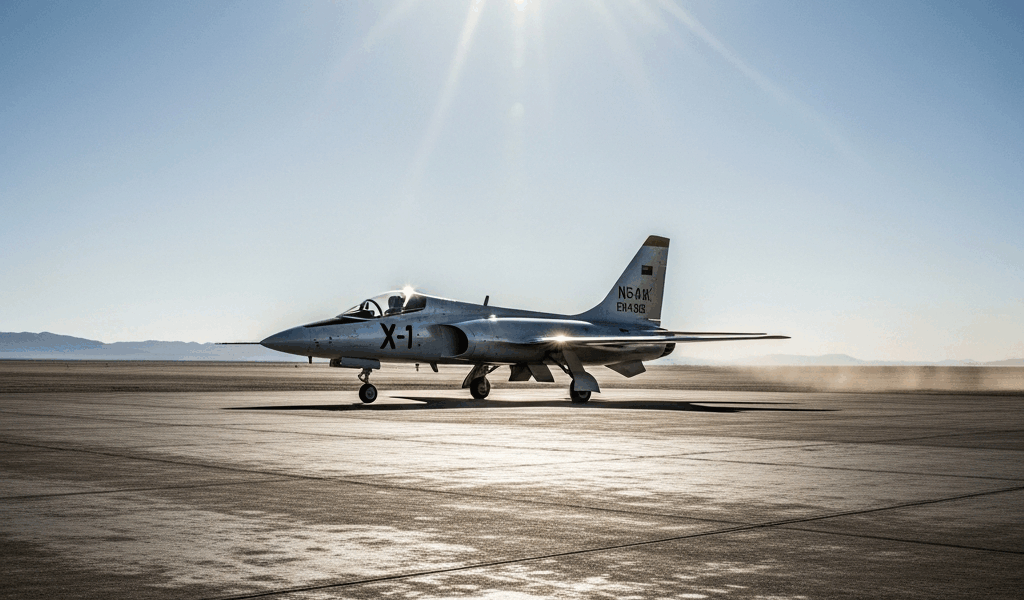
Yeager is strapped into the Bell X-1. Small, bright orange, roughly shaped like a .50 caliber bullet — which was deliberate, because the .50 cal was the only object engineers knew was already stable at supersonic speeds. He has been dropped from the belly of a B-29 at 20,000 feet. He fires the four rocket chambers in sequence. Climbing through 40,000 feet at roughly 0.85 Mach when most pilots would be paying very close attention to their hands.
Every pilot before him who pushed past Mach 0.965 hit what the test community was calling the transonic buffet — a violent shaking that made the controls feel reversed or dead. They pulled back. Every single one. That decision is completely understandable to any pilot. When the airplane starts telling you it is unhappy, you listen. Yeager did not pull back. That is the whole story. Everything else is detail.
The Broken Ribs Yeager Hid From the Flight Surgeon
Probably should have opened with this section, honestly. This is where the actual character of the man shows up.
Two nights before the scheduled flight — October 12 — Yeager and his wife Glennis went horseback riding at Pancho Barnes’ Happy Bottom Riding Club near Muroc Dry Lake. He pushed the horse too hard in the dark, galloped into a closed gate, and got thrown. Two broken ribs on his right side. He knew immediately. Most fighter pilots have broken ribs before, and you know the difference between bruised and broken by the way breathing punishes you.
He did not report it to the flight surgeon. If he had, the flight would have been scrubbed, possibly reassigned. This was the most important test flight in aviation history and Yeager had been working toward it for months. So Yeager said nothing.
Here is where this becomes an airmanship story and not just a pain-tolerance story. The X-1 hatch — the entry door to the cockpit — was sealed from the inside by a handle that required the pilot to reach across with the right arm and crank it shut. With two broken ribs on the right side, Yeager could not generate that motion. He could not raise his right arm without the kind of pain that breaks concentration, and concentration is the only thing keeping you alive in that airplane.
He told his friend and flight engineer Jack Ridley. Ridley — a brilliant engineer with a master’s from Caltech who Yeager always credited as the smartest person in the room — listened to the problem and thought about it. Then Ridley went and sawed off about ten inches from a broom handle. He gave it to Yeager as a lever. Yeager could wedge the short piece of wood into the door handle mechanism and use his left arm and body weight to crank it shut without needing to extend the right arm fully.
I have been haunted by that image ever since. A ten-cent piece of wood and a man willing to hide a broken bone from his own medical team. That is not recklessness — that is priority. Yeager had done the math on himself. He knew his cockpit procedures well enough to know that sealing the hatch was the only task that required that specific motion. Once sealed, he could fly the airplane. So he solved the hatch problem and said nothing else.
His wife Glennis knew. She helped him get dressed that morning. That detail appears in his autobiography and it hit me differently as a married man who has tried to hide minor injuries from a spouse. Glennis knew exactly what was happening and she let him go. That is its own kind of courage.
Why Mach 1 Was Considered a Wall
The term “sound barrier” was not invented by a poet. It came from real data showing that as aircraft approached the speed of sound, the aerodynamic forces became not just difficult but seemingly contradictory. Control inputs stopped working the way the math said they should. Some controls reversed. The buffet could be violent enough to tear an airplane apart.
The math everyone was using was built on wind tunnel data, and the wind tunnels of the 1940s had a critical flaw — they choked at transonic speeds. Air flowing through the tunnel would reach Mach 1 in the constricted section around the model before the model itself got there, creating shockwaves that contaminated every reading. The engineers knew the data was suspect. They were using bad numbers to design airplanes for a speed range nobody had ever actually flown through and come back from.
Geoffrey de Havilland Jr. is the name that every serious test pilot of that era knew. On September 27, 1946, he climbed into the de Havilland DH 108 Swallow and pointed it at a speed record. The DH 108 was a swept-wing experimental jet, genuinely advanced for its time. At approximately Mach 0.875, the aircraft broke apart in the air over the Thames Estuary. De Havilland’s body was recovered from the water.
The accident investigation determined that the airplane encountered severe pitch oscillation in the transonic range — the same buffet that was stopping everyone — and the structure failed. He was 36 years old. His death was not a freak accident. It was a data point, and every test pilot at Muroc knew what that data point meant.
So when pilots before Yeager hit the buffet around Mach 0.965 and pulled back, that decision had Geoffrey de Havilland’s name written all over it. Pulling back was not timidity. It was survival instinct backed by recent, specific, fatal evidence. The wall was real. The question was whether it was a physical wall or an engineering problem — whether the speed of sound represented a genuine barrier for any aircraft, or whether the right airplane, flown correctly through the transonic range, could punch through it into calmer air on the other side.
Yeager and the Bell engineers believed it was an engineering problem. The bullet-shaped fuselage was their bet. The movable horizontal stabilizer — a design feature that let Yeager control pitch even if the elevators became useless in the transonic buffet — was their specific, deliberate answer to what had killed de Havilland.
What Yeager Actually Felt at Mach 1.06
The buffet started around Mach 0.88. Yeager had felt it before on previous X-1 flights. They had been methodically stepping up the speed — 0.82, then 0.86, then 0.92, then 0.96 — each flight pushing the envelope a little further and bringing back data. He knew the buffet. He had made his peace with it.
What happened around Mach 0.965 is the part that separates Yeager from everyone before him. The buffet intensified and the controls got soft — not reversed, but soft, unresponsive in a way that felt like flying through cotton. Previous pilots felt this and interpreted it as the airplane telling them they had reached the limit. Yeager held course.
He trimmed with the movable stabilizer instead of the elevators. That is a technique difference. The elevator surfaces were losing effectiveness in the transonic shockwave, but the whole horizontal tail, when moved as a unit, still had authority. He was essentially flying with a different control surface than the one pilots normally use for pitch. It worked.
The Machmeter needle jumped. Hit 0.96, then 0.98, then it went off the scale entirely. The Machmeter installed in the X-1 only read to Mach 1.0. The needle went past the last graduation and buried itself. Yeager later said he was not entirely sure what that meant in the moment — whether the instrument had failed or whether he had actually done it.
What he reported over the radio was that the ride had smoothed out. The buffet stopped. The controls came back. At supersonic speed, the shockwave had moved all the way aft on the wing and the disturbed airflow that had been causing the buffet was behind him. He described it as smooth as a baby’s bottom. That exact phrase. He was flying at 40,000 feet, Mach 1.06 — approximately 700 miles per hour — in a rocket plane with two broken ribs and a piece of broom handle on the floor of the cockpit, and the airplane felt better than it had at any point in the transonic range.
Post-flight data confirmed Mach 1.06. The flight lasted approximately 14 minutes from drop to landing on the dry lake bed. The sonic boom rolled across the high desert and reached the ground crew, who knew what it meant before any voice call confirmed it.
He kept quiet. The engineers celebrated in the data room. Ridley knew. Yeager’s wife knew that evening. The program was classified and the discipline was real. This was not the kind of secret that got told at the bar. Yeager was a military officer with a clearance and an understanding of why the program existed. He stayed quiet.
The Test Pilot Code — Why the Sound Barrier Was a Secret for Months
The X-1 program was a joint project between Bell Aircraft, the Army Air Forces, and what would become in September 1947 — just weeks before the flight — the newly independent United States Air Force. The aircraft itself was government property. The data belonged to the program. The classification was not bureaucratic obstruction. It was operational security during a period when the Cold War was already underway and the Soviet aviation program was a real concern.
The flight remained classified until June 1948, when Aviation Week broke the story — a leak the Air Force was not happy about. By the time the public found out, Yeager had already exceeded Mach 1 multiple times. The X-1 program had continued flying. The data had been analyzed, written up, and distributed within the classified community. The Bell test team — including Jack Ridley, Dick Frost, and the other engineers who had built and refined the airplane — had all signed the same security agreements and honored them.
That code of silence is something I understand from the inside. Test programs classify results for real reasons. The information about what the X-1 had done — specifically that Mach 1 was survivable and that a specific configuration could achieve it — had enormous implications for aircraft design, for weapons development, for the entire trajectory of air power. You do not put that in the newspaper while the Soviets are standing up their own aviation programs.
What I find remarkable is that the Bell test team and the Air Force personnel at Muroc held that secret completely for eight months. Dozens of people knew. Nobody talked. That is not an accident. That is a culture, a professional identity built around the idea that what happens at the test site stays at the test site until someone with the authority to release it decides otherwise.
Yeager did not run to a publicist. He did not give an exclusive. He flew home, filed his reports, and waited. The Air Force version of the right stuff did not include fame as a reward. The work was the reward.
What Yeager Thought of the Hollywood Version
Tom Wolfe’s 1979 book The Right Stuff gave Yeager his public mythology. Before that book, the general public knew almost nothing about what had happened at Muroc in 1947. Wolfe put Yeager at the center of a story about a particular kind of American masculine competence — cool under pressure, laconic, physically fearless, contemptuous of bureaucracy. Most of that is accurate. Wolfe did his research and he understood that the test pilot world had a code that was different from anything in civilian life.
Philip Kaufman’s 1983 film adaptation is a different thing. Sam Shepard played Yeager — which Yeager was apparently pleased about, because Shepard looked the part and carried the quietness correctly. Yeager himself had a cameo in the film as a bartender at Pancho’s bar. He found that funny. He appreciated that Kaufman understood the Pancho Barnes world, the social ecosystem of Muroc where test pilots and engineers drank together and talked through problems and the line between work and not-work was blurry on purpose.
What Yeager took issue with publicly was a specific technical detail in the film’s depiction of his supersonic flight — the wing configuration shown on screen was not accurate to the actual X-1. He mentioned this in interviews with a kind of quiet irritation that felt very familiar to me. When you have actually done something, wrong details in a dramatization are not charming creative license. They are errors. The X-1 had a 10-degree straight wing. The film’s airplane looked different. Yeager noticed.
His own autobiography, published in 1985 and co-written with Leo Janos, is the better source. He describes Glennis as the emotional center of his life in a way that the film does not fully develop. Barbara Hershey plays her well but the script underserves the relationship. In the book, Glennis appears on almost every significant page. She knew about the ribs. She knew the stakes. She was not a supporting character in her husband’s story. She was a full partner in it, and Yeager knew that and said so in print.
What Wolfe got most right, and what I think about when I think about Yeager, is the concept of the right stuff as an unspoken agreement among a small group of people that certain standards exist and must be maintained even when no one is watching. Especially when no one is watching. Yeager could have reported the broken ribs. He could have asked for a postponement. He could have, after the flight, given interviews to every newspaper in the country. He did none of those things. He had two broken ribs and a piece of a broom handle and the most important flight in aviation history ahead of him, and he got in the airplane and did his job.
That is the airmanship story. Not the Mach number. Not the date. The broken ribs and the broom handle and the man who understood exactly what was required of him and did not do one thing more or less than that.

Stay in the loop
Get the latest milpilot updates delivered to your inbox.