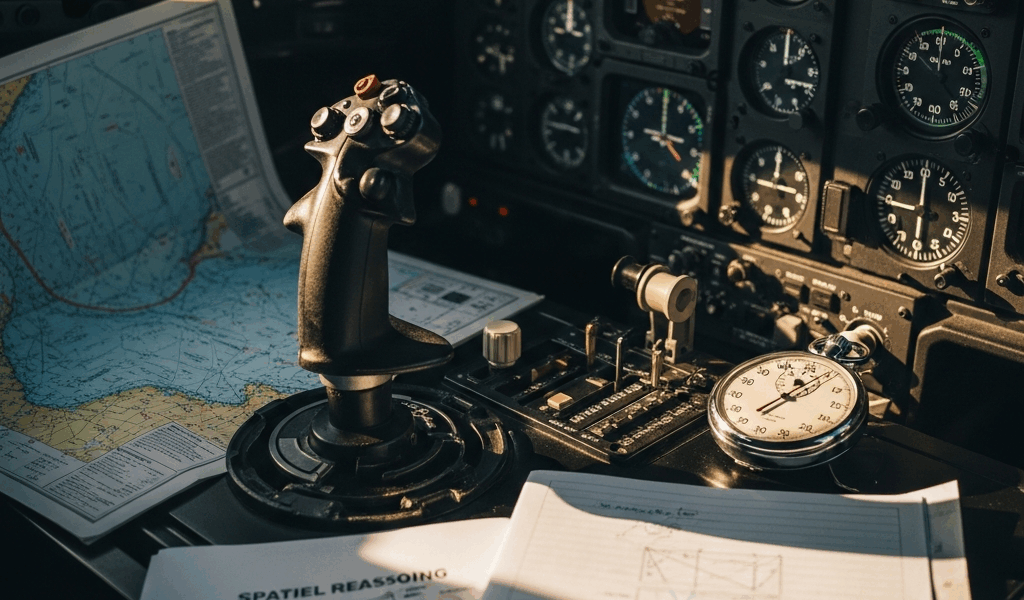
The AFOQT does not have one standalone “pilot section.” It has 12 timed subtests whose results create several composite scores.
The Pilot composite uses five subtests:
- Arithmetic Reasoning
- Math Knowledge
- Instrument Comprehension
- Table Reading
- Aviation Information
“Spatial Apperception” is not listed as a Pilot-composite subtest in the official Air Force AFOQT Information Pamphlet, so a study plan should not be built around an invented aircraft-silhouette section.
A useful preparation plan starts with the real test structure, uses authorized materials and protects every composite needed for the applicant’s commissioning path.
AFOQT Pilot composite at a glance
| Subtest | Official pamphlet description or task | Pilot composite? |
|---|---|---|
| Arithmetic Reasoning | Solve arithmetic word problems | Yes |
| Math Knowledge | Apply mathematical terms, formulas and relationships | Yes |
| Instrument Comprehension | Determine aircraft attitude from cockpit instruments | Yes |
| Table Reading | Locate values accurately in a coordinate table | Yes |
| Aviation Information | Demonstrate knowledge of aeronautical concepts | Yes |
| Verbal Analogies | Recognize relationships among words | No, but affects other required composites |
| Word Knowledge | Understand synonyms and vocabulary | No, but affects other required composites |
| Block Counting | Perceptual/spatial counting task | No |
| General Science | General scientific knowledge | No |
| Rotated Blocks | Spatial rotation task | No reported composite in the official table |
| Hidden Figures | Perceptual identification task | No reported composite in the official table |
| Self Description Inventory | Noncognitive inventory | No reported aptitude composite in the official table |
“Not in the Pilot composite” does not mean “skip it.” The Air Force administers the entire test, commissioning programs require Verbal and Quantitative minimums, and other composites may affect classification.
How the AFOQT is scored
AFOQT composite scores are percentiles from 1 to 99.
A Pilot score of 70 means the examinee scored equal to or higher than 70% of the relevant validation reference group on the combination of subtests used for that composite. It does not mean the examinee answered 70% of questions correctly.
The Air Force does not publish a simple weighted formula that lets candidates calculate the Pilot composite from raw practice-test results. Do not treat a commercial practice score as an official percentile.
Current DAFMAN 36-2664 lists these minimum standards:
- Verbal: 15 for commissioning
- Quantitative: 10 for commissioning
- Pilot: 25 for pilot and remotely piloted aircraft applicants
Those are eligibility minimums, not guaranteed selection scores. AFROTC, OTS, Guard and Reserve processes evaluate additional factors and can use different whole-record methods.
No official current source establishes a universal “70 is competitive,” “75 is the floor” or “below 60 closes the pilot door.” A score’s practical competitiveness depends on commissioning source, PCSM, applicant pool, board, unit and available pilot allocations.
How the Pilot score affects PCSM
Pilot applicants also complete the Test of Basic Aviation Skills. The Air Force combines:
- the AFOQT Pilot composite score of record;
- TBAS performance; and
- credited civilian flying or approved aviation-training-device hours
to calculate the Pilot Candidate Selection Method score.
PCSM is also a 1–99 score, but it is not the same percentile or construct as the AFOQT Pilot composite.
Current DAFMAN 36-2664 says:
- the current PCSM calculation uses civilian flying hours up to 41 hours;
- AFOQT Pilot superscoring is used in the PCSM score of record;
- updated flight-hour documentation should reach the PCSM Program Office at least seven calendar days before the board suspense; and
- pilot and RPA selection boards require a minimum PCSM of 10, absent an approved exception.
GPA can matter separately in selection, but it is not one of the three components the current manual identifies in the PCSM calculation.
Start with the official AFOQT pamphlet
The Air Force AFOQT Information Pamphlet is the best first diagnostic because it:
- identifies the actual subtests;
- shows the relationship between subtests and composites;
- provides official task directions and sample items;
- gives question counts and timing for the paper form it describes; and
- explains that guessing is not penalized.
The pamphlet is a familiarization document, not a complete curriculum. Its sample questions may be easier than the operational test, and test versions can differ. Still, a candidate should understand every official direction before buying a commercial resource.
Use the currently linked preparation material from the PCSM/Air Force testing site. Do not download purported “real AFOQT questions,” recollections from prior examinees or unauthorized answer banks.
Build a diagnostic by skill, not a fake percentile
Complete the official sample material under its listed time limits and classify every missed item.
For each mistake, record:
- subtest;
- topic or question type;
- whether the error came from knowledge, setup, calculation, interpretation or time;
- whether an answer was guessed;
- time remaining or number unfinished; and
- the rule or concept that would have prevented the error.
Useful diagnostic categories include:
Arithmetic Reasoning
- translating words into equations;
- ratios, rates and proportions;
- percentages;
- distance/rate/time;
- averages;
- unit conversion; and
- multi-step arithmetic.
Math Knowledge
- algebraic manipulation;
- exponents and roots;
- geometry;
- equations and inequalities;
- factoring;
- functions and graph interpretation; and
- formulas.
Instrument Comprehension
- recognizing pitch from the attitude indicator;
- recognizing bank;
- reading heading;
- distinguishing aircraft attitude from observer viewpoint; and
- maintaining accuracy under the short time limit.
Table Reading
- locating the correct row and column;
- tracking positive and negative coordinates;
- avoiding off-by-one errors;
- transferring answers accurately; and
- maintaining visual place under speed.
Aviation Information
- basic aerodynamics;
- aircraft components and controls;
- flight instruments;
- airport and airspace concepts;
- weather;
- navigation;
- regulations and safe operations; and
- elementary flight principles.
Do not convert an unofficial raw score into a claim such as “you would score 82.” Use the diagnostic only to choose what to study.
How to study Arithmetic Reasoning
Arithmetic Reasoning tests whether you can model and solve a word problem efficiently.
A practical routine:
- Identify what the problem asks.
- Write the relevant quantities and units.
- Translate the relationship into an equation.
- Estimate the expected size and sign of the answer.
- Calculate.
- Compare the result with the estimate and available choices.
Study underlying arithmetic before trying to gain speed. If percentages are weak, review percent increase/decrease and part-whole relationships. If distance/rate/time is weak, practice deciding which variable is missing rather than memorizing one layout.
Then add timed mixed sets. Review every miss, including lucky guesses.
How to study Math Knowledge
Math Knowledge is more direct than Arithmetic Reasoning but covers a wider range of algebraic and geometric concepts.
Build a list of formulas and rules you can derive and apply, not a dump sheet of unexplained symbols. Practice:
- solving linear and quadratic equations;
- simplifying expressions;
- operations with fractions and radicals;
- exponent rules;
- perimeter, area and volume;
- angle and triangle relationships;
- coordinate geometry; and
- interpreting simple functions.
When reviewing an error, solve it a second way where possible. That helps distinguish a missing concept from a careless calculation.
How to study Instrument Comprehension
Instrument Comprehension measures rapid interpretation of aircraft attitude from instruments.
Learn what each official sample instrument communicates:
- The attitude indicator shows pitch and bank relative to the horizon.
- The heading indicator shows the direction the nose points.
- The illustrated aircraft must match those readings.
Start untimed until the translation is consistently correct. Then use fresh, authorized practice items under the official timing. Avoid memorizing the position of answers in one book; learn the instrument relationships.
Do not spend weeks preparing for a separate aircraft-rotation component that does not appear in the official Pilot-composite structure.
How to study Table Reading
Table Reading rewards fast, error-resistant visual extraction.
Use a repeatable scan:
- Read both coordinates.
- Identify the row and column signs.
- Move along one axis while keeping a finger, scratch mark or permitted visual reference where allowed in practice.
- Cross to the second coordinate.
- Confirm both headers before recording the value.
Practice with tables at the official scale and question count. Small or simplified commercial tables can create false confidence.
Accuracy comes first, but this subtest is intentionally time constrained. After the process is reliable, reduce time gradually and track errors per minute rather than celebrating completion alone.
How to study Aviation Information
Use authoritative introductory aviation material instead of memorizing trivia lists.
Build understanding in layers:
- Four forces and basic stability.
- Flight controls and how they change aircraft motion.
- Major aircraft systems and instruments.
- Airport signs, markings and traffic patterns.
- Weather fundamentals.
- Navigation and airspace concepts.
- Basic regulations and operational judgment.
The official pamphlet’s questions reveal the level and style expected. FAA handbooks can support concept review, but they are much broader than the AFOQT. Use the official sample taxonomy to limit scope.
Civilian flight training is not required to learn the tested concepts, and a private pilot certificate does not replace timed test practice.
Do not neglect Verbal and Quantitative requirements
Arithmetic Reasoning and Math Knowledge also affect the Quantitative composite. Verbal Analogies and Word Knowledge affect the Verbal composite.
A candidate focused only on Pilot content can still fail a commissioning minimum or weaken an officer application.
Use the diagnostic to allocate time across:
- Pilot-specific weaknesses;
- Quantitative minimum and competitiveness;
- Verbal minimum and competitiveness; and
- any additional composite relevant to the intended career field.
Do not use 70% of study time on two invented “most important” sections without evidence about your own weaknesses or the official composite.
A flexible six-week study plan
The right duration depends on baseline skills and the board deadline. Six weeks is a framework, not a guarantee.
Week 1: Official diagnostic
- Read the official pamphlet.
- Complete every sample subtest under official timing.
- Build the error log.
- Verify test date, version and board deadline with the testing office or commissioning source.
Weeks 2–3: Repair knowledge gaps
- Alternate Arithmetic Reasoning and Math Knowledge.
- Study Aviation Information by concept.
- Practice Instrument Comprehension untimed until accurate.
- Establish a reliable Table Reading scan.
- Include Verbal work if needed.
Weeks 4–5: Add speed and mixed practice
- Complete timed subtest sets.
- Recreate the sequence and fatigue of several back-to-back sections.
- Review wrong answers and guesses.
- Keep one or two sessions devoted to the weakest category rather than repeating strengths.
Week 6: Confirm readiness
- Complete one full authorized simulation early in the week.
- Review the error log.
- Reduce volume rather than cramming.
- Confirm identification, arrival time, permitted materials and location.
- Sleep normally and report illness or inability to test to the administrator before beginning.
Candidates with large math or language gaps may need longer. Candidates near a board deadline may need to prioritize qualification and submit the best available record. Cadre, recruiter or unit deadlines control.
Current AFOQT retest rules
Older two-attempt and 150-day-wait summaries are obsolete.
DAFMAN 36-2664, dated January 17, 2025, says:
- at least 90 days must normally pass between AFOQT administrations;
- three administrations are authorized;
- the third administration requires a waiver from the appropriate authority;
- an exception is required to retest inside 90 days;
- valid current-version scores do not expire; and
- the Air Force uses superscoring across composites.
Superscoring means the best composite score from any valid test attempt becomes the score of record for that composite. It does not mean individual subtest answers from different attempts are manually combined.
Documentation for a third-test waiver must show relevant preparation or improvement since the previous administration, such as coursework, significant flying experience or an approved preparation course.
Always confirm that your commissioning source has enough time to receive and process the result before its board cutoff.
AFOQT group-study and test-security rules
These rules are essential for both first-time and repeat examinees.
Current DAFMAN guidance says:
- applicants who have never taken the AFOQT may study in a group with other first-time examinees using approved or general-domain material;
- applicants who have taken the AFOQT at least once may not participate in group study; and
- actual controlled test content may not be possessed, reproduced, discussed or shared.
A repeat examinee can study independently using authorized preparation material. They cannot share remembered questions or join a group to compare operational test content.
Avoid:
- “exact question” repositories;
- screenshots or copied pages said to come from the test;
- recollection-based group notes;
- flashcards whose source is unknown;
- coaching that asks prior examinees what appeared; and
- software marketed as a clone of live controlled items.
Test compromise can invalidate scores and trigger administrative or disciplinary action.
Test-day strategy
The official pamphlet says wrong answers are not penalized. If time is expiring, record a best answer rather than intentionally leaving a question blank.
Other durable practices:
- Follow the administrator’s instructions over any blog strategy.
- Read each subtest’s directions and sample items.
- Ask about directions before the timed questions begin.
- Work quickly without letting one problem consume the section.
- Use provided scratch paper only as authorized.
- Do not write in controlled test material.
- Do not bring prohibited notes or devices into the testing room.
If you are physically unable to test, tell the administrator before starting. The official pamphlet says candidates can be rescheduled when they report that they are not able to take the test at that time.
Frequently asked questions
What subtests make up the AFOQT Pilot composite?
Arithmetic Reasoning, Math Knowledge, Instrument Comprehension, Table Reading and Aviation Information.
Is Spatial Apperception on the AFOQT Pilot composite?
No subtest with that name appears in the current official 12-subtest table. Rotated Blocks and Hidden Figures appear in the test but are not shown as Pilot-composite inputs.
What is the minimum AFOQT Pilot score?
Current DAFMAN 36-2664 lists 25 for pilot and RPA applicants, plus commissioning minimums of 15 Verbal and 10 Quantitative. Selection can be considerably more competitive than minimum eligibility.
What AFOQT Pilot score guarantees selection?
None. Selection depends on the program and complete record, including PCSM and other commissioning-source or unit factors.
How many times can you take the AFOQT?
Three administrations are authorized under current policy, with a waiver required for the third. The normal interval is at least 90 days.
Does the Air Force use the newest AFOQT score?
The Air Force superscores across composites, using the best valid composite score from any administration as the score of record.
Can I study with friends?
First-time examinees may use authorized group study with other people who have never taken the test. Anyone who has taken the AFOQT must study independently under current DAFMAN rules.
Does PCSM include GPA?
Not in the current calculation described by DAFMAN 36-2664. PCSM uses the AFOQT Pilot score, TBAS and credited flight experience. GPA may separately affect selection.


Stay in the loop
Get the latest milpilot updates delivered to your inbox.