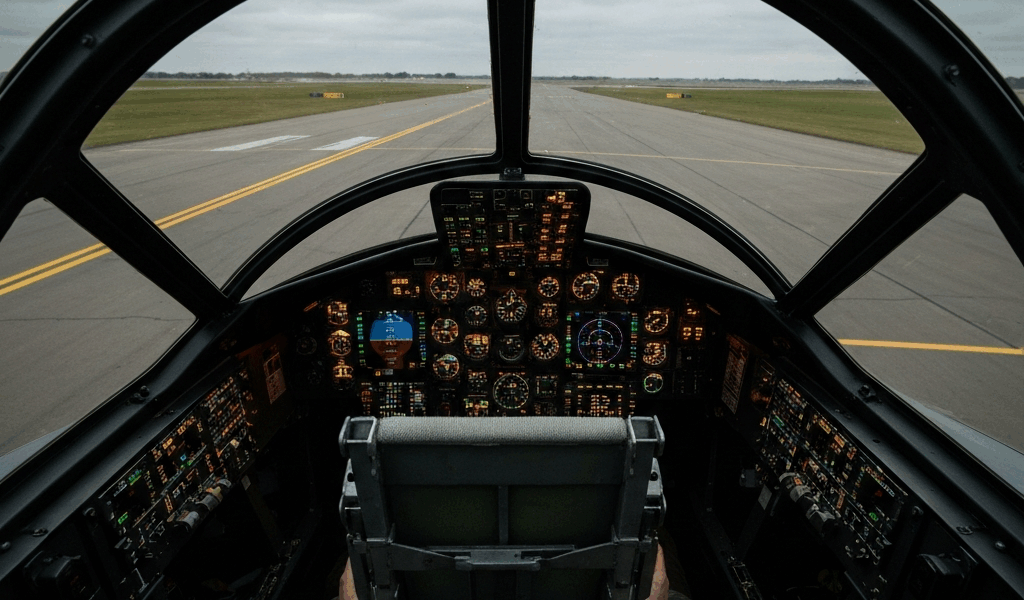
The U.S. Air Force does not publish a current, service-wide Undergraduate Pilot Training washout rate in a form that supports one reliable percentage.
Claims such as “UPT has a 4–8% washout rate,” “15% fail” or “one in three wash out” need a defined cohort and source. The public Air Force material reviewed for this guide provides graduation and production figures, training policy and historical attrition data—but not a current annual table showing:
- how many students entered the complete Air Force pilot-training pipeline;
- which training model and bases they entered;
- how many earned wings;
- how many remained in training;
- how many left for performance, medical, voluntary or administrative reasons; and
- how transfers or alternative pipelines were counted.
Without those elements, there is no defensible 2026 Air Force UPT washout percentage.
Quick answer: Air Force pilot training is selective and demanding, but the public evidence does not support a precise current personal “chance of washing out.” AETC’s current production totals are not attrition rates. Students who fail to meet standards enter documented training and review processes; one mistake does not trigger one universal automatic-elimination rule.
Why the internet gives different UPT washout rates
Most numbers answer different questions.
Different entry points
A study might begin counting at:
- pilot-slot selection;
- medical qualification;
- contracted civilian Initial Pilot Training;
- arrival at an Air Force training base;
- the first T-6 event;
- entry into T-38 training; or
- an aircraft-specific Formal Training Unit.
If 100 selected candidates include two medical losses before training, five departures in initial civilian training and five later military-training eliminations, a source beginning at the T-6 phase will report a different rate from a source beginning at selection.
Different endpoints
The endpoint might be:
- completion of Initial Pilot Training;
- Air Force wings;
- completion of T-38 or other advanced training;
- an aircraft assignment;
- completion of a Formal Training Unit; or
- mission qualification in an operational squadron.
Future Undergraduate Pilot Training has changed the sequence for some students. Under AETC’s current description, pilots can earn wings after contracted civilian Initial Pilot Training and the military T-6 phase. Fighter- and bomber-bound graduates then continue into advanced jet training, while other graduates proceed toward aircraft-specific training.
An older statistic in which wings came after a different syllabus cannot be compared directly with that model.
Different definitions of “washout”
An article may combine:
- flying-performance elimination;
- academic deficiency;
- procedural deficiency;
- medical disqualification;
- self-initiated elimination or withdrawal;
- administrative or disciplinary removal;
- reclassification;
- transfer to a different training pipeline; and
- a delayed student who later completes training.
Calling every non-graduate a person who “could not fly” is inaccurate.
Different years
Air Force screening, aircraft, syllabi, medical standards and pilot-production demand have changed substantially.
Historical figures can show how attrition behaved in a specific period. They should not be relabeled as a 2026 rate.
What current AETC reporting does show
Air Education and Training Command has publicly described a goal of producing approximately 1,500 active-duty, Reserve, Guard and international pilots annually beginning in fiscal year 2026.
Its June 2025 FUPT update reported:
- contracted Part 141 Initial Pilot Training;
- FAA private pilot, instrument and multiengine training in that initial phase;
- a military T-6 phase focused on military competencies;
- approximately 108 days for the military phase in the described model;
- fighter/bomber continuation after winging; and
- aircraft-specific follow-on training for other communities.
The same update described projected graduate totals at individual bases and aircraft-availability constraints.
Those figures describe production, not a washout rate.
For example, reporting 355 graduates does not reveal whether the relevant denominator was 360, 400 or 500 students. It may also mix cohorts that started at different times and exclude students delayed by weather, maintenance, medical status or training capacity.
Small-group success is not a service-wide rate
AETC reported that 10 U.S. students completed a 2026 small-group FUPT tryout using civilian Initial Pilot Training followed by the Italian T-346A program.
That is useful evidence that the tested group completed the program. It is not evidence that every Air Force pilot-training cohort has zero attrition.
A 10-person test should remain labeled by its program, dates and sample size.
Does the Air Force publish any official attrition numbers?
Official historical Air Force data exists.
An AETC history of flight screening reports total pilot-training attrition of 36.6% in fiscal year 1960 and 15.7% in fiscal year 1965. A 1990 Government Accountability Office report said Air Force Academy graduate attrition from UPT was 18% during fiscal years 1979–1988, compared with 24% for total Air Force pilot training during that period.
Those numbers are valid historical evidence. They describe:
- older aircraft;
- older selection systems;
- older medical and training policies;
- different force requirements; and
- different cohorts.
They do not establish the FUPT washout rate.
The responsible modern conclusion is not “the historical range proves today is 15–30%.” It is that Air Force attrition changes with the system and must be dated and defined.
What “washing out” means in Air Force policy
“Washout” is informal. Current AETC policy uses terms such as:
- failure to meet course training standards;
- progress check;
- elimination check;
- Commander’s Review;
- elimination;
- disenrollment;
- withdrawal;
- washback;
- reclassification; and
- alternative pipeline recommendation.
These terms are not interchangeable.
Progress check
A progress check is a formal evaluation used when the syllabus or student’s progression calls for a closer assessment. It can help determine whether the student should continue, receive other action or enter further review.
The exact trigger comes from the applicable syllabus and policy. It is not accurately summarized as “fail any two rides and you are out.”
Elimination check
An elimination check evaluates a student’s skill and potential when training standards have not been met. Its purpose includes determining whether the student should continue or be recommended for elimination.
An elimination-check recommendation is part of a process; it is not the same thing as a final anonymous “washout statistic.”
Commander’s Review
AETC Instruction 36-2605, Volume 4 establishes a Commander’s Review process for formal flying training.
Current policy says students go through Commander’s Review before being eliminated or withdrawn from training, with a separate training-review-board process for ENJJPT. The process creates a record, notifies the student of the proposed action and allows review under the applicable authority.
The approving authority can determine an outcome consistent with the governing instruction and syllabus.
This directly contradicts claims that one forgotten emergency-procedure item always causes immediate elimination with “no board, no retest and no second chance.”
Syllabus triggers matter
Current AETC policy identifies failure to meet flying, academic or procedural standards as possible grounds for elimination review. It also contains course and event triggers tied to unsuccessful checks and failure to progress.
The details belong to the current course syllabus. A student should use issued training guidance rather than an old base-specific supplement or online “gouge.”
Reasons a student may leave Air Force pilot training
Flying-performance deficiency
A student does not demonstrate the required aircraft-control, instrument, formation, navigation, mission-management or other flying competencies within the authorized training framework.
The required skills depend on the phase and syllabus.
Academic or procedural deficiency
Students must meet academic and procedural standards in addition to flying standards. This can include systems knowledge, flight rules, planning, emergency procedures and other course material.
An academic deficiency should not be converted into a claim that the student lacked physical flying talent.
Medical disqualification
An illness, injury or medical finding can interrupt or end training. Outcomes can include:
- temporary duties-not-involving-flying status;
- evaluation or treatment;
- return to training;
- waiver review;
- reclassification; or
- permanent disqualification.
Medical cases are not uniform and should not be diagnosed from an online article.
Self-initiated elimination or withdrawal
A student may request to leave training. The administrative, service-commitment and career consequences depend on the person’s commissioning source, component, agreement and policy.
No public current dataset reviewed here establishes what percentage of Air Force UPT attrition is voluntary.
Administrative or disciplinary action
Conduct, integrity, security or military-performance problems can affect training independently of flying skill.
Failure to continue in a particular pipeline
Leaving fighter-track training does not always mean leaving pilot training.
Current AETC policy allows certain T-38 students in Commander’s Review for failure to meet course standards to be recommended for multiseat crew-piloted aircraft training. For ENJJPT students, the approving authority can make recommendations for alternative undergraduate training or reclassification under the policy.
These are recommendations subject to the applicable personnel authority—not guaranteed outcomes.
Is not receiving a fighter assignment a washout?
No.
Active-duty aircraft assignment reflects:
- training performance;
- class ranking or applicable training record;
- instructor recommendations;
- student preferences; and
- Air Force needs.
A student who earns wings and receives a mobility, special operations, command-and-control, intelligence/surveillance/reconnaissance or other aircraft assignment completed the relevant pilot-training milestone.
Disappointment about an aircraft does not convert graduation into attrition.
Guard and Reserve students may enter training sponsored by a unit and mission. Their training-change notifications and outcomes involve the home unit and component authorities, but selection by a unit still does not remove course standards.
Where does attrition happen?
No current public Air Force cohort table supports a percentage-by-phase breakdown.
Potential points include:
- contracted civilian Initial Pilot Training;
- military academics and physiology;
- simulators;
- T-6 training;
- T-38 or another advanced path;
- medical evaluation;
- aircraft-specific Formal Training Unit; and
- operational mission-qualification training.
A claim that “60–70% of washouts happen in Phase 1” needs a defined source, dates and denominator. No current public Air Force cohort source reviewed here supports it.
FUPT also makes old “Phase I/II/III” descriptions unreliable for current students. The pipeline and winging point have changed for some cohorts.
Does civilian flight experience prevent washout?
No.
Civilian flight experience can:
- help an applicant understand whether flying is genuinely appealing;
- contribute to PCSM under current Air Force selection rules;
- create basic aircraft and airspace familiarity; and
- reduce novelty during initial instruction.
It cannot guarantee success in military training.
Military pilot training evaluates skills and behaviors beyond a civilian private pilot syllabus. Prior experience can also create habits that must be adapted to the issued procedure and military standard.
No current, controlled Air Force cohort source reviewed here establishes that a private pilot certificate or 100-plus instrument hours measurably improves UPT completion odds.
Candidates should not incur unsustainable debt to chase an invented completion-rate advantage.
Does pilot demand cause standards to loosen?
No current source reviewed supports the claim that standards “loosened” after 2015 to reduce washout.
AETC’s current messaging says it is changing curriculum, capacity and training methods while maintaining desired quality and rigor. Production pressure, aircraft availability and syllabus design can affect pipeline performance, but it is irresponsible to infer that a pilot shortage means students are passed below standard.
Use evidence about:
- required competencies;
- authorized training;
- sorties and simulators;
- instructor capacity;
- maintenance constraints; and
- actual cohort outcomes.
Do not equate a production goal with relaxed graduation standards.
Does TAPAS predict who will wash out?
The Tailored Adaptive Personality Assessment System appears in Air Force personnel assessment, but no current official cohort evidence reviewed here establishes that it was introduced specifically to screen out “high washout-risk psychological profiles” or that it noticeably compressed front-end attrition.
Selection tools can be validated against training outcomes without producing an individual guarantee. PCSM, AFOQT, TBAS and other assessments inform selection under current rules, but a score is not a personal completion probability.
What happens during a Commander’s Review?
The exact procedure depends on the current instruction, course and facts. At a high level:
- an initiating authority identifies an applicable trigger;
- the student is notified of consideration for elimination;
- the training and supporting record is assembled;
- reviewing authorities evaluate the case;
- the student has the procedural opportunity provided by the instruction;
- the approving authority makes or forwards the authorized decision; and
- training, reclassification or personnel action follows.
The review considers documented performance rather than an online rule of thumb.
Students should obtain the current AETC instruction, local supplement and syllabus through their unit. This article is not a substitute for the governing documents or legal assistance.
How students can reduce avoidable training risk
No preparation method guarantees completion, but students can control several behaviors.
Use current issued material
Study the syllabus, publications and instructor guidance assigned to the course. Online procedures can be obsolete or belong to another base and syllabus.
Chair-fly precisely
Rehearse the sequence, calls, configuration changes, visual references and contingencies expected for the event. Precision matters more than vague repetition.
Apply feedback immediately
Write down debrief items, identify the underlying error and define what will change on the next event.
Ask early
Confusion that persists across events becomes harder to fix. Use instructors, academic support and authorized study partners before a deficiency compounds.
Protect sleep and health
Fatigue, illness and overtraining can degrade learning and decision-making. Follow medical and fitness guidance rather than hiding a condition to avoid delay.
Maintain integrity
Never falsify preparation, grades, checklists, flight records or medical information. An integrity problem can become more serious than a training deficiency.
Separate aircraft preference from pilot qualification
Concentrate on mastering the current phase. Chasing a desired aircraft at the expense of fundamentals is not a sound training plan.
How to evaluate an Air Force washout-rate claim
Ask:
- Is the source Air Force, GAO, RAND or a documented research institution?
- Which fiscal years are covered?
- Does the cohort start at selection, IPT, T-6 or another point?
- What counts in the numerator?
- Are students still training excluded?
- Does graduation mean wings or a later course?
- Are medical, voluntary and administrative losses separated?
- Are Guard, Reserve and international students included?
- Are washbacks counted twice or as failures?
- Does a transfer to another pipeline count as attrition?
If those questions cannot be answered, the percentage should not guide a career decision.
What happens after a UPT elimination?
There is no single automatic outcome.
Possibilities can include:
- reinstatement or continuation;
- additional or alternative training;
- a different pilot-training path;
- reclassification into another career field;
- return to a sponsoring Guard or Reserve unit for further action;
- medical processing;
- other administrative action; or
- separation when authorized.
The reason, component, commissioning source, service commitment, point in training and Air Force needs all matter.
MilPilot’s separate What Happens If You Wash Out of UPT guide owns that administrative question and should be updated against current personnel policy.
Frequently asked questions
What is the Air Force UPT washout rate in 2026?
No current public Air Force source reviewed provides one complete, service-wide cohort rate. Production totals and base graduation counts cannot establish the percentage without entries and defined outcomes.
Is the UPT completion rate 92–96%?
No current public cohort source was found supporting that range across Air Force UPT. The figure should not be repeated without a defined denominator, fiscal year and pipeline.
Does one checkride failure end UPT?
There is no universal rule that every single failed check ends training. The applicable syllabus defines triggers, and current AETC policy includes progress, elimination and Commander’s Review processes.
Do two failed checkrides automatically eliminate a student?
Not as one universal rule across every course and phase. Specific combinations can trigger review under the applicable syllabus and AETC policy. Triggering review is not identical to a final elimination decision.
Are medical disqualifications counted as washouts?
Sometimes, depending on the dataset. A credible rate must disclose whether medical cases are included.
Is fighter-track attrition higher?
No current public cohort table reviewed here supports a single fighter-track attrition percentage. Advanced training has different competencies, but the rate must be sourced and dated.
Does Guard or Reserve sponsorship protect a student from washout?
No. Sponsored students must meet course standards. Their home unit and component are involved in notifications and follow-on decisions.
Is getting a non-fighter aircraft a washout?
No. A graduate assigned another aircraft remains a pilot-training graduate.
Does private-pilot experience guarantee UPT success?
No. It can provide familiarity and affect selection inputs, but it does not guarantee completion.
What is the military-wide pilot washout rate?
There is no universal rate. See Military Pilot Training Washout Rates for the cross-service evidence and Navy’s current public estimate.
Bottom line
The defensible answer is not a dramatic percentage:
- the Air Force does not currently publish a complete service-wide UPT attrition table in the public sources reviewed;
- AETC publishes production and curriculum information, which cannot substitute for attrition data;
- historical rates are not modern predictions;
- “washout” combines different outcomes unless a source defines it; and
- current policy uses documented progress, elimination and Commander’s Review processes.
Applicants should prepare seriously without treating an unsourced rate as destiny. A future rate should be trusted only when its source identifies the cohort, dates, numerator, denominator and training endpoint.
What is the Special Missions Aviation washout rate?
The Air Force does not publish a current, service-wide Special Missions Aviation washout rate that can be responsibly applied to every class. Special Missions Aviator is an enlisted aircrew pipeline, not Undergraduate Pilot Training, so generic UPT statistics are not a valid substitute. Training location, course phase, medical or administrative removals and whether reclassification counts can all change the denominator. Treat an exact percentage without a named course, date range and official source as an estimate—not a fact.
This article focuses on commissioned Air Force pilot training. Readers researching enlisted Special Missions Aviation should verify the current pipeline and attrition definitions with an Air Force recruiter or training unit.

Stay in the loop
Get the latest milpilot updates delivered to your inbox.