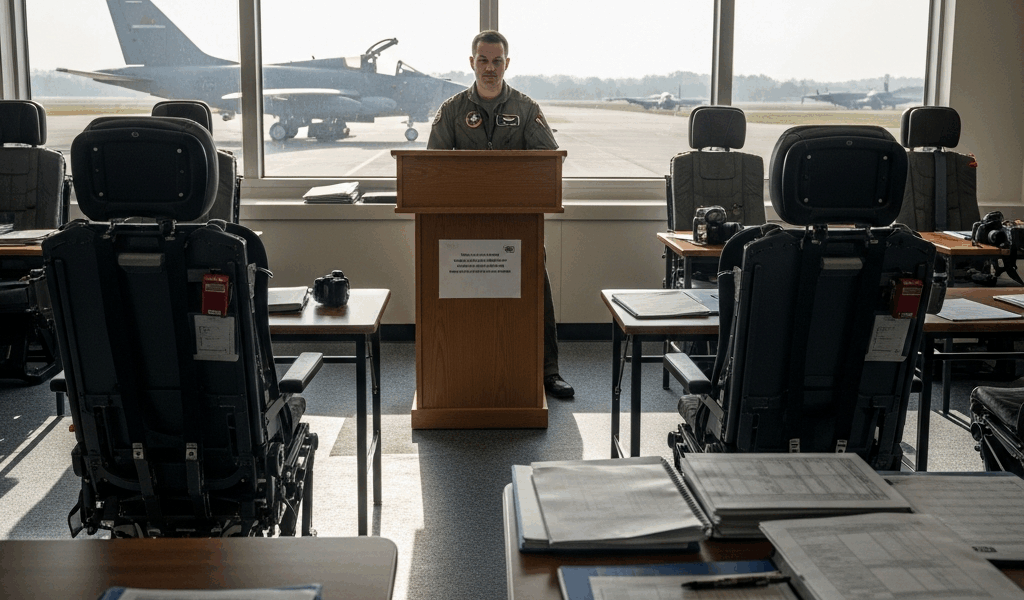
“Washing out” of Air Force Undergraduate Pilot Training does not trigger one automatic career outcome.
A student being considered for elimination normally enters a documented Commander’s Review. The reviewing authority recommends retention or elimination, and the approving authority makes the training decision. If a Regular Air Force officer is eliminated, current personnel policy can lead to:
- return to a previously awarded Air Force Specialty Code, if the officer remains qualified in it;
- consideration for reclassification into another available career field;
- referral for separation processing;
- separation when reclassification is not approved; or
- in limited training circumstances, a recommendation for another rated-training path.
Air National Guard and Air Force Reserve cases involve the sponsor or home unit and component authorities, so their disposition is not identical to the Regular Air Force process.
There is no universal “60-to-120-day reassignment window,” no guaranteed list of alternate jobs and no rule that every eliminated student is immediately discharged.
Quick answer: UPT elimination is a training decision, not an instant assignment or discharge order. The immediate process is documented through Commander’s Review. A Regular Air Force officer without a prior qualified specialty is then considered for reclassification or separation according to current Department of the Air Force requirements. Personal preferences matter, but they do not control the result.
First, “washout” is an informal term
Air Force training instructions use more precise terms:
- retention or reinstatement in training;
- elimination;
- withdrawal or drop on request;
- washback to another class;
- medical disqualification;
- reclassification; and
- separation.
Those outcomes should not be collapsed into one word.
A student can be temporarily removed from flight-line activity while a review is pending and later be reinstated. A washback changes the student’s class and graduation date; it is not necessarily an elimination. A medical interruption can end with return to training, a waiver decision or another disposition. A voluntary withdrawal can affect eligibility for other rated training differently from a performance case.
The reason and procedural stage therefore matter.
For the available public evidence on attrition—not career outcomes—see our separate guides to the Air Force pilot-training washout rate and military pilot-training washout rates by service.
What happens immediately during Commander’s Review
The governing public training instruction is AETC Instruction 36-2605, Volume 4.
Its Commander’s Review process does not support the common claim that one failed event always causes an instant, final elimination.
1. The student receives notice
The initiating authority enters the student into the review process after the applicable syllabus trigger or decision and gives written notice that elimination is being considered.
The exact trigger comes from the current course syllabus and the student’s record. It may involve flying, academic, procedural, medical, voluntary or other circumstances.
2. Training is normally suspended pending the decision
The instruction says the student is suspended from training while the final approving-authority decision is pending. The initiating authority can, with the required concurrence, allow continued academic training. A UPT student is otherwise instructed not to participate in flight-line activities or training until reinstated.
That temporary status is not proof of the final outcome.
3. The student can submit written matters
The public Commander’s Review template gives a student the opportunity to submit a “show cause” memorandum and supporting written statements. Under the current AETC instruction, the ordinary deadline is two duty days after written notification.
The memorandum should address why the student should be retained or reinstated and identify specific circumstances that bear on the case. It becomes part of the formal record.
A student facing an actual review should use the notice and counsel provided in the case—not an online template—as the controlling guidance.
4. The reviewing authority makes a recommendation
The reviewing authority examines the training record and recommends elimination or retention. The recommendation includes the significant facts and rationale.
5. The approving authority decides
The approving authority reviews the record and decides whether the student will be retained in or eliminated from training.
If the student is reinstated, the decision can authorize specific additional simulator, aircraft or ground-training events—or state that no additional training is authorized.
If the student is eliminated, the training documentation records the decision and can include a recommended follow-on career field. That recommendation is not the same as an assignment order.
Do you lose an 11X pilot AFSC immediately?
This question starts from a common misconception.
A UPT student normally holds reporting identifier 92T0, which means pilot trainee. Under the current DAFMAN 36-2100, the personnel office awards the entry-level rated AFSC after graduation from rated initial-skills training.
AETC’s current pilot-training AFSC guide likewise says the 92T0 reporting identifier is maintained until the aeronautical rating, assignment notification and applicable specialty requirements are satisfied.
Therefore, saying that an eliminee’s “11X AFSC disappears immediately” is usually inaccurate for a non-rated UPT student. The person generally had a pilot-trainee reporting identifier, not a fully awarded pilot specialty that is simply erased after one event.
Rated officers in later pipeline training are different. They may already hold an aeronautical rating and rated AFSC, and their cases can require additional rated-status action.
What happens to a Regular Air Force officer after elimination?
The post-elimination personnel process is separate from the training decision.
Current DAFMAN 36-2100 says Regular Air Force line-officer initial-skills-training eliminees are considered for reclassification or separation based on Department of the Air Force requirements. That applies whether the elimination was self-initiated or not and whether it happened before or after training began.
If you already have another qualified AFSC
An officer with a previously awarded AFSC that the officer remains qualified to hold returns to that specialty instead of meeting the initial-skills-training eliminee panel.
This can apply to an officer who entered pilot training after already qualifying in another career field. It does not mean every prior job, duty title or enlisted specialty automatically becomes the officer’s follow-on AFSC.
Personnel authorities determine whether the previously awarded specialty remains valid and qualified.
If you do not have a prior qualified AFSC
The Air Force uses an initial-skills-training reclassification process. Depending on the package, the responsible division can make a reclassification determination from available specialties or convene a panel.
The current manual describes a five-member panel of field-grade officers. The eliminee completes a package under the current myFSS instructions.
The process is not a marketplace in which the officer selects any desired job.
How the reclassification decision is made
Current policy frames reclassification around Air Force needs and a whole-person review.
Factors include:
- the commander’s assessment;
- the reason for elimination;
- commitment to continued Air Force service;
- quality-force or disciplinary issues;
- potential to complete training for another specialty;
- education and relevant coursework;
- special abilities or high-demand language skills;
- potential contribution to available career fields;
- prior educational investment; and
- expected value to the Department of the Air Force.
The officer’s preferences are considered. They are not guaranteed.
An AFSC must be both available to receive eliminees and one for which the officer meets the current specialty qualifications. Career-field manning, training capacity, year-group needs and qualification standards can change the list.
That is why fixed online lists of “the five jobs UPT washouts always receive” are unreliable.
There is no responsible universal AFSC list
The live version of this article previously named several supposed common outcomes, but some codes were wrong or obsolete. For example, Combat Systems Officer is a 12X rated field, not “13O,” and an online article cannot promise access to space, intelligence, cyber, acquisitions or any other specialty.
The reliable answer is procedural:
- AFPC identifies specialties available under current requirements.
- The officer submits the required package and preferences.
- The authority considers qualifications and the whole-person record.
- The final authority approves reclassification, separation or another authorized disposition.
An officer approved for reclassification is matched to an available training course through the normal assignment process.
Can the Air Force separate you after UPT elimination?
Yes. Separation is a possible outcome, but elimination does not itself equal immediate discharge.
DAFMAN 36-2100 says the reclassification and separation authority can:
- approve reclassification;
- approve separation;
- refer the case to the officer’s command for processing under the military-separations instruction; or
- forward the case to the Secretary of the Air Force Personnel Council for action.
The supporting AFPC Instruction 36-112 applies to Regular Air Force officer initial-skills-training reclassification panels. It says the final authority decides whether to separate or retain and describes written notification after the decision.
Current DAFMAN 36-2100 also states that officers not approved for reclassification will be separated, with educational-cost recoupment as directed by the proper authority.
The precise process, timing and financial consequences depend on the record and governing authority. A generic promise that separation will occur within 30, 60 or 90 days is not supported by the public instructions.
What service commitment applies after UPT elimination?
This is another area where online answers often confuse graduation with elimination.
Under the current DAFMAN 36-2139:
- completion of Undergraduate Pilot Training carries the standard 10-year active-duty service commitment; but
- formal withdrawal or elimination from UPT carries a two-year active-duty service commitment under the training-elimination rule.
So an eliminated student does not normally incur the same 10-year UPT commitment as a graduate, but the correct answer is not “no pilot-training commitment.”
Other commitments can also exist because of:
- the U.S. Air Force Academy;
- an AFROTC scholarship;
- Officer Training School;
- funded education;
- a prior assignment;
- another completed training program;
- a bonus or special pay; or
- an earlier service agreement.
Multiple commitments may run concurrently or be governed by specific rules. Separation and recoupment decisions can also affect unearned educational assistance, bonuses or special pay.
The servicing personnel office must calculate the individual’s actual commitments. An online calculator cannot determine a reliable date of separation from commissioning source and UPT status alone.
Can you get another chance at rated training?
Sometimes a different rated-training recommendation is possible. It is not a universal second chance.
AETC policy provides several narrow examples:
- certain rated T-38 pipeline students can be recommended for multi-place, crew-type aircraft training;
- certain ENJJPT students can be recommended for an alternative undergraduate-training pipeline or reclassification; and
- the Commander’s Review form can address eligibility or recommendations for other rated training in qualifying cases.
The wording matters: these are recommendations, subject to the relevant component, personnel, qualification and training authorities.
The same instruction restricts other-rated-training recommendations in certain academic-deficiency, manifestation-of-apprehension and drop-on-request cases. A voluntary statement that the student does not want reinstatement can limit other rated options.
Current personnel guidance also contains conditional provisions for a UFT eliminee selected for another undergraduate flying-training program. Those provisions keep an administrative route open; they do not create an entitlement to repeat UPT because a student disliked an instructor or believes another base would be a better fit.
No applicant should plan on UPT elimination as a route to CSO, ABM, RPA or another pilot pipeline.
How medical elimination differs
A medical case is not interchangeable with a performance elimination.
A student can be:
- temporarily medically restricted;
- evaluated for return to flying training;
- considered under waiver standards;
- found medically disqualified for a specific duty; or
- processed for another disposition.
For a UPT medical eliminee, current AETC training documentation calls for an assessment of the student’s ability to complete training if medically requalified.
That does not guarantee reinstatement. It does show why “medical washout means automatic separation” is too broad.
Medical facts are protected and case-specific. The flight-medicine office, waiver authority and personnel authorities—not peers or an online forum—determine the official status.
What changes for Air National Guard and Air Force Reserve students?
The Regular Air Force reclassification panel described above does not govern every Guard or Reserve outcome in the same way.
Current policy says:
- Air National Guard officer eliminations are reported to the appropriate ANG initial-skills-training liaison;
- Air Force Reserve officer eliminations are reported to the officer’s home unit for disposition; and
- the training unit notifies the sponsor or component authorities during the Commander’s Review process.
Guard and Reserve students often entered training for a unit-associated position, which makes sponsor-unit and component decisions central.
That does not justify a blanket claim that a Guard or Reserve student automatically returns to the same unit, receives a non-flying billet or is discharged. The component and unit must act under the person’s appointment, orders, qualifications and current requirements.
What should a student do during the process?
The best response is accurate, timely and documented.
Read the written notification
Identify:
- the reason for review;
- the governing syllabus trigger;
- the response deadline;
- the records being considered; and
- the authority making the decision.
Do not rely on a classmate’s case from another base, syllabus or year.
Preserve your records
Keep authorized copies of notices, training records, medical documentation and submitted statements. Do not alter, destroy or remove government records.
Use the opportunity to respond
If submitting a show-cause memorandum, address the documented issue directly. Relevant facts, corrective actions and supported circumstances are more useful than attacks on instructors or unsupported comparisons with classmates.
Ask the correct office the correct question
- The training chain explains the Commander’s Review and syllabus record.
- The servicing personnel office explains AFSC, assignment and commitment data.
- Flight medicine addresses medical qualification and waiver routing.
- The appropriate legal-assistance or defense counsel explains available legal advice and rights for the actual proceeding.
- Guard and Reserve students should include their sponsor or home-unit channels.
Separate preferences from entitlements
An officer can state career-field preferences and document relevant qualifications. That does not mean the preferred AFSC is available or that the officer meets every current requirement.
Can you still fly as a civilian?
Military training elimination does not by itself create an FAA certificate revocation.
Any FAA certificates and ratings already earned remain governed by FAA rules. A former student can pursue civilian certificates and experience if medically eligible and otherwise qualified.
However:
- military flight time does not automatically equal a civilian certificate or rating;
- the person must accurately report records when an application or employer requires them;
- FAA medical eligibility is a separate determination; and
- airline employment is never guaranteed.
Someone who later completes the civilian requirements can build a civilian aviation career. The path depends on certificates, medical status, experience, record and hiring conditions—not on a promised salary or anonymous success story.
For the actual FAA path, see our guide to the military-to-airline pilot transition.
Frequently asked questions
Does one failed checkride mean automatic UPT elimination?
Not under one universal public rule. The applicable syllabus defines triggers, and the Commander’s Review process evaluates retention or elimination. A specific course can have mandatory actions after unsuccessful events, so the student must use the current syllabus.
Are you immediately reassigned after washing out?
No universal immediate-reassignment rule exists. The training decision must be documented, and the component or personnel authority then determines the follow-on disposition.
Can you choose your new Air Force job?
You can submit preferences and qualifications in the Regular Air Force reclassification process. Air Force needs, available specialties, training capacity and individual qualifications control the result.
Will you automatically be separated?
No. Reclassification, return to a prior qualified AFSC and separation are all possible depending on status and component. But separation is a real outcome when reclassification is not approved.
Do UPT washouts owe ten years?
The current 10-year UPT commitment applies to the UPT completion event. Current policy assigns a two-year active-duty service commitment after formal UPT withdrawal or elimination. Other commitments may also remain.
How long does reclassification take?
The public instructions reviewed here do not promise one fixed duration. Package completion, review timing, specialty availability, training dates and component actions can all affect the timeline.
Can a washout apply to UPT again?
Another undergraduate flying-training path can be recommended in limited circumstances, but it is not an automatic right. The original reason, medical and qualification status, component needs, recommendation and personnel approval all matter.
Bottom line
Air Force UPT elimination is not the end of one meeting followed by an automatic assignment.
The process has two major stages:
- Training disposition: Commander’s Review determines whether the student is retained or eliminated.
- Personnel disposition: the appropriate Regular Air Force, Guard or Reserve authority determines return to a prior specialty, reclassification, another authorized training path or separation.
The most reliable expectations are:
- your record and reason for elimination matter;
- your component matters;
- preferences are considered but not guaranteed;
- the normal 10-year graduate UPT commitment is different from the current two-year elimination commitment; and
- no online article can predict your AFSC, separation date or final disposition.
Use the current written notice, official record and responsible authorities for the individual case.


Stay in the loop
Get the latest milpilot updates delivered to your inbox.