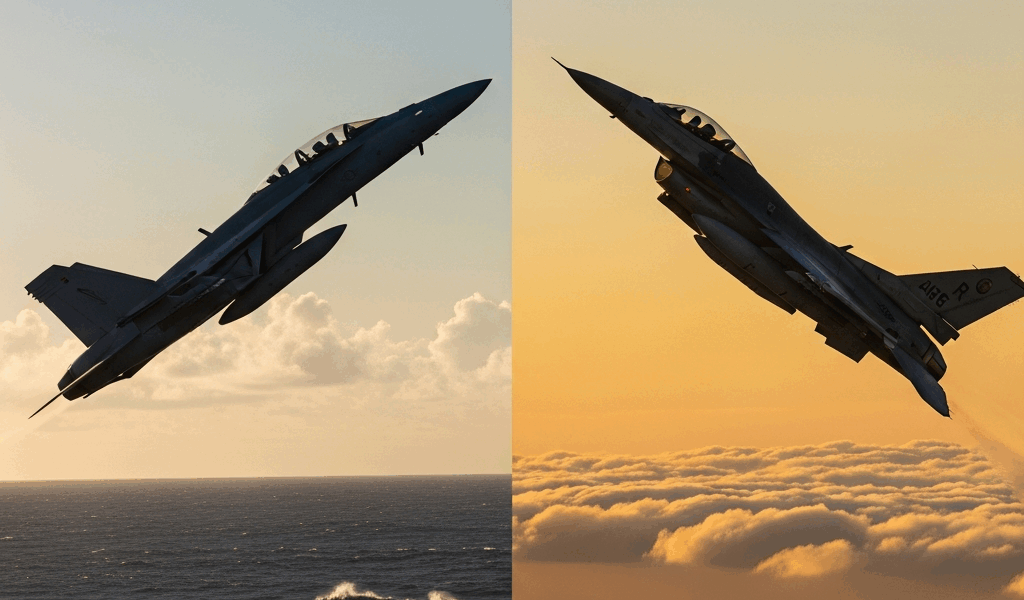
Navy vs Air Force Pilot Training: Which Is Harder
Navy vs Air Force pilot training has gotten complicated with all the recruiting noise, YouTube glorification, and half-informed Reddit threads flying around. As someone who spent years embedded in military aviation communities — talking to actual pilots, cross-referencing GAO reports, and reading training command documents at an embarrassing level of detail — I learned everything there is to know about both pipelines. Today, I will share it all with you. No recruiter spin. No branch loyalty. Just the actual numbers, the lifestyle realities, and the stuff that usually ends up buried in a footnote.
How the Two Training Pipelines Are Actually Structured
The Navy starts you at Naval Air Station Pensacola with Aviation Preflight Indoctrination — API. Six weeks. Academics only: aerodynamics, navigation, physiology, water survival. You are not flying yet. You’re memorizing the Bernoulli principle and doing survival swims at 0530 in a pool that is never, ever the right temperature.
Primary flight training follows — still Pensacola or Corpus Christi — in the T-6B Texan II. That runs about 22 weeks. Then you track into advanced training based on performance. Strike pilots head to NAS Kingsville or Meridian and spend roughly 35 weeks in the T-45C Goshawk before carrier qualification. Start to wings: somewhere between 18 and 24 months, depending on the training command’s tempo and whether you hit any holds along the way.
The Air Force structure looks different from day one. Candidates without prior flight experience go through IFS — Initial Flight Screening — at Pueblo, Colorado. Thirteen days in a Cessna 172 SP. It’s less a training program and more a filter to ensure you don’t immediately wash out at the next phase.
Specialized Undergraduate Pilot Training — SUPT — runs approximately 54 weeks at Columbus, Laughlin, or Vance. T-6A in primary, then a track split: the T-38C Talon for fighters and bombers, or the T-1A Jayhawk for heavies and tankers. No carrier qualification. No ship. Wings, then straight to a formal training unit for your assigned airframe.
The Navy pipeline is objectively longer. Carrier qualification alone — field carrier landing practice plus the actual carrier qual event — tacks on weeks that Air Force pilots simply never encounter. That’s not a criticism of Air Force training. It’s just a different mission requiring a different sequence.
Washout Rates and What Actually Drives Them
Probably should have opened with this section, honestly. It’s what most people want to know the moment they start comparing branches.
Navy attrition through the full strike pipeline — API through carrier qualification — historically runs 20 to 30 percent. Some years higher. The consistently brutal phases are primary and FCLP. Students who struggle with instrument scan in primary can sometimes recover. Students who can’t stabilize a 3-degree glideslope approach at 130 knots against a moving datum generally don’t survive the T-45 phase. The ball — the meatball on the Fresnel lens optical landing system — does not care about your GPA or your feelings.
Air Force SUPT attrition runs roughly 10 to 15 percent by most available data. The phase that disproportionately kills students is formation flying. Close formation specifically — 3 to 6 feet of wingtip separation at altitude in a T-38C. Some people’s brains do the spatial processing required. Some don’t. It isn’t about effort or desire. It’s about whether the hardware between your ears can execute the task.
Both branches wash students for academics, medical issues surfaced during training, and what gets diplomatically labeled “unsatisfactory progress.” Checkride attempts are finite. Use them all without hitting standard and you’re done — regardless of branch, regardless of effort.
Frustrated by the vague and contradictory information floating around online, I spent months cross-referencing DoD training command documents, GAO reports, and firsthand pilot accounts on forums like BaseOps.net using nothing fancier than a spreadsheet and a lot of free evenings. The conclusion was fairly straightforward: the Navy’s longer pipeline, with carrier qual layered on top, creates more total exposure to failure points. That’s just arithmetic.
The Aircraft You Fly in Training — and What Comes After
Both services use the T-6 in primary. This creates a moment of false equivalence worth addressing immediately. Yes, same airframe family — T-6A for the Air Force, T-6B for the Navy with slightly different avionics. After primary, the paths split hard.
Air Force students on the fighter or bomber track move to the T-38C Talon — a supersonic tandem-seat jet from the 1960s that’s been upgraded enough to stay relevant. Fast, unforgiving at slow speeds, and it prepares you for F-22s, F-15Es, B-1s, B-52s. Heavy track students fly the T-1A Jayhawk, a modified Beechcraft 400A, which transitions cleanly to C-17s, KC-135s, and similar platforms. The Air Force track system means specialization happens earlier than most people expect.
Navy strike students go to the T-45C Goshawk — a carrier-capable trainer derived from the British Aerospace Hawk. It lands on ships. That sentence sounds simple. It isn’t. Landing a jet on a carrier is one of the most technically demanding tasks in all of military aviation, and the T-45 is specifically engineered to replicate the approach characteristics of fleet aircraft like the F/A-18E/F Super Hornet. After training, strike pilots typically report to a Fleet Replacement Squadron — an FRS — which functions as the fleet equivalent of a formal training unit.
That’s what makes each aircraft selection endearing to us aviation obsessives — every airframe in the training pipeline reflects a specific mission requirement. The Navy needs pilots who can fly a consistent approach to a moving ship in degraded conditions at night. The Air Force needs pilots who can manage complex multi-ship employment or heavy airlift operations across global distances. Neither is wrong. They’re different problems with different solutions.
Lifestyle and Deployment Realities Most Pilots Won’t Lead With
Navy pilots deploy on carriers. Standard deployment: six to eight months. During that stretch, you live in a stateroom roughly the size of a large walk-in closet — shared with one or more roommates — about 40 feet below the flight deck. Sleep schedule dictated by flight ops. Shore duty exists, but across a 20-year career, Navy pilots spend substantially more time away from home than Air Force counterparts. That’s not an opinion. It’s a scheduling reality.
Air Force pilots operate from fixed installations — Langley, Luke, Mountain Home, Nellis. Deployments happen, but they’re generally shorter and involve established air bases with gyms, dining facilities, and reliable internet. The Air Force gets called garrison-focused as a dig. That criticism has some merit — and also, “garrison-focused” frequently translates to “able to maintain a functional family life,” which matters enormously to a lot of people and nobody should apologize for that.
I’m apparently the kind of person who asked Navy pilots about their marriages before asking about their aircraft — and every single one of them gave me the same answer: they’re proud of the carrier experience and wouldn’t trade it, but the lifestyle demands a level of sustained sacrifice that land-based operations simply don’t require at the same frequency. Sea duty reshapes family planning, marriages, kids’ school years. None of that shows up in any recruiter’s slide deck. Don’t make my mistake of underweighting it when you’re doing your research.
Which Branch Should You Actually Choose
So, without further ado, let’s dive in to the framework that actually matters here.
Go Navy if: you specifically want the carrier experience, you’re fixed on tactical jets, and you can honestly — not optimistically, honestly — accept that your family will operate without you for significant stretches of your career. The pipeline is harder by duration and by the specific demands of carrier qualification. The platform community is tight. The missions are aggressive.
Go Air Force if: platform diversity appeals to you, land-based operations fit your life better, or being home with reasonable consistency across 10 to 20 years matters more to you than flying off a ship. The training is still demanding. Washing out of SUPT is a real outcome for real people every single class. The Air Force is not a shortcut to wings.
But what is the most common mistake people make choosing between them? In essence, it’s picking based on which aircraft looks coolest on a poster. But it’s much more than that — it’s a choice about the life you’ll be living for the next decade or two, and the jet is a downstream consequence of that choice. Pick the life first. The airframe follows. If you want to go deeper on actually competing for a pilot slot in either branch, the articles on officer candidate preparation and minimum flight hour requirements are worth reading next.



Stay in the loop
Get the latest milpilot updates delivered to your inbox.