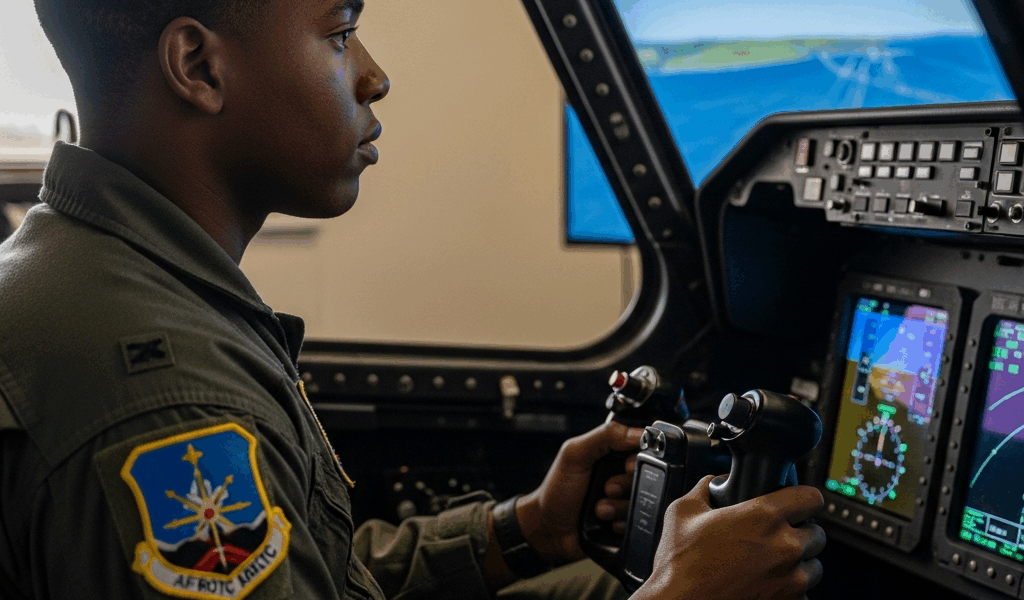
AFROTC Pilot Slot — How Competitive It Really Is and How to Win One
Getting a pilot slot through AFROTC has gotten complicated with all the conflicting information flying around — forums saying one thing, upperclassmen saying another, and the actual numbers buried somewhere in AFPC briefings nobody outside a detachment commander’s office ever sees. As someone who went through AFROTC at a mid-sized detachment in the Southeast and commissioned as a rated officer, I learned everything there is to know about this process — mostly by obsessing over it for three years straight. The selection rate hovers around 60–70% in good years. That number will either make you feel great or keep you up at night, depending entirely on where your package actually sits.
How Competitive Is the AFROTC Pilot Slot — The Numbers
Let’s put real figures on the table. AFROTC commissions roughly 1,000–1,100 officers per year across all specialty codes. Rated slots — pilot, CSO, RPA, ABM combined — eat up somewhere between 35% and 45% of that total, shifting year to year based on what the Air Force actually needs. Pilot slots specifically run around 500–550 annually across all commissioning sources, with AFROTC responsible for roughly a third of that number.
Probably should have opened with this section, honestly. The rated board convenes once per fiscal year — typically fall of a cadet’s AS400 year. Every eligible cadet who submits a package gets evaluated at the same time. You’re not exactly competing against a national pool in the traditional sense. You’re competing within your detachment’s submitted packages, with your detachment commander stacking you against other cadets before the national board ever sees your name.
Here’s what the percentage alone won’t tell you. In years where the Air Force has a genuine pilot shortage and Congress is pushing accession numbers up, selection rates can climb past 70%. During drawdown cycles, that same rate can drop below 50% for otherwise qualified applicants. The mid-2010s saw some brutal boards — well below 50% by some accounts that surfaced in detachment briefings and on forums like the AFROTC subreddit. Those numbers don’t get published cleanly by AFPC. You have to dig for them.
The timeline is its own kind of punishment. Packages go in September or October. Results come back December through January. That’s two to three months of sitting with every decision you made — or didn’t make — over the previous three years. Loud, uncomfortable months.
What the Rated Board Actually Evaluates
But what is the Rated Applicant Score? In essence, it’s a composite that combines your PCSM with several other weighted factors. But it’s much more than that — because some of those factors were locked in long before you ever submitted a package.
PCSM Score
Your PCSM pulls from your AFOQT Pilot and Navigator subtests plus your TBAS score, modified by total logged flight hours up to a cap. The scale runs 1–99. Above 80 is competitive. Above 90 puts you in a genuinely strong position. Below 60 and you’re fighting uphill regardless of everything else in the package. I scored a 72 the first time and a 76 after retesting — not exactly a brag. It was enough, but I left points on the table because I underestimated the TBAS going in. Don’t make my mistake.
AFOQT Scores
The AFOQT is a 12-subtest battery running about three and a half hours. For pilot applicants, the Pilot composite and the Navigator-Technical composite are the ones that move the needle. The Pilot subtest hits instrument comprehension, aviation information, table reading — all things you can actually prepare for. One critical detail most people get wrong: you can take the AFOQT twice, but your second score replaces your first whether you improve or not. That’s not forum speculation. That’s policy. Treat the first attempt like the only one that matters.
GPA
There’s no hard published cutoff, but competitive pilot candidates are typically carrying a 3.2 or above. The board isn’t naive about major difficulty either — a 3.4 in aerospace engineering reads differently than a 3.9 in communications. STEM GPAs get scrutinized, but not always in the direction you’d expect. A hard-earned 3.3 in a technical major can hold its own against a shinier number from an easier one.
Commander Ranking and Field Training
Your detachment commander’s ranking of you against other cadets in your class is arguably the most significant piece of paper in the entire package. You can’t calculate it. You can’t game it at the last minute. It gets built over years — through performance evaluations, leadership assessments, and whatever professional relationship you’ve managed to build with your cadre. Field training, the summer encampment between AS200 and AS300 year, feeds directly into this. That’s what makes field training so endearing to us cadet types who thought PT at 0500 was optional — it turns out it was the whole point. I knew cadets with stronger PCSM scores than mine who ranked lower in commander evaluations and didn’t get pilot. That’s real, and it happens every cycle.
Physical Fitness Assessment
The Air Force PFA — push-ups, sit-ups, 1.5-mile run — runs on a 100-point scale with age and gender norms factored in. For a rated board package, you want to be in the Excellent category, ideally scoring in the 90s. At minimum it’s a tiebreaker. At the margins of a competitive board, it signals something about consistency and discipline that a single test score can’t.
The Three Things You Can Control
AFOQT Preparation — Actually Prepare
Frustrated by genuinely bad advice from an upperclassman who told me the AFOQT was “basically impossible to study for,” I walked into my first attempt with a Barron’s prep book I’d skimmed for maybe six hours total over two weeks. That approach cost me points I never got back. The test has predictable question types and a format that rewards deliberate, structured practice — not cramming the night before in your dorm room.
Use the official AFOQT Study Guide from AFPC as your baseline. Supplement it with the Trivium AFOQT Study Guide — runs about $28 on Amazon — and practice tests from sites that mirror the instrument comprehension section specifically. Give yourself 8–10 weeks of actual prep. The table reading subtest fools people because it looks simple. It’s a pure speed drill, and the only way through it is repetition until the process becomes automatic. The aviation information section is straight memorization. Memorize it.
For the TBAS, download the free practice software directly from pcsm.af.mil. The multi-tasking subtest is the section with the highest PCSM impact — and it’s also the most trainable with deliberate practice. Run it daily for two weeks leading up to your test date. A Logitech Extreme 3D Pro joystick runs about $50 and makes the stick-tracking task significantly more realistic to practice at home. Probably the best $50 you’ll spend in this whole process.
Flight Hours — How Many Actually Matter
Flight hours modify your PCSM on a sliding scale that caps out at 201.5 hours — beyond that threshold, additional hours don’t move the needle further. The biggest PCSM jumps happen in the 1–40 hour range, which means getting your private pilot certificate does real work. Typical cost runs $10,000–$12,000 at a small FBO in a Cessna 172, usually 60–70 hours total time. While you won’t need to show up with a commercial certificate, you will need enough hours to demonstrate actual aviation orientation — and enough to talk about flying like someone who’s done it, not just read about it.
If the cost is a barrier — and it was for me, genuinely — look at the CAP flight scholarship program and the EAA Ray Aviation Scholarship. Both are competitive but real. EAA Ray Scholarships cover up to $11,000 in flight training. Applications open every fall. Apply the first year you’re eligible, not the year you actually need the money.
Physical Fitness — Be Consistent, Not Heroic
The PFA gets documented across your full four years as a cadet. A consistent trend of 90-plus scores across eight semesters says something very different than one outstanding score your senior year right before the board. Build the habit as an AS100 — run three days a week minimum, and train to hit a sub-9:00 on the 1.5-mile so that test-day nerves don’t push you over the Excellent threshold at the worst possible moment. The published standard for Excellent is around 9:30 for most male age groups and 10:45 for most female age groups. Train harder than that. That’s the actual number worth targeting.
What Happens If You Don’t Get Pilot — Rated Alternatives
Not getting a pilot slot from the rated board is not the end of the road. That sentence lands hollow when you’re living it at 0200 checking your email again — I get that. But it’s factually true and worth sitting with before you make any decisions.
CSO, RPA, and ABM Slots
The same board that selects pilot candidates also selects Combat Systems Officers, RPA pilots, and Air Battle Managers. These are rated officer designations — same commissioning, often the same deployment tempo as manned aircraft pilots. The RPA track in particular has seen serious investment as the Air Force expands MQ-9 operations and develops next-generation UAS platforms. Several classmates of mine who didn’t get pilot went RPA and deployed more frequently in their first five years than people flying T-6s in IFS. This new direction took off several years back and eventually evolved into the career track RPA pilots know and build entire careers around today. It’s not a consolation prize.
The Nav-to-Pilot Pipeline
This one doesn’t get discussed much at the cadet level. Officers who commission into CSO can apply for cross-training to pilot through the assignment process after building a service record. It’s competitive and timing-dependent — but it’s a documented pathway. It’s a real board action called a retraining request, and it processes every year. Not a myth people repeat to feel better. An actual thing.
Apply Again Through OTS
X might be the best option, as the OTS route requires only that you’re still serving and under the age ceiling. That is because the age waiver limit for pilot training entry sits at 33 years old — which means officers who commission into non-rated AFSCs and then build strong Officer Performance Reports have a legitimate shot at a rated retraining board later. A few years of documented performance on active duty can strengthen a package that wasn’t competitive coming out of AFROTC. First, you should commission and serve well — at least if pilot is genuinely the only outcome you’re willing to accept.
The AFROTC pilot slot selection rate is worth knowing. It’s also a population-level number that tells you almost nothing about what your specific package looks like sitting in front of a board. The cadets who walk away with pilot slots aren’t always the ones with the highest PCSM scores. They’re the ones who showed up consistently over three years, built real relationships with their cadre, prepared deliberately instead of hoping things would sort themselves out. They don’t sort themselves out — not in this process. You sort them out, starting the day you walk into your first AS100 class.

Stay in the loop
Get the latest milpilot updates delivered to your inbox.