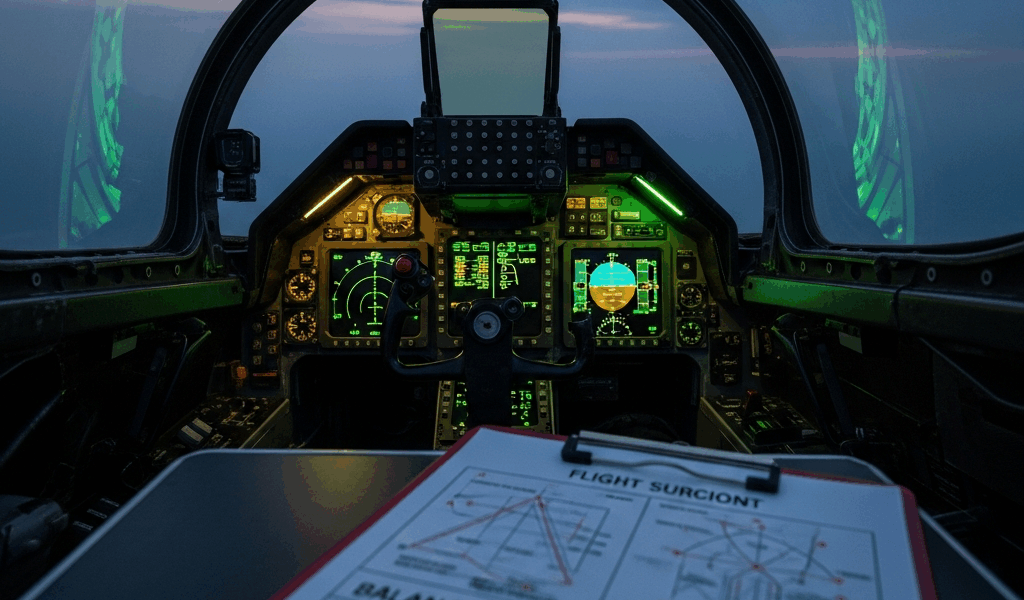
What Vertigo Actually Feels Like in the Cockpit
Military pilot vertigo has gotten complicated with all the misconceptions flying around. I spent three years in T-6 Texans before my first real vertigo episode — and let me tell you, that spinning sensation is only half the story.
But what is true vertigo? In essence, it’s the illusion that you or your environment is moving when it isn’t. But it’s much more than that. In the cockpit, pilots report the runway tilting when they’re lined up straight. The horizon appears to rotate. Some describe it as watching the world spin at 45 degrees while their instruments read level. That distinction matters — it’s not dizziness (vagueness or lightheadedness) and it’s not spatial disorientation (confusion about attitude relative to the actual horizon). Vertigo is specific. It’s involuntary. It’s terrifying.
The nausea arrives quickly. During one approach, a pilot I knew experienced sudden spinning sensations at 800 feet AGL and had to talk himself through the landing while fighting the urge to vomit. His instruments said he was stable. His inner ear said otherwise. He landed safely, but the event still cost him six weeks on the ground waiting for test results.
Benign Paroxysmal Positional Vertigo (BPPV) causes brief, intense spinning triggered by specific head movements — rolling over in bed, looking up, or turning during instrument scans. Labyrinthitis inflames the inner ear after viral infections and produces sustained spinning with hearing loss and tinnitus. Vestibular neuritis attacks the nerve itself. Each has a different flight profile and waiver outcome.
Here’s the honest problem: you can’t fake your way through a vertigo episode. The moment it hits, your body knows something is wrong, and your flight surgeon will know you waited too long to report it.
When Vertigo Triggers Medical Disqualification
The Air Force Flight Surgeons’ Guide — AFI 48-123 — treats vertigo as a disqualifying condition until proven otherwise. This doesn’t mean you’re permanently grounded. It means the process starts with a medical hold.
Acute episodes — a single spinning event during a training flight — typically ground you for 30 to 90 days pending workup. Your flight surgeon will schedule an audiogram, a Dix-Hallpike test, and possibly videonystagmography (VNG). During this window, you won’t fly. You’ll attend brief, stay current in the simulator if allowed, and wait for specialist feedback.
Chronic vertigo or recurrent episodes trigger a waiver request. The Air Force distinguishes between controlled conditions (resolved with medication or therapy) and persistent ones (ongoing despite treatment). A pilot with successfully treated BPPV who completes vestibular rehabilitation has a strong waiver case. A pilot with undiagnosed, ongoing spinning sensations faces denial or extended evaluation.
Probably should have opened with this section, honestly. The timeline crushes people psychologically. A waiver board convenes monthly. Documentation delays add weeks. Specialist appointments book out 60 days in many regions. I’ve seen pilots assume a six-week hold becomes a six-month nightmare because they didn’t know to request priority scheduling from their flight medicine clinic.
The rule: report vertigo immediately. Hiding an episode and reporting it later damages credibility. Flight surgeons respect transparency. They don’t respect pilots who fly through balance problems and report them only when forced.
Medical Workup You’ll Need Before Your Flight Surgeon Visit
An audiogram measures hearing sensitivity across frequencies. Inner ear disorders often affect high-frequency hearing. A normal audiogram doesn’t rule out vertigo, but an abnormal one flags labyrinthitis or Meniere’s disease. Cost: usually free if done at your base clinic. Wait time: 1–3 weeks for scheduling.
The Dix-Hallpike test is simple — at least if you want definitive BPPV diagnosis. Your flight surgeon moves your head into a specific position while you watch their finger. If BPPV is present, your eyes twitch involuntarily (nystagmus) and spinning sensation returns — but briefly and in a controlled environment. Positive result equals strong BPPV diagnosis. Negative result equals BPPV ruled out. Takes five minutes. Feels strange for 30 seconds. Worth the discomfort.
Videonystagmography uses infrared cameras to track eye movements during head rotation and visual tracking tasks. It catches nystagmus patterns invisible to the naked eye and measures vestibulo-ocular reflex function. This test separates peripheral vertigo (inner ear problem) from central vertigo (brainstem or cerebellum issue). Central vertigo is riskier for flight. The test takes 45 minutes. Most military bases contract this out. Budget 6–8 weeks for scheduling and 3–4 weeks for results.
MRI becomes necessary if VNG results suggest central involvement or if imaging is needed to rule out acoustic neuromas. Expect a 2–3 month wait at military medical centers. Cost: zero for active duty. The scan takes 30 minutes and produces results your flight surgeon can brief within two weeks.
Caloric testing measures inner ear response to temperature changes. A specialist instills warm and cool water into the ear canal and watches for predictable eye movements. Abnormal response indicates peripheral vestibular dysfunction. Not all flight surgeons order this immediately — many save it for unresolved cases. Cost: $200–400 if done outside military, free at military hospitals. Timeline: 4–6 weeks.
Prepare a flight history document before your appointment. Write down every episode: date, altitude, maneuver, duration, associated symptoms, and your actions. Pilots who show organized documentation get faster specialist referrals and waiver approvals. I learned this from a flight surgeon friend who said poorly documented cases sit in review for months.
Waiver Strategy and Return-to-Flight Path
Waivers grant when evidence supports safe flight. Flight surgeons want three things: specialist clearance, objective test results showing resolution or stability, and proof you can handle the condition operationally.
Specialist clearance is mandatory. A neuro-otologist or vestibular specialist must evaluate you. Their letter should state the diagnosis, prognosis, and whether they cleared you for flying duties. “Patient is cleared to return to duty” beats “patient’s symptoms are stable” by a wide margin. The former is an explicit waiver recommendation. The latter requires your flight surgeon to interpret.
Objective testing matters more than your subjective report. A normal VNG, caloric test, and audiogram after a BPPV episode strengthen your case. So does a negative MRI ruling out tumors or structural problems. Flight surgeons trust numbers over narratives.
Flight simulator validation accelerates approval. After BPPV treatment, a pilot who completes 5–10 simulator flights under G-load and complex maneuvers demonstrates they can manage. Some wings offer this. Some require you to find a civilian flight training center and pay out of pocket — $5,000 to $8,000 for structured validation flights. It costs money, but it cuts waiver timeline from four months to six weeks.
Vestibular therapy completion is expected for certain diagnoses. BPPV requires canalith repositioning maneuvers (Epley maneuver). Vestibular neuritis requires vestibular rehabilitation — specific exercises retrain your brain to compensate. Finishing therapy and showing improvement before your waiver board review is the difference between approval and “return when therapy is complete.”
Realistic timeline: 90–180 days from initial report to return-to-flight clearance if your case is straightforward (BPPV, resolved with treatment). Complex cases stretch to 6–12 months. I’ve seen waiver denials only when pilots presented incomplete medical records or when their specialist clearance was equivocal.
Pitfalls: don’t overstate your symptoms in initial reports, then minimize them in follow-ups. Don’t skip specialist appointments hoping symptoms resolve on their own. Don’t return to the flight surgeon without updated test results. These contradictions sink waivers.
Preventing Vertigo Episodes During Training and Ops
Hydration is non-negotiable. Dehydration thickens blood, reduces inner ear fluid volume, and triggers balance problems. Drink 16–20 ounces of water two hours before flying, then another 8 ounces 30 minutes before engine start. Sounds basic. It works.
Sleep debt worsens vestibular sensitivity. Fatigue degrades your brain’s ability to filter conflicting signals from your eyes and inner ear. Get seven hours minimum before high-G training sorties. Six hours of sleep before a BFM hop increases vertigo risk substantially — that’s not official data, but every flight surgeon I’ve talked to confirms pilots report more balance issues after sleep-deprived periods.
G-awareness matters. Sustained G-load can trigger BPPV in susceptible pilots. Know your tolerances. Brief high-G maneuvers with your instructor. Don’t assume you’ll adapt. One pilot I knew developed recurrent vertigo after three weeks of sustained 5-G training. His specialist later told him his particular inner ear geometry was vulnerable to G-load-induced BPPV. He returned to duty, but only after switching to aircraft with lower G-envelope demands.
Instrument scan discipline prevents spatial disorientation, which compounds balance problems. Smooth scans, cross-check sequences, and horizon reference prevent the mental spinning that makes true vertigo worse. Train this relentlessly.
Vestibular training exercises on the ground help. The Gaze Stabilization Exercise — focus on a fixed point while moving your head side to side at increasing speeds — improves vestibulo-ocular reflex. The Balance Training Exercise (standing on one leg, then closing your eyes, then standing on foam) strengthens proprioceptive feedback. Ten minutes daily for three weeks measurably improves balance tolerance. Some flight surgeons recommend these preventively. Most prescribe them after an episode.
Self-report culture is the hardest part. Peer pressure pushes pilots to push through. When you feel vertigo during a flight, land safely, declare to ATC, brief your instructor, and report to flight medicine immediately. The pilots who get waivers fastest are the ones who report early. The ones who hide episodes and fly through them break trust with their flight surgeons and invite permanent grounding.
Your flight surgeon wants you flying. They also won’t sign off on someone unsafe. Meet them halfway — transparent, documented, proactive. That’s how you get back to the cockpit.


Stay in the loop
Get the latest milpilot updates delivered to your inbox.