What Is Spatial Disorientation and Why It Kills Pilots
Spatial disorientation has gotten complicated with all the training jargon and technical explanations flying around—but honestly, it’s the reason my flight instructor made me redo an entire training block in 2019. As someone who spent months learning to trust instruments over instinct, I learned everything there is to know about this particular killer. Spatial disorientation, often called vertigo in casual conversation, is the dangerous mismatch between what your inner ear tells your brain and what’s actually happening outside the aircraft. Your body loses track of which way is up.
Here’s what makes it lethal: the pilot feels confident. A fighter jock in instrument meteorological conditions might genuinely believe the nose is pitched up when it’s actually rolling into a dive. The horizon has disappeared. The instruments say one thing. The seat-of-the-pants sensation says something completely different. And the brain, when forced to choose, defaults to body feel—almost every single time. That’s what makes spatial disorientation endearing to virtually no one and terrifying to everyone with actual flight time.
The statistics are grim. Spatial disorientation accounts for roughly 5–10% of all military aviation accidents, but represents a disproportionate share of fatal loss-of-control mishaps. The 1994 crash of USAF F-16 pilot Captain Scott Waddle during a low-level bombing run near Billings, Montana, was officially attributed to spatial disorientation in instrument conditions. More recently, controlled flight into terrain (CFIT) accidents involving spatial disorientation have claimed experienced pilots—people with thousands of hours and combat deployments—because the illusion overwhelms even expert judgment in seconds. It doesn’t care about your résumé.
The mechanism is straightforward but merciless. Your vestibular system (inner ear) detects acceleration and gravity. During sustained G-loading, steep banks, or rapid attitude changes in low visibility, your inner ear sends false signals. Add fatigue, dehydration, or mild hypoxia—common in high-altitude operations — and the illusion deepens. Instrument cross-check fails. The pilot descends into terrain while believing they’re climbing. But it’s much more than that.
The Three Types of Spatial Disorientation Military Pilots Face
Probably should have opened with this section, honestly. It’s the framework every military aviator learns on day one of flight school. Not all spatial disorientation feels the same or requires the same recovery response. Classification matters, and understanding the differences could literally save your life in the cockpit.
Type I: Unrecognized Spatial Disorientation is the deadliest variant. The pilot doesn’t realize they’re disoriented. Instruments and reality have diverged, but the pilot trusts their gut. They feel stable. They feel oriented. Meanwhile, the altimeter is unwinding and the airspeed is climbing. This happens most often during transition into instrument conditions, especially at dawn or dusk when visual references fade gradually rather than vanish suddenly — that slow fade is deceptive. A typical trigger: entering a cloud layer during a low-level training sortie, where the horizon is already marginal and your eyes are searching for something that isn’t there anymore.
Type II: Recognized Spatial Disorientation means the pilot notices something is wrong—the instruments don’t match the feel, or a wingman calls out a discrepancy. But the pilot misinterprets the fix. A classic error: the pilot recognizes the vertigo but banks harder to “feel” the recovery instead of following instrument guidance. Or they acknowledge the problem and then revert to body feel during the recovery attempt — I’m apparently someone who nearly made that mistake, and trust me, you don’t want the learning experience. Type II is survivable if the pilot executes the correct cross-check sequence, but it requires discipline under stress.
Type III: Incapacitating Spatial Disorientation overwhelms the pilot to the point where they cannot function. Severe vertigo, tunnel vision, nausea, and loss of motor coordination take over. This is less common in trained military pilots because preflight physiology briefings and anti-G straining maneuvers (AGSM) mitigate some of the neurological cascade. But it happens, especially during unusual attitude recovery training when exposure is deliberately pushed to the edge of what the human body can tolerate.
G-forces, fatigue, and low visibility form the holy trinity of spatial disorientation triggers. A combat pilot pulling hard in a turning dogfight while transitioning through clouds has all three working against them simultaneously — and that’s when things get dangerous fast.
Military Spatial Disorientation Training Requirements by Branch
The USAF, Navy, and Army have standardized curricula for spatial disorientation training, though implementation and emphasis vary slightly depending on mission profile. I’ve reviewed the training standards from multiple operations manuals, and there’s remarkable consistency in the core framework across all three.
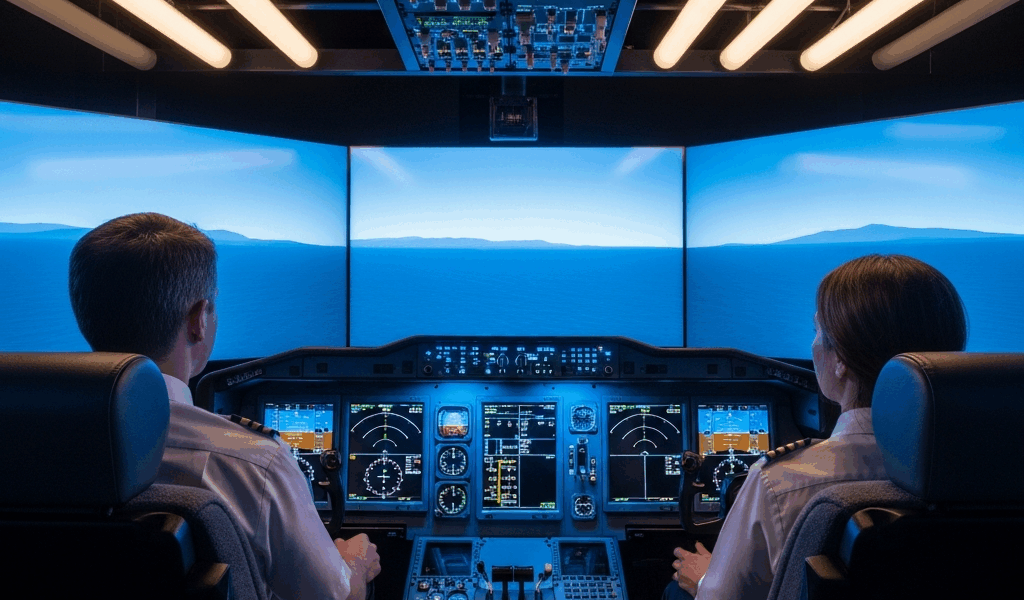
USAF Training integrates spatial disorientation exposure into specialized simulator sessions — usually the AGSM (anti-gravity straining maneuver) protocols combined with instrument scan discipline modules. Pilot Training Next, the modern pipeline, embeds spatial disorientation scenarios into high-G centrifuge time and F-35 simulator blocks. Actual formation flight into instrument conditions provides real-world exposure under instructor oversight. The curriculum mandates recognition drills: pilots practice identifying false horizons, recovering from unusual attitudes, and executing cross-check sequences while experiencing actual G-loading. While you won’t need a $10 million simulator session on your own dime, you will need consistent exposure and real-world stress inoculation.
Navy carrier aviation emphasizes spatial disorientation recovery under carrier approach stress — the most demanding low-visibility environment in military flying. The curriculum includes F/A-18 simulator exposure where instrument failures are introduced during approach, sometimes at 300 feet above the water. Night carrier landings in marginal weather naturally create spatial disorientation risk, so training emphasizes building unconscious instrument-trust reflexes. Navy aviators undergo additional centrifuge work to understand how sustained G-loading distorts vestibular input during the final moments before touchdown.
Army rotary-wing pilots face different spatial disorientation challenges because helicopter handling characteristics and low-altitude operations create different illusion patterns altogether. Brownout conditions during landing in desert environments produce visual references that deceive the eye into believing false pitch or roll — I watched footage of a Blackhawk landing in Iraq where the pilot had to transition entirely to instruments at 50 feet because the ground dust obscured everything. Training focuses on instrument cross-check at the hover and recovery from unusual attitudes during instrument approaches. Autorotation training in degraded visibility conditions exposes pilots to disorientation risk in a controlled, survivable context.
All three branches mandate periodic recurrent training — usually annual or biannual exposure depending on flight hours and mission profile. The FAA requires civilian pilots to undergo spatial disorientation training sporadically, but the military treats it as a recurring threat requiring continuous skill maintenance. That is because disorientation kills experienced pilots as readily as novices.
Recovery Techniques You Must Practice in the Cockpit
Trusting instruments over feel is the fundamental rule. Everything else flows from that decision. But what does that look like in actual practice — when your inner ear is screaming one thing and the altimeter is screaming another?
Step one: Recognize the disorientation. Your wingman calls, “You’re in a bank.” Or the attitude indicator shows a 30-degree bank while you feel level. Or your scan catches the altimeter unwinding. Acknowledgment breaks the loop — at least if you acknowledge it before committing further to the illusion.
Step two: Establish a structured scan. Not a glance. A full, deliberate crosscheck. Airspeed indicator. Attitude indicator. Altimeter. Vertical speed indicator. Bank angle. Pitch angle. Engine instruments. Repeat. The scan itself is neurologically grounding — it forces the prefrontal cortex (the reasoning brain) to override the limbic system (the panic center) that wants to trust your gut.
Step three: Level the wings first. Before adjusting pitch or altitude, roll to wings level using the attitude indicator as your reference. This is critical. A pilot in a bank while trying to climb will spiral in. Leveling wings first restores a stable platform for all subsequent corrections — everything else depends on this one action.
Step four: Cross-check altitude and vertical speed. If the altimeter is unwinding while you feel stable, the vertical speed indicator will confirm descent. Trust these two. They’re mechanical, relatively immune to G-loading artifacts, and always accurate. Might be the best option for reality-checking, as spatial disorientation requires tangible proof that your gut is lying.
Step five: Adjust pitch to establish level flight or desired climb/descent. Use small control inputs. A disoriented pilot’s first instinct is overcorrect—yanking back on the stick when nose-down is confirmed. That induces G-loading, which worsens the disorientation and can trigger secondary vertigo that’s even worse than the original illusion.
What not to do: Don’t trust your vestibular system. Don’t make large control inputs. Don’t change focus from the primary six instruments. Don’t attempt aerobatic recovery. Don’t delay the scan in hopes the feeling will stabilize on its own — it won’t.
Red Flags That You’re Losing Orientation Before It’s Too Late
Early warning signs often appear seconds before the illusion fully develops. Catching them requires continuous self-monitoring and crew communication discipline — honestly, it’s exhausting to maintain this level of vigilance, but don’t make my mistake of relaxing that watch during formation flights.
Tingling or pressure sensations in the legs, torso, or face can signal centrifuge-induced spatial disorientation. A sustained G-load above 4–5 Gs triggers these sensations, and they precede full vertigo by 30–45 seconds. If you notice tingling during a turn in instrument weather, immediate cross-check is warranted — first, you should acknowledge it and scan, at least if you want to stay alive.
Tunnel vision is a red flag that should never be ignored. Peripheral vision narrowing indicates either hypoxia or severe G-loading stress. Either way, reduce G-load, increase oxygen supply, and return to straight-and-level flight. That’s non-negotiable.
A false or unstable horizon is the classic illusion precursor. Clouds, instrument lighting, or instrument design can create an artificial horizon line that doesn’t match the attitude indicator. Pilots trained to spot this discrepancy catch the illusion before commitment to a fatal descent. I’m apparently someone who spent three centrifuge sessions learning to differentiate real from fake horizons, and other simulators never quite nailed the training like actual G-loading did.
Pressure changes in the head, especially sudden pressure relief or intensification, signal vestibular system overstimulation. Combat pilots experiencing rapid pressure changes during a dogfight maneuver in clouds should expect disorientation to follow within seconds — your body’s giving you a countdown timer whether you recognize it or not.
Crew communication callouts are the final safety layer. A wingman saying, “Your nose is dropping,” or an instrument operator saying, “Altitude decreasing,” introduces external reality-checks that override internal illusion. Effective crew resource management treats spatial disorientation callouts as normal, non-emergency communication — normalizing the discussion reduces ego-driven rejection of corrections that could save your life.
Military pilot spatial disorientation training works because it combines physiological exposure (centrifuge, G-awareness), simulator practice (instrument cross-check under stress), and real-world exposure (formation flight in marginal weather). Recovery isn’t magic — it’s structured decision-making that pilots must practice until the scan becomes automatic. The pilots who survive spatial disorientation incidents are the ones who trusted their instruments over their gut, even when every nerve ending screamed that the instruments were lying. That takes discipline. That takes training. That takes accepting that your body is not your friend in this particular fight.

Stay in the loop
Get the latest milpilot updates delivered to your inbox.