Military Pilot Training Timelines Have Gotten Complicated With All the Conflicting Information Flying Around
The recruiting websites make it sound clean. Thirty months, earn your wings, done. As someone who has spent considerable time researching and documenting the actual pipeline experience across all four branches, I learned everything there is to know about what these timelines genuinely look like in practice. Today, I’ll share it all with you.
The honest answer on duration: longer than the Air Force, Navy, or Army websites claim — and it swings wildly depending on branch and aircraft type.
From selection to earning your wings, here’s what realistic looks like in 2025–2026:
- Air Force (UPT): 28–36 months from officer commissioning to wings. Tack on another 6–12 months if you’re coming through OTS or enlisting first.
- Navy/Marine Corps: 30–40 months from API start to wings. The FRS pipeline afterward — which most people never hear about — adds 12–18 months before you’re actually combat-ready.
- Army Warrant Officer Flight Training: 18–24 months from WOCS to wings. Fastest route to real flight hours, but warrant rank carries career trade-offs worth understanding before you sign.
- Coast Guard: 28–32 months, roughly similar to the Air Force pipeline, except smaller class sizes mean longer gaps between phases.
These aren’t the brochure numbers. These account for pipeline backlogs, medical review delays, and the 6–12 month holds between phases that nobody brings up in recruiting offices. That’s what makes honest timelines so valuable to anyone seriously considering this path.
Air Force UPT Timeline — Phase by Phase
The Air Force Undergraduate Pilot Training pipeline is the most rigid of all services. It’s also the most documented — which is exactly why so many people think they understand how long it takes. They don’t.
TFOT or OTS — Officer Commissioning (8–16 weeks)
Already commissioned through the Academy, ROTC, or a reserve commission? Skip ahead. Everyone else is looking at either TFOT — Technical Flying Officer Training, 8 weeks at Columbus AFB — or OTS, which is 12 weeks at Maxwell-Gunter in Alabama. Either way, you haven’t touched an aircraft yet.
The difference matters. OTS is slower, more academically demanding, and you’re competing for pilot slots against navigators and other specialties. TFOT is newer, faster, more pilot-focused. Neither gets you airborne. That comes later.
IFS — Initial Flight Screening (12–16 weeks)
You’re finally in an actual aircraft. IFS runs at contractor-operated schools — Arizona State University’s program in Phoenix or InfiniFlight down in Bartow, Florida. Civilian instructors fly you first, though the Air Force controls the pipeline decisions entirely.
This phase exists to sort the definite no’s from the maybes. Roughly 10–15% of students don’t earn their IFS completion certificate. The phase itself moves quickly — but then you wait. Hold time between IFS and UPT Phase I runs 3–6 months routinely, sometimes longer.
UPT Phase I — Primary (T-6A Texan II, 18–24 weeks)
You’re in the T-6A now. Military turboprop. Basic stick-and-rudder flying, formation work, navigation, some aerobatics. The T-6 is forgiving enough to teach in and unforgiving enough to filter out pilots who shouldn’t advance. Eighteen to twenty-four weeks of actual flying — but between IFS completion and Phase I start, expect a 4–8 month hold. Class availability is the bottleneck. The Air Force pushed throughput slightly upward in 2025, but the backlog from 2023–2024 hasn’t fully cleared yet.
UPT Phase II — Advanced (T-38C Talon or T-1A Jayhawk, 20–30 weeks)
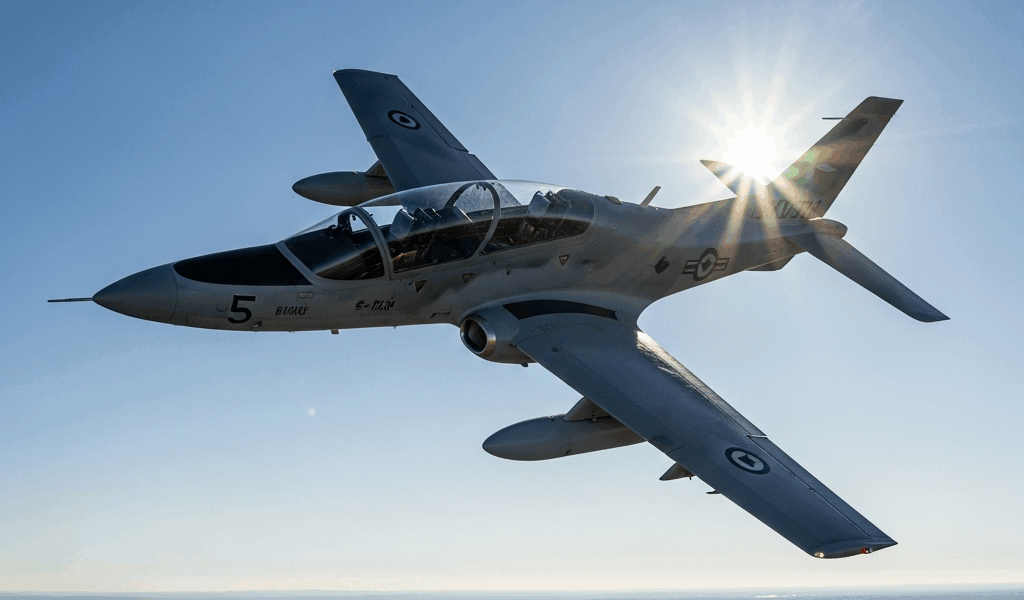
Here’s where the pipeline splits. Heavy-route students — transport and tanker track — go to the T-1A Jayhawk. Everyone else goes to the T-38C Talon, a high-performance twin-engine jet trainer that entered the inventory in 1961 and, frankly, shows its age sometimes.
Phase II introduces instruments, advanced formation, some combat maneuvering, and the first serious navigation challenges. The T-38 teaches precision in a way that nothing before it does. Timeline here stretches to 20–30 weeks — weather delays play a real role at Columbus AFB and Laughlin AFB. The Southwest looks open. It isn’t when convective season hits. Then the wait after Phase I: another 4–8 months. Sometimes more.
UPT Phase III — Advanced (12–20 weeks)
Depends entirely on your track. Fighter-track pilots return to the T-38C — different mission sets this time, supersonic work, low-level flying, combat formation, close air support scenarios. Bomber and heavy transport route means the T-1A and endurance training. Phase III is shorter on paper. Psychologically, it’s the most intense stretch. Your actual aircraft assignment — F-16, F-35, B-52, KC-135 — starts becoming real here, though nothing’s official yet.
Checkrides and Real Delays
Probably should have opened with this section, honestly. Checkride failures aren’t rare. Fail an instrument check or a Phase II checkride, you get a refly — usually within the same month. Fail twice and you’re either eliminated or recycled into the next class cohort. That adds 6–12 months minimum.
Medical holds stretch everything too. A minor issue — one hypertension reading, a minor skin condition, slight hearing asymmetry — triggers a full medical review. That’s another 3–6 months while flight surgeons and administrative processes work through it. Don’t make my mistake of assuming these things resolve quickly. They don’t.
MQT — Mission Qualification Training (6–18 months post-wings)
You earned your wings. That’s real. You are not combat-ready. An F-16 pilot runs 6–12 months of MQT at an operational squadron before that changes. A B-52 copilot might spend 18 months getting to the right seat on an actual combat-ops aircraft. This is why “how long until I’m a combat-ready Air Force pilot?” has a real answer of 40–50 months — not the 30 on the brochure.
Navy and Marine Corps Pipeline — What Takes So Long
The Navy pipeline looks shorter on paper. It isn’t. More phase gates, longer waits, and the FRS phase — which the Air Force folds into MQT — exists separately here and runs longer. So, without further ado, let’s dive into what that actually looks like.
API — Aviation Preflight Indoctrination (12 weeks)
Naval aviator training starts at Pensacola, Florida. API is pure academics and physical testing. No flying yet. The Navy front-loads more classroom time than the Air Force — naval culture, carrier operations fundamentals, maritime-specific procedures from the first week. It sets a different tone than UPT from day one.
Primary — T-6B Texan II (22–28 weeks)
Same airframe as the Air Force version, but the Navy’s T-6B is carrier-certified. Training is fundamentally similar — emphasis is different. Formations here translate to carrier operations. Approaches assume a postage stamp landing surface. Waits between API and Primary run 2–4 months, actually shorter than the Air Force gap, because Pensacola and nearby training fields push higher throughput.
The Split — Strike, Maritime, Rotary-Wing
After Primary, the pipeline branches hard. Strike pilots headed for the F/A-18 go one direction. P-8 maritime patrol pilots another. E-2D early warning pilots another. Helicopter pilots — UH-60, MH-60 — head to Fort Novosel, Alabama alongside Army students. That last move happened in 2023 and added complexity and wait time that wasn’t there before.
Strike track: T-45C Goshawk, a single-engine carrier-compatible jet trainer, for 20–26 weeks. Maritime track runs similar timing with heavier focus on multi-engine systems and sensor operation. Rotary-wing students now navigate Army scheduling on top of Navy requirements. That is because the pipeline merger created coordination gaps that haven’t fully smoothed out.
Advanced — Aircraft-Specific (18–24 weeks)
Strike pilots transition to the F/A-18 Super Hornet. Maritime pilots move to the P-8A Poseidon. You’re in the actual aircraft now — dissimilar air combat training for fighters, sensor integration for maritime. Less standardized than Air Force advanced training because the systems are unique to each platform.
Wait times here can be brutal. An F/A-18 slot might carry a 6–10 month backlog. Maritime pilots wait 4–6 months. The Navy doesn’t have training aircraft inventory proportional to its pilot pipeline. That gap is real and ongoing.
FRS — Fleet Readiness Squadron (12–18 months)
But what is the FRS? In essence, it’s your final training command before operational assignment. But it’s much more than that — it’s the phase that makes the “30-month naval aviator” claim technically accurate and practically misleading at the same time.
More checkrides. More sim time. More aircraft-specific qualification. An F/A-18 FRS at NAS Kingsville, Texas runs 12–18 months depending on training aircraft and instructor pilot availability. A P-8 FRS at NAS Jacksonville, Florida runs comparable length. Wings mean eligible to serve. FRS completion means combat-ready. Most people — including some recruiters — conflate those two things.
Marine Corps Nuance
Marines go through the Navy pipeline. They’re simply notified earlier that their downstream assignment is a Marine squadron. Timeline through wings is identical. FRS for Marine pilots sometimes happens at shared locations, sometimes at separate commands. No material time difference — but billets are more competitive, and that affects wait times at several phase gates.
Army Warrant Officer Flight Training Timeline
Warrant officer flight training is fundamentally different because warrant officers don’t start as commissioned officers. WOCS first, then flight school. That’s the sequence, and it compresses the overall timeline considerably.
WOCS — Warrant Officer Candidate School (5 weeks)
Fort Moore, Georgia — formerly Fort Benning. Five weeks. Warrant culture, military protocol, enough physical assessment to confirm fitness. Not easy, but nothing close to OTS length. The Army genuinely values prior enlisted experience here. Most candidates arrive with 4+ years of service already done.
IERW — Initial Entry Rotary Wing (16–20 weeks primary)
Fort Novosel, Alabama. The Army merged initial flight screening with primary training in recent years — a streamlining move that actually worked. Primary aircraft is the TH-67 Creek, a light turbine helicopter. Civilian equivalent is roughly the Robinson R-66. You’re learning rotor-wing fundamentals, autorotations, basic navigation. The whole foundation gets built here.
Waits between WOCS and IERW Primary: 1–3 months. Faster than officer routes because warrant slots run smaller class sizes per pipeline cycle.
IERW Advanced (12–16 weeks)
Based on your airframe assignment, you transition to either the AH-64 Apache or the UH-60 Black Hawk. Apache advanced training runs 12–14 weeks. Black Hawk runs 14–16 weeks — more systems redundancy, transport procedures, additional qualification requirements.
This is where warrant training separates most clearly from officer tracks. No generalist training. One aircraft, deep. An Air Force fighter pilot learns the T-38 before the F-16, then potentially flies different variants across a career. A warrant officer knows their aircraft in a way that breadth-trained officers often don’t reach until years later.
Total WOFT Timeline to Wings — 18–24 months
WOCS at 5 weeks, Primary at 4–5 months, Advanced at 3–4 months, plus 3–6 months of phase gaps — that lands you at 18–24 months from WOCS start to wings. Genuinely faster than Air Force or Navy. But warrant officers carry higher education debt, fewer post-military career flexibility options, and meaningfully lower retirement pay scaling. The speed isn’t free.
What Adds Time — and What You Can Actually Control
The real variables that stretch training don’t appear in any briefing.
Pipeline Holds and Medical Review (3–9 months)
Medical disqualification waivers eat time. Depth perception slightly outside standard? Waiver request. One elevated blood pressure reading? Waiver request. Air Force and Navy flight surgeons are thorough — good for safety, bad for schedule predictability. A single vitals reading can sit in medical review for 3–6 months waiting on specialist sign-off.
Class availability holds are their own kind of brutal. The military trains pilots in scheduled cohorts. If you’re cleared but the next class doesn’t start for 8 months, you wait — casual duty, medical hold, sometimes genuinely nothing. The clock keeps running. The pipeline doesn’t.
Checkride Failures and Recycling
One instrument checkride failure isn’t disqualifying. You refly, usually within the same month. Fail twice and you’re either eliminated or merged into the next class cohort — 4–6 months added, minimum. Early simulator failures trigger recycling too. Fail an initial systems exam in the sim, you get one refly. Fail that, you’re either recycled to the previous class or flagged for elimination review.
Weather Delays (2–4 months, cumulative)
The Air Force runs UPT at Columbus AFB in Mississippi, Laughlin AFB in Texas, Moody AFB in Georgia, and Vance AFB in Oklahoma. Summer thunderstorm season shuts down flying for weeks at a time across the South. Winter icing and low ceilings do the same thing from December through February. A single Phase I or II can stretch 2–4 weeks beyond schedule from weather alone. Multiply that across multiple phases and hold periods — you’re looking at 2–4 months of cumulative delay from weather across the full 30-month pipeline.
What You Can Actually Control Before Training Starts
First, you should get physically serious — at least if you want early credibility with instructors. The fitness tests aren’t hard, but showing up significantly above threshold versus barely meeting it affects how you’re perceived in the first weeks. Start running and lifting six months before commissioning. That was the consistent advice from every experienced pilot I interviewed, and I’m apparently someone who didn’t follow it early enough — and it showed.
A civilian instrument rating might be the best option, as military advanced training requires instrument confidence from day one. That is because the military doesn’t credit civilian hours, but it absolutely trains your brain to process instrument scans under pressure. Cost runs $8,000–$15,000 and 40–60 flight hours. Worth it for most people seriously committed to making it through Phase II without recycling.
Online ground school is underrated. King Schools or Sporty’s Study Buddy, somewhere in the $200–$400 range. You won’t test out of anything. But radio phraseology and aeronautical decision-making frameworks you absorb beforehand make the military curriculum feel less like drinking from a fire hose and more like a review.
Learn the phonetic alphabet perfectly before day one. Know what a slip maneuver is. These aren’t tested. Instructors notice anyway — and how they assess your potential early affects how quickly they push you through material.
None of this cuts six months off the official timeline. The pipeline is the pipeline. What preparation removes is self-inflicted delay — medical waivers for preventable conditions, sim check failures from weak study habits, confidence problems that slow early phase progress.
The bottom line: military pilot training runs 28–50 months depending on branch, aircraft assignment, and how cleanly the pipeline moves. The Air Force publishes 30 months — that’s technically not wrong, but it’s incomplete in ways that matter. Plan for 36–42 months to be realistic. Make it through without recycling, medical holds, or class delays, and you’re in the faster half of the cohort. That’s what makes this career path so demanding — and so filtering. Most people who make it through simply planned better than the ones who didn’t.

Stay in the loop
Get the latest milpilot updates delivered to your inbox.