What REACH 871 Actually Is — Callsign and Crew
The REACH 871 story has gotten complicated with all the misinformation flying around. As someone who has logged thousands of hours in C-17s, I learned everything there is to know about what actually happened on August 15th, 2021. Today, I will share it all with you.
REACH 871 is a callsign — not a tail number, not a unit designation. It’s a mission identifier assigned to a single sortie under Air Mobility Command’s prefix system. The flight itself was crewed by aviators from the 14th Airlift Squadron, Joint Base Charleston, South Carolina. That unit’s lineage traces back to World War II troop carrier operations. These weren’t people who stumbled into a C-17 cockpit. They train for exactly this kind of contingency — the ugly, fast-moving, nothing-goes-as-planned kind.
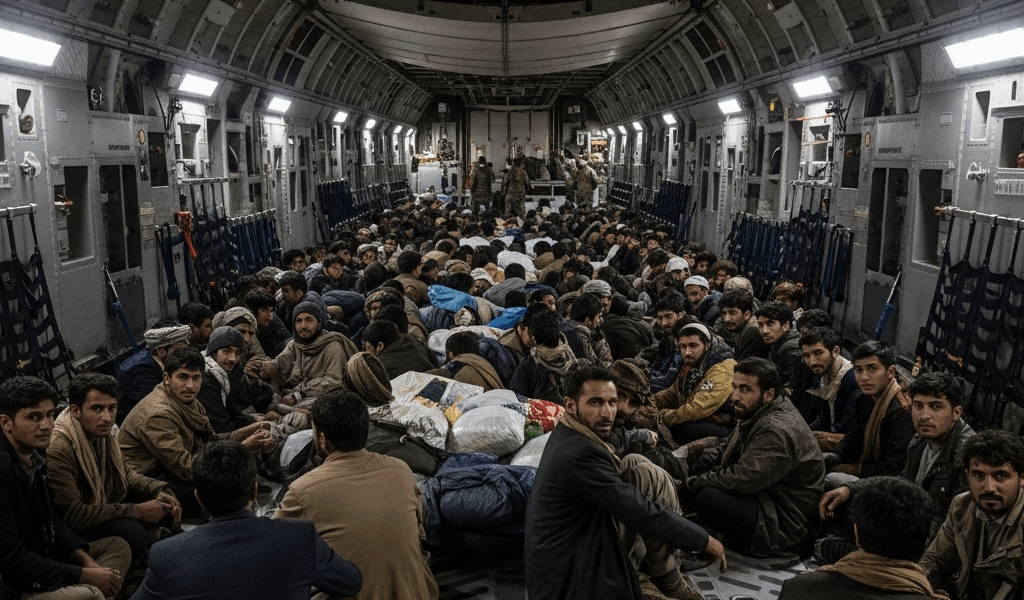
I remember exactly where I was when that photograph started circulating. A grainy overhead shot of a cargo bay so packed with Afghan evacuees the floor had disappeared entirely — human beings sitting shoulder to shoulder, knee to back, children folded into laps. The comment sections filled immediately with people who had never been within a hundred feet of a C-17 declaring the airplane was overloaded, the crew was reckless, physics had somehow been violated. It hadn’t. But explaining why takes more than a tweet.
The aircraft commander has been publicly identified as Maj. William “Will” Vose. His crew included a co-pilot, two loadmasters, and additional support personnel. When General Mike Minihan — at the time commanding Air Mobility Command — awarded the crew Distinguished Flying Crosses at Joint Base McGuire-Dix-Lakehurst, he described the flight as “the most souls ever carried on a single aircraft.” That’s a four-star general who has flown C-17s himself. He wasn’t being poetic.
Initial passenger count reported after landing: 640. Corrected figure, once investigators reviewed imagery and crew accounts and actually counted the 183 children who had been held in arms, tucked under legs, essentially invisible in the chaos: 823. Eight hundred and twenty-three people. On one jet.
The Decision at the Door — 400-Person Jet, 823 People
But what is the actual decision that happened at that aircraft door? In essence, it’s a professional judgment call under fire — literally, there was gunfire near the perimeter. But it’s much more than that.
Reporters keep framing this moment as spontaneous and emotion-driven. “The crew saw the crowd and couldn’t say no.” That framing is a disservice. What happened was a weight-critical operational judgment made by people with thousands of combined flight hours, made fast, with the security situation actively deteriorating around them. The math, if they worked it correctly, would hold. They knew that. They worked it.
The C-17’s standard troop carrier configuration holds approximately 102 passengers — seats installed, restraints in place. Aeromedical evacuation gets you to around 36 litter patients plus ambulatory. The cargo floor is roughly 88 feet long by 18 feet wide. On REACH 871, there were no pallets, no seats, no configuration at all. Just open floor and human beings streaming up the ramp.
The loadmaster owns the cargo bay. The aircraft commander flies the jet, but the loadmaster signs for the load, manages center of gravity, and calls the weights. When Afghans started boarding in numbers that made individual counting nearly impossible, the loadmaster had to run a calculation in real time — gross weight as boarding continued, CG position, floor structural load, ramp clearance. Nobody had a clipboard with 823 boxes to check. They were estimating, counting in groups, trusting professional judgment built over careers. That’s what airmanship actually looks like when it matters.
Weight and Balance — How a C-17 Even Takes Off Like That
Probably should have opened with this section, honestly. This is where the engineering reality lives and where most of the public confusion originates.
The C-17A Globemaster III has a maximum gross takeoff weight of 585,000 pounds. Maximum payload: 170,900 pounds. Those two numbers define the outside of the envelope. Now run the math. The U.S. military uses a standard average weight of 165 pounds per person for evacuation weight-and-balance calculations — sometimes heavier, to stay conservative. At 165 pounds, 823 people come to approximately 135,795 pounds. That’s inside the 170,900-pound payload limit. Add the operating empty weight — roughly 282,500 pounds — plus mission fuel, and total gross weight, while heavy, stays within certified limits.
That surprises people. The C-17 isn’t a 400-person airplane because of structural limits. It’s a 400-person airplane because of floor space, egress requirements, and the certification assumptions baked into how seated, restrained passengers distribute weight. Remove the seats. Remove the certification assumptions. Pack people on the floor. The weight distribution problem changes completely — but the structural limits don’t move.
Center of gravity is the more delicate issue — at least if you care about not losing control of the aircraft, which the crew did. A C-17’s CG must stay within roughly 16% to 35% mean aerodynamic chord for most flight conditions. With 823 people self-distributing across a cargo floor, getting an accurate CG estimate is genuinely hard. The loadmaster manages that actively — directing people forward or aft as boarding progresses, making a final call before giving the aircraft commander a thumbs-up.
They got the thumbs-up. The jet flew. The math held.
What Happens in the Cockpit During a Max Effort Takeoff
Hamid Karzai International Airport — HKIA — sits at 5,877 feet MSL. Density altitude on a hot August afternoon in Kabul could push effective performance altitude above 9,000 feet. That degrades engine thrust, increases takeoff roll distance, and raises V-speeds. Runway 29 at HKIA offers approximately 11,500 feet of usable surface. Sounds generous. At max gross weight in those conditions, it isn’t a comfortable margin.
V-speed calculations — V1, the decision speed above which you’re committed to fly; VR, rotation speed; V2, minimum safe climb speed — are not memorized. They come from performance charts or onboard mission planning systems and they shift with every significant weight change. At 585,000 pounds gross, those speeds are considerably higher than what crews see on typical missions. Higher V-speeds mean more runway consumed before liftoff. Less margin if an engine quits at V1.
The crew ran those numbers under time pressure. People were still boarding. The security situation was deteriorating outside the aircraft. “Calculating performance data while someone is actively shooting near your jet” isn’t in any training syllabus I’ve seen written down, but that was the environment. Don’t make my mistake of underestimating what that cognitive load actually feels like.
Frustrated by the instinct to force the aircraft off the ground prematurely, experienced C-17 pilots learn to hold rotation rate steady and let airspeed build on its own. The jet at max gross feels heavy in a way that’s almost tactile through the controls — sluggish pitch response, different climb gradient, no margin for aggressive technique. You resist the urge to chase a pitch attitude. The aircraft will fly. It will climb. At its own pace.
I’m apparently someone who notices that sensation immediately — that particular heaviness through the yoke — and sim time either prepares you for it or it doesn’t. For this crew, it did. The departure was textbook. HKIA’s terrain environment isn’t as demanding as Bagram, but at that gross weight, obstacle clearance occupies your thinking from the moment the wheels break ground. They worked the jet. It flew.
The Distinguished Flying Cross — Why This Crew, Why This Flight
The DFC has a specific meaning that’s worth explaining, because “distinguished” has gotten vague in an era where recognition is handed out freely. The Distinguished Flying Cross is awarded for heroism or extraordinary achievement in aerial flight. Same decoration Charles Lindbergh received. Same decoration awarded to the Doolittle Raid pilots. That was 1942. In the C-17 community specifically, a DFC is not a common occurrence.
General Minihan presented the awards at JB MDL — Joint Base McGuire-Dix-Lakehurst, home of the 621st Contingency Response Wing and AMC’s East Coast hub. The Air Force has been measured about how much individual profile it assigns to the crew members, which I think is appropriate. The mission was exceptional. The crew would probably say they were doing their jobs. Both things are true.
The 183-child correction to the passenger count deserves its own moment. The initial figure of 640 came almost immediately after landing. Getting to 823 required reviewing imagery, manifests, and crew accounts — and then counting infants carried in arms, children tucked into the crowd, individuals who were simply invisible in the chaos at boarding. The loadmaster’s head count before departure was a genuine best effort under impossible conditions. 823 is the correct number. The children were always on board. They just weren’t countable in the moment.
That distinction matters — not because 640 versus 823 changes the essential story, but because it illustrates the operational reality precisely. In evacuation conditions, precision is an aspiration. You manage the weight on estimated figures, confirm the load is flyable, and go. The exact count comes later. That’s how real operations work, and anyone who thinks otherwise has never worked a ramp under fire.
What This Mission Says About Air Mobility Command
Operation Allies Refuge — later renamed Allies Welcome — extracted approximately 124,334 people from Afghanistan between August 14th and 30th, 2021. The Air Force flew somewhere around 387 C-17 missions during that window. REACH 871 was one flight. One famous flight, one famous photograph, one crew who became the face of the airlift — but one among hundreds.
The crews flying those missions were operating under crew rest waivers. Normal AMC requirements mandate a minimum rest period before flight — typically 8 hours crew rest before a 12-hour duty day for airlift crews. During the Kabul airlift, those standards were waived repeatedly by commanders exercising contingency authority. The mission demanded it. Commanders made the call. Crews flew. That’s the Air Force — at least if you’re being honest about how surge operations actually function.
What that means practically: the people flying REACH 871 and the other 386 sorties were fatigued. Not in ways the system flagged as dangerous, but working at the edge of what sustained airlift demands from human beings. Loadmasters managed cargo bays that looked nothing like their training. Crew chiefs turned aircraft in conditions that would’ve been unacceptable at any peacetime base. Aeromedical crews received patients in configurations nobody had rehearsed. Everyone improvised within their professional competence — which is simultaneously the miracle of the airlift and what makes it brutal to execute.
Air Mobility Command’s motto is “Rapid Global Mobility.” It’s on the patches, the squadron t-shirts, the wing-level commanders call slides. REACH 871 is what that motto looks like when it stops being a motto and becomes an actual requirement at 0200 local time with gunfire audible from the ramp.
That’s what makes this crew endearing to us in the airlift community. They didn’t set out to carry 823 people. They set out to evacuate as many people as the jet could safely carry — made the judgment that 823 was within that number — and flew. The photograph made them famous. The judgment call made them deserving of it.
There’s a lesson I took too long to fully internalize in my own flying. The limitation on a C-17 mission is almost never the airplane. The airplane is extraordinary. The limitation is usually information, time, and the courage to trust your training when the situation stops resembling anything you’ve practiced. The crew of REACH 871 had the information, used the time available, and trusted sixteen years of collective C-17 experience. Eight hundred and twenty-three people landed safely because of it.

Stay in the loop
Get the latest milpilot updates delivered to your inbox.