The Short Answer Most Sites Won’t Give You
Becoming a military pilot has gotten complicated with all the misinformation flying around. So let me give you the number nobody leads with: roughly one in ten people who start this process actually finish it. Ten percent. From serious, qualified candidate to wings on chest.
As someone who spent six years deep in military aviation pipelines — interviewing washouts, active pilots, and actual selection board members — I learned everything there is to know about this brutal filtering system. What struck me most was how openly people talked once you got them going. Everyone knows fighter pilot slots are competitive. What nobody tells you is exactly where you’ll get cut.
Today, I will share it all with you.
There are four gates. Medical qualification. Test scores and academics. Slot selection — where boards reject 80-plus percent of applicants. And then the training pipeline itself, where another 5-10 percent wash out even after earning a spot. Most articles just list requirements. This one gives you the actual odds at each stage. So, without further ado, let’s dive in.
Medical Standards — Where Most Candidates Wash Out First
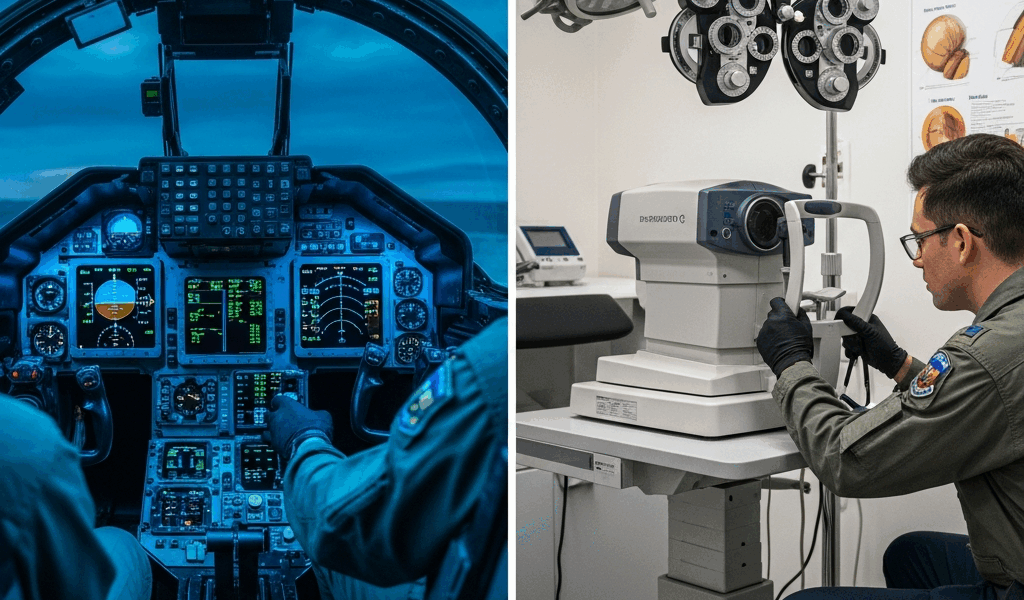
Probably should have opened with this section, honestly. The military flight physical catches people before they ever fill out a commissioning application — and it’s not because the doctors enjoy washing people out. The standards exist because you’re handling G-forces, oxygen deprivation, and spatial disorientation at 35,000 feet. An arrhythmia up there isn’t a medical incident. It’s a crash.
Here’s what they’re testing:
- Vision — uncorrected vision must be correctable to 20/20. Anything beyond roughly -8.00 diopters without a waiver and you’re done before you start. This is the one that catches people earliest.
- Color vision — you must pass the Ishihara plates. Red-green color blindness disqualifies you outright. No waiver. Not negotiable. Full stop.
- Hearing — must meet military standards across all frequencies. Mild loss sometimes gets a waiver. Significant loss doesn’t.
- Cardiovascular — stress test, EKG, full workup. Any arrhythmia, valve irregularity, or family history of sudden cardiac death triggers a full investigation.
- Orthopedic — spine, joints, range of motion. You need to survive an ejection. That’s the standard they’re measuring against.
About 8-12 percent of candidates fail the initial flight physical entirely — before any competitive evaluation happens. That’s the first filter, and it’s purely medical.
The LASIK question. I’m apparently sensitive to how often this comes up, and honestly, the answer is simpler than forums make it sound. The Air Force cleared LASIK and PRK back in the late 1990s. You need to be 3-plus months post-op, show stable vision for 90 days, and document everything meticulously. I know three pilots personally who had LASIK before selection — all three passed their physicals cleanly. Don’t make my mistake of assuming it’s automatically disqualifying.
Waivers exist for almost everything except color blindness and structural heart defects. But here’s the part that kills timelines: a waiver means medical documentation, letters from civilian specialists, and a formal request to the Air Force Medical board — and that process runs 4-6 months minimum. Budget for it early or watch your application cycle slip.
Test Scores and Academic Requirements That Actually Matter
But what is the AFOQT? In essence, it’s a standardized Officer Qualifying Test with a specific pilot subsection scored out of 99. But it’s much more than that — it’s the first number a selection board sees when your file lands on their desk.
Each branch runs its own exam. Here’s the breakdown:
Air Force: AFOQT pilot section. Official minimum sits around 25-30 depending on the board cycle. That is, genuinely, a failing score in competitive terms. Sixty-plus is where you become viable. Eighty-plus puts you in serious contention.
Navy and Marines: The ASTB-E. Pilots typically need a Flight Officer Score around 4 or 5 on a 1-9 scale. Meeting the floor is not the same as being competitive. Not even close.
Army: The SIFT — Selection Instrument for Flight Training. Minimum is 40. Competitive starts around 60.
Here’s what most candidates completely miss. Official minimums are not selection-board scores. A 30 on the AFOQT pilot section won’t get you selected at a competitive ROTC school or an OTS board. You’re not just clearing a bar — you’re beating 300 other people who already cleared the same bar. That’s a different exercise entirely.
GPA follows the same logic. Minimums hover around 2.0-2.5 on paper. Competitive is 3.0. At selective ROTC programs and OTS boards, average GPAs run 3.2-3.4 — and those applicants chose hard majors. You’re not competing against minimums. You’re competing against people who took Thermodynamics and kept a 3.3.
Here’s the practical breakdown:
- ROTC candidates: 3.0-plus GPA, AFOQT pilot section at 70 or above, vision-qualified, clean disciplinary record, and PFT scores that aren’t just passing.
- OTS/OCS candidates: 3.0-plus GPA, equivalent test scores, and 5-plus years of professional experience demonstrating actual leadership — not just job titles.
- Enlisted-to-officer path: More flexibility on GPA if you’re coming from service, but test scores are equally unforgiving because you’re still competing against ROTC graduates.
I spoke with four pilots who each prepared for the AFOQT for 3-4 months — prep books, practice tests, monthly scoring sessions to track progress. They scored 75-88. Candidates who crammed for two weeks? Forty-five to sixty. It’s not complicated. It’s just prep versus wishful thinking.
Getting a Pilot Slot — The Most Overlooked Obstacle
You passed medical. You scored an 82 on the AFOQT. Your GPA is 3.2. You’re fit and motivated and ready to apply. You will probably not get selected. That’s not pessimism — that’s the math.
ROTC pilot slot selection runs around 15-20 percent. OTS pilot selection is worse — sometimes 8-12 percent. That means 85-92 percent of fully qualified applicants get rejected. Not because they failed. Because there aren’t enough slots.
That’s what makes the selection process so quietly brutal to us candidates who’ve done everything right. The board doesn’t reward meeting the standard. It rewards being in the top 15 percent of 300 people who all met the standard. Every slot someone else earns is one you don’t.
Selection boards evaluate:
- Test scores — already covered, but they matter more than most applicants admit
- Academic record, with visible preference for STEM and difficult majors
- Physical Fitness Test score — top tier, not just passing
- Officer Fitness Reports or supervisor evaluations for enlisted and OCS applicants
- Interview performance and specific, credible motivation for particular airframes
- Diversity background — the military is actively recruiting women and underrepresented groups into pilot pipelines right now
National Guard and Reserve routes run different boards with different applicant pools — sometimes dramatically better odds for specific states or squadrons. A friend of mine got rejected at two active-duty boards. Applied to a Guard squadron 40 miles from his apartment. Selected on the first attempt. Same credentials. Different pool. Don’t sleep on that path.
Surviving Undergraduate Pilot Training
You got selected. Top 15-20 percent nationwide. Congratulations — now you’re entering a pipeline where 5-15 percent of students wash out depending on the track and the year. UPT runs about 52 weeks. You’ll log 200-plus flight hours and spend another 800-plus hours in classrooms and self-study. Evaluation is constant.
Washout phases break down like this:
- Contact flying phase: T-6 Texan II trainer. Basic stick-and-rudder fundamentals. Roughly 40 hours. Washout rate here is relatively low — around 2-3 percent — because spatial disorientation screening happens early and fast.
- Instrument phase: Flying by instruments alone, in degraded conditions, with simulated system failures. Approximately 30 hours. Higher washout rate, around 3-4 percent. Instrument flying breaks people — it’s pure cognitive load under sustained stress, and some people’s brains genuinely don’t process it quickly enough under those conditions.
- Advanced phase: T-1 Jayhawk or T-38 Talon, depending on track. Formation flying, complex navigation, advanced procedures. Sixty-plus hours. This is where serious filtering happens — another 3-5 percent wash out here.
- Leadership evaluations: Running the entire time, quietly. Instructors score judgment, maturity, and professional behavior continuously. Washing out in this category typically means unsafe or unprofessional conduct — not skill deficiency.
People wash out because they freeze under G-forces. Because they can’t build muscle memory fast enough inside the training window. Because they get an ear infection at week 14, fall behind two sorties, and never fully recover. Because the stress load reveals something about their emotional readiness that no written test could catch. Because an instructor logs that they’re not safe — and that log entry doesn’t disappear.
There’s no grade inflation here. An instructor sees you struggling, documents it. You get additional training sorties. You improve or you get a down-check. Two down-checks on the same maneuver and you’re washed out. It’s that clean.
One more thing: graduating UPT doesn’t guarantee fighters. Candidates earn their wings and get assigned to tankers, transports, or helicopters based on the military’s needs — not personal preference. That’s not a failure. That’s the deal you accepted when you took the slot.
The Realistic Path Forward
One in ten. That’s the number you’re working with, from “I want to fly” to wings on your chest.
The people who actually make it tend to over-prepare at every single gate. They study for six months for one test. They get redundant letters of recommendation from people who know them in operational contexts. They train PFT performance like they’re competing — not just clearing a threshold. They start the medical waiver process six months early because they already read that it takes 4-6 months. They understand the difference between being qualified and being selected, and they build their files around that distinction.
It’s hard. It is genuinely, statistically hard. But people clear these gates every year — and they do it by knowing exactly what’s coming before it arrives. Now you do too.



Stay in the loop
Get the latest milpilot updates delivered to your inbox.