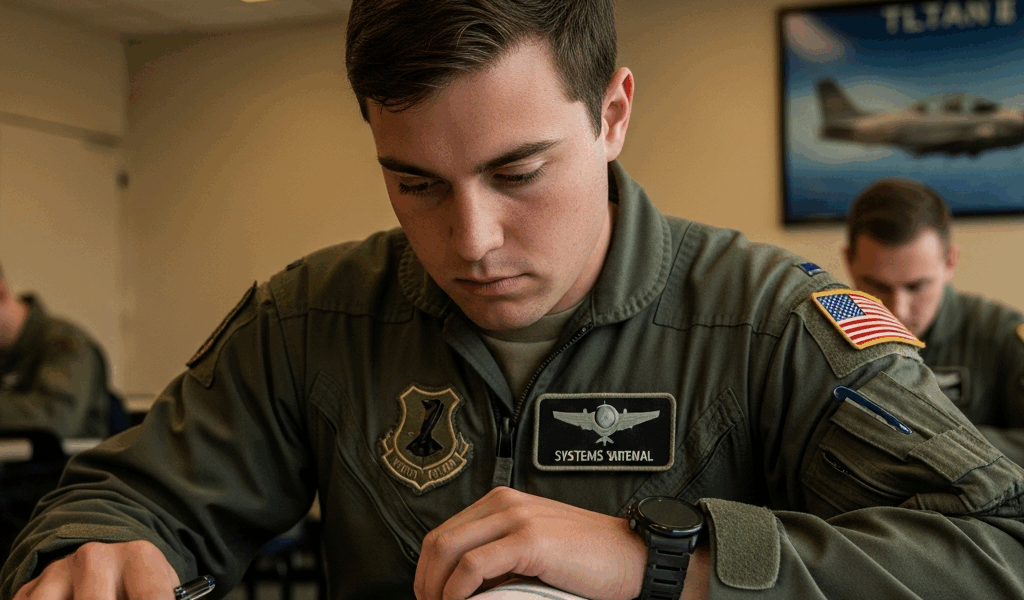
There is no defensible single “military pilot washout rate.”
The services run different programs, define attrition differently and rarely publish current cohort-level results in a form that supports an apples-to-apples comparison. A percentage can include or exclude:
- academic or flight-performance elimination;
- medical disqualification;
- voluntary withdrawal;
- transfer into another aviation track;
- delay or setback followed by completion;
- attrition during civilian screening;
- international students; and
- students still in training when the report closes.
The most responsible current answer is:
- Navy Medicine says approximately 15–20% of naval flight students attrite from aviation training each year.
- The Air Force does not publish a comparable current annual, service-wide UPT attrition rate in the public sources reviewed for this article.
- The Army does not publish a comparable current annual WOFT/flight-school attrition rate in the public sources reviewed.
- Historical Air Force and program-specific Navy figures exist, but they cannot be presented as a 2026 prediction.
That answer is less dramatic than an uncited “three out of four fail” claim. It is also more useful.
What current official sources support
| Service or program | Public figure | What it means |
|---|---|---|
| Navy/Marine naval flight training | Approximately 15–20% annual attrition | Navy Medicine’s current ASTB FAQ describes naval flight students broadly; it does not promise the same rate for every pipeline |
| Air Force UPT/Future UPT | No current service-wide rate located | AETC publishes production, curriculum and graduation information, but the reviewed public releases do not give a complete entry-and-attrition denominator |
| Army flight training | No current service-wide rate located | Army sources describe eligibility and training, but the reviewed public material does not provide a current cohort completion rate |
| Navy Contract Operated Pilot Training–Rotary trial | Zero attrition among the first 80 students reported | A small, specific program result—not the Navy-wide washout rate |
| Navy strike intermediate/advanced, FY2019 | 8% attrition at Training Air Wing One | A dated result for specific phases and one wing, not all naval flight training |
“No public rate located” does not mean nobody inside the service tracks attrition. It means a public article should not invent a number or reverse-engineer one from unrelated pilot-production totals.
Why common washout statistics conflict
Different starting points
One source may start counting when candidates receive pilot slots. Another may start at civilian flight screening, military academics, the first aircraft phase or an advanced track.
If 100 candidates enter an initial screening program, 95 reach military primary training and 90 eventually earn wings, then:
- attrition from initial screening to wings is 10%;
- attrition after reaching military primary is about 5.3%; and
- screening attrition alone is 5%.
All three calculations can be accurate while describing different questions.
Different endpoints
“Earned wings,” “completed UPT,” “qualified in an operational aircraft” and “arrived mission-ready at a squadron” are not interchangeable endpoints.
Future Undergraduate Pilot Training has also changed the Air Force winging point for some cohorts. A student can receive wings after T-6 training and then continue through advanced jet or aircraft-specific training. Comparing that cohort with an older syllabus that awarded wings after an advanced phase creates a false equivalence.
Different reasons for leaving
Attrition can result from:
- flying performance;
- academics;
- medical findings;
- conduct or administrative action;
- self-initiated elimination;
- loss of motivation;
- transfer to another aviation program; or
- other service-specific categories.
An article that labels all of those people “unable to fly” misrepresents the data.
Different years and syllabi
Weather, aircraft availability, instructor staffing, selection standards and training design change. So do the T-6, T-38, T-1 and civilian-training roles.
A percentage from 1950, 1988 or 2019 can describe history. It cannot be silently relabeled “the 2026 rate.”
Air Force UPT washout rate
No current Air Force dataset reviewed for this guide supports a modern service-wide 4–8% attrition range or a corresponding 92–96% completion range.
AETC’s current public reporting emphasizes pilot production and transformation:
- Future UPT incorporates contracted civilian Initial Pilot Training.
- The military phase uses the T-6A for military competencies.
- Fighter/bomber students continue into advanced jet preparation.
- Other pilots proceed toward aircraft-specific training.
- AETC has stated a goal of producing 1,500 pilots annually.
Production is not completion rate. For example, saying a base graduated 300 pilots does not reveal whether 310, 340 or 500 entered the relevant cohort. It also does not show medical, voluntary or performance losses separately.
Historical Air Force figures
Official Air Force historical studies demonstrate why an undated rate is dangerous:
- Air Force training history reports total pilot-training attrition of 36.6% in FY1960.
- That source shows the rate declining to 15.7% by FY1965 as the accession and training system changed.
- A 1990 GAO report said Air Force Academy graduate attrition from UPT was 18% during FY1979–1988, compared with 24% for total Air Force pilot-training attrition.
Those figures are legitimate historical evidence. They do not establish today’s rate under PCSM screening, modern medical qualification, UPT 2.5 or Future UPT.
What can be said today
Air Force candidates should assume the training standard is demanding without converting an unsupported percentage into personal odds.
The best current questions are:
- Which training syllabus and start point does a statistic cover?
- Does it include civilian Initial Pilot Training?
- Does “graduate” mean wings, advanced training or Formal Training Unit completion?
- Are medical and voluntary losses included?
- What fiscal year and bases are represented?
Unless a source answers those questions and provides both entries and outcomes, it is not a current UPT washout rate.
Navy and Marine Corps flight-training attrition
Navy Medicine’s Aviation Selection Test Battery FAQ says approximately 15–20% of naval flight students attrite from aviation training each year. It explains that ASTB-E scores predict aviation-training outcomes and that improved selection reduces costly attrition.
This is the strongest current, public, service-origin estimate found for the article. It still has limits:
- “naval flight students” can encompass more than one service and pipeline.
- The statement does not separate pilots from Naval Flight Officers.
- It does not break out academic, flight, medical or voluntary attrition.
- It does not provide a fiscal-year cohort table.
- Strike, rotary, maritime, tilt-rotor, E-2/C-2 and E-6 pipelines differ.
Program-level figures illustrate the variation.
Training Air Wing One reports that its strike intermediate and advanced phases had a combined 8% attrition rate in FY2019. Of those who did not finish that program, 55% transferred to helicopter or maritime communities and performed successfully. In that context, “attrition” from strike did not always mean leaving naval aviation.
A Navy Reserve article reported zero attrition among the first 80 students in the Contract Operated Pilot Training–Rotary program. That is a useful trial result, but it cannot replace the Navy-wide 15–20% estimate.
The Navy’s modern Naval Introductory Flight Evaluation program was explicitly designed to identify problems earlier, decrease later attrition and improve performance. That makes pre-NIFE rates poor predictors of a current student’s experience.
Army flight-school washout rate
Current Army public pages describe the route through selection, Warrant Officer Candidate School, medical qualification and flight training. They do not provide a current service-wide entry cohort and graduation table that supports a WOFT washout percentage.
There is likewise no public basis for claiming Army candidates complete training at a higher rate than Air Force or Navy students.
Army aviation includes commissioned and warrant-officer paths, multiple components and rotary- and fixed-wing assignments. A useful Army statistic would need to state:
- whether WOCS attrition is included;
- whether the cohort begins before or after Class 1 medical qualification;
- which flight syllabus and fiscal years are covered;
- whether setbacks count as attrition; and
- whether the result combines active Army, Army Reserve and National Guard.
Without that information, a confident Army percentage is speculation.
What counts as washing out?
“Washout” is informal language. Official processes use more precise terms such as elimination, attrition, disenrollment, disqualification, withdrawal or transfer.
Performance elimination
A student does not meet the academic, simulator or flight standard after the remediation and review available under the applicable syllabus.
There is no universal rule that one missed memory item or a fixed number of checkride failures automatically ends training across every base and service. Actual triggers, additional-training authority and review procedures belong to the current course instruction.
Medical disqualification
A student develops or is found to have a medical condition incompatible with the applicable aviation standard. The result can be temporary grounding, evaluation, treatment, waiver review, redesignation or permanent disqualification.
Medical removal is not proof of poor performance.
Voluntary withdrawal
A student may request to leave training. The administrative and service consequences depend on component, commissioning source, contract and current personnel policy.
Do not assume voluntary withdrawal means immediate separation from military service.
Administrative or conduct elimination
Integrity, misconduct, failure to maintain military standards or other administrative issues can end training independently of flying skill.
Transfer or reclassification
Leaving one track does not always mean leaving aviation. The Navy FY2019 strike example explicitly documents transfers to other aviation communities. Air Force and Army outcomes depend on the governing training and personnel process.
Where attrition occurs
No current public dataset supports a universal claim that a fixed percentage of washouts happens in one phase.
Conceptually, exposure points include:
- initial civilian or military screening;
- academics and physiology;
- primary aircraft training;
- advanced or track-specific training;
- medical evaluation;
- aircraft-specific Formal Training Units; and
- administrative transitions.
Early phases can reveal basic aptitude, adaptation or medical issues. Later phases introduce more complex competencies. That does not justify assigning invented rates such as “60–70% of all washouts occur in T-6” without a cohort dataset.
How to evaluate a washout-rate claim
Before trusting a percentage, ask:
- Who published it? Prefer the service, GAO, RAND or a documented research institution.
- What dates does it cover? A current webpage can reproduce a decades-old statistic.
- What is the numerator? Performance eliminations only, or every departure?
- What is the denominator? Applicants, selected candidates, training entrants or students reaching a specific phase?
- Which endpoint is used? Wings, track completion or operational qualification?
- Which program? Air Force, Navy strike, Army WOFT and Coast Guard training are not one pipeline.
- Are transfers counted as failures? They may remain military aviators.
- Were students still in training excluded or incorrectly counted?
If the source cannot answer those questions, do not use its percentage to make a career decision.
What the data means for applicants
The absence of one precise rate does not mean preparation is unknowable.
Candidates can reduce avoidable risk by:
- arriving medically and administratively ready;
- building disciplined study and sleep routines;
- using authorized course material;
- chair-flying and preparing for simulator or flight events;
- applying instructor feedback quickly;
- maintaining fitness without overtraining injuries;
- asking for help before a deficiency compounds; and
- avoiding copied procedures or obsolete “gouge.”
Civilian flight experience can improve familiarity and affect selection scores in some programs. It does not guarantee military-training completion, and candidates should not take on unsustainable debt to chase an unsupported success-rate claim.
What happens after elimination?
The outcome depends on:
- service and component;
- commissioning source and contract;
- reason for elimination;
- point in training;
- medical status;
- available reclassification options;
- personnel needs; and
- any appeal or review rights in the applicable instruction.
Possible outcomes include return to training, transfer to another aviation pipeline, reassignment to another career field, continued service in a different capacity or separation. None is automatic across all services.
For current Air Force administrative and career outcomes, see What Happens If You Wash Out of UPT.
Frequently asked questions
Do 75% of military pilot students wash out?
No current official evidence supports that as a universal rate. Historical Air Force attrition varied substantially, and current programs use different screening and training models.
What is the Air Force UPT washout rate?
The reviewed public Air Force sources do not provide a current service-wide rate with a complete cohort denominator. Claims of 4–8%, 15% or 30% should be dated and sourced before use.
What is the Navy pilot-training washout rate?
Navy Medicine says approximately 15–20% of naval flight students attrite annually. Individual pipelines and phases can differ, and the estimate is broader than Student Naval Aviators in one track.
What is the Army flight-school washout rate?
No current service-wide cohort rate was found in the official Army sources reviewed. Do not substitute a forum estimate.
Is changing aviation tracks a washout?
It can count as attrition from the original track while the student remains in aviation. A statistic must disclose how transfers are classified.
Does one failed checkride end pilot training?
Not under one universal military rule. The current syllabus and service instruction define unsatisfactory events, remediation, progress checks and elimination review.
Are medical disqualifications counted?
Sometimes. A source must define whether medical, voluntary, administrative and performance losses are combined.
Related MilPilot guides
- Air Force Pilot Training Washout Rate
- What Happens If You Wash Out of UPT
- How Air Force Pilot Training Works Now
- How Long Military Pilot Training Takes
- Military Pilot Vision Requirements
Why do fighter pilot candidates wash out more often early in training?
Public data do not establish that every fighter candidate washes out at one predictable rate. Early training does create a sharp transition: students must absorb procedures, radio work, instrument skills and graded flying while adapting to a military syllabus. Attrition figures also become misleading when selection out of a fighter track is described as a training washout. A student who continues to another aircraft pipeline has not necessarily been eliminated from pilot training.
For the Air Force-specific policy and evidence, see our Air Force pilot training washout-rate analysis.

Stay in the loop
Get the latest milpilot updates delivered to your inbox.