What a Training Pipeline Actually Means
Military pilot training pipelines have gotten complicated with all the conflicting information flying around — outdated blog posts, veteran forums, and recruiter briefings that don’t always match reality. As someone who’s spent years around flight programs and talked to hundreds of candidates, instructors, and washouts, I learned everything there is to know about how these pipelines actually function. Today, I will share it all with you.
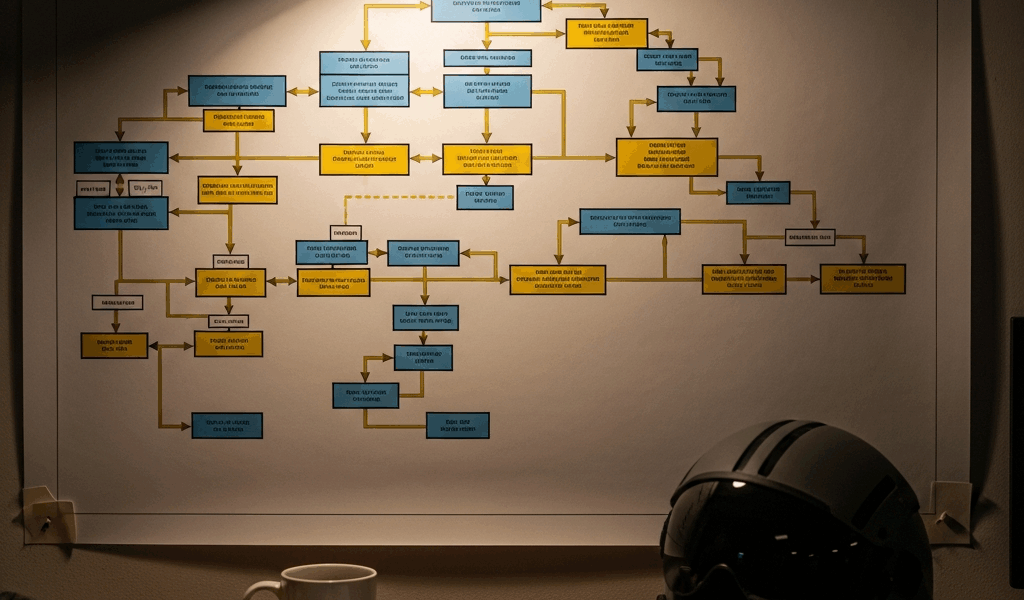
But what is a training pipeline? In essence, it’s a series of sequential phases, each with its own performance gates, where failing phase two looks nothing like failing phase five. But it’s much more than that. It’s a deliberate selection architecture — not just a teaching curriculum.
Most candidates show up expecting something linear. You keep attending, you gradually improve, you get wings. That’s not how this works. Each phase tests something specific. Pass the test, move forward. Fail it, and you’re out — or recycled, which is its own complicated category. The Air Force knows it can’t train everyone who shows up. The Navy knows this too. So they build gates into the pipeline that force a binary decision: this person advances, or they don’t.
Think of the pipeline as a funnel with teeth. The funnel narrows as you go deeper. The teeth are the gates. They’re selection points, designed to filter, not just teach. That’s what makes the pipeline endearing to us aviation nerds — it’s brutally honest in a way most institutional systems aren’t.
The architecture matters because washout rates aren’t uniform. Early phases carry higher attrition — candidates are still being screened for raw aptitude. By advanced phases, you’re dealing with a smaller, already-filtered population, and the gates are higher. A check ride failure in primary is common. The same failure in advanced training is rare. It usually means something went seriously wrong. Reading a pipeline means understanding not just what each phase teaches, but what it demands and who gets removed when. That’s the actual map. So, without further ado, let’s dive in.
Air Force Pipeline From IFS to Wings
Probably should have opened with this section, honestly, because it’s the one people ask about most. The Air Force pipeline has changed shape considerably over the last few years. Post-UPT 2.5, the structure is cleaner than it used to be, and knowing the current layout keeps you from wasting time on obsolete sources.
Initial Flight Screening at Pueblo
Before SUPT — Specialized Undergraduate Pilot Training — comes IFS. Initial Flight Screening runs out of Pueblo Memorial Airport in Colorado. It’s the real first gate. You’re flying a Cirrus SR20, a civilian glass-cockpit trainer, for roughly 45 hours. This isn’t a traditional check ride in the military sense. It’s a pass-fail evaluation of whether you can handle basic flying tasks without endangering yourself or your instructor.
The Air Force contracts civilian flight schools to run IFS. You’ll log time in basic airwork, instrument fundamentals, and cross-country navigation. Attrition here is real — somewhere between 15 and 25 percent wash out or DOR (drop on request, which is voluntary). Most failures cluster around the instrument portion. Instrument flying demands a specific scan discipline: airspeed, altitude, heading, vertical speed, in rhythm. Miss the rhythm and the whole scan collapses.
Candidates who finish IFS arrive at SUPT with a meaningful edge. They’ve already proven they can fly. The rest of the pipeline simply assumes basic airmanship from that point forward.
SUPT Primary — The T-6 Texan II
Primary is the longest single phase. You’re flying the Beechcraft T-6 Texan II — a turboprop trainer that runs somewhere around $35 million per airframe in operational terms. You’ll log approximately 110 hours across multiple bases, though assignments vary depending on Air Education and Training Command scheduling at any given moment.
Primary teaches you to actually fly — not just stay airborne, but handle the aircraft with precision under real pressure. Formation flying, aerobatics, instrument approaches. Check rides are high-stakes: an instructor pilot evaluates you on a specific sequence of maneuvers, and you perform them to standard or you don’t advance. Simple as that.
Washout rates in primary typically run five to ten percent. That sounds low until you remember it’s already a filtered population. IFS removed the candidates who couldn’t handle basic flying. Primary removes people who can fly adequately in calm conditions but fall apart under pressure — or whose stick-and-rudder skills simply plateau and stop developing.
Track Select — The Highest Gate
After primary comes track select. Fighter/attack track or airlift/tanker track. This is the highest-stakes internal gate in the entire Air Force pipeline — it determines your career path permanently. There’s no going back and re-selecting later.
Fighter slots go to the top 20 to 30 percent of the class, by ranking. Bottom half of your class? You’re not flying fighters, regardless of preference. This is how the Air Force optimizes inventory. The best-performing pilots go to the highest-demand platforms. That’s the system and it isn’t changing.
I’m apparently someone who’s watched a lot of talented pilots miss fighter track — and poor class-ranking strategy works against candidates while strong early performance almost always pays off. Don’t make my mistake of assuming late-primary performance carries more weight than cumulative ranking. Your track is usually locked in by your final primary check ride. By that point, the math is already done.
Advanced Training — T-38 or T-1
Fighter track gets the T-38 Talon — twin-engine, supersonic, unforgiving. You’ll log roughly 90 hours and learn high-altitude instrument flying, basic tactical formation, and emergency procedures specific to jet operations. Airlift track gets the Beechcraft T-1 Jayhawk, a twin turboprop that mirrors airlift aircraft handling characteristics closely enough to matter.
Advanced phases run about six months. The gates are real. Standard is higher because you’re supposed to be approaching wings qualification. Washouts in advanced are rarer — maybe three to five percent — but they happen. Usually it’s a combination: an instructor frustrated with stagnant progress, a candidate who never recovered psychologically from a bad ride, someone whose instrument fundamentals never fully solidified back in primary.
After advanced, you earn your wings and move directly into initial qualification training on your specific operational airframe.
Navy and Marine Corps Pipeline From API to Wings
Navy and Marine pilots follow a different route entirely. The structure reveals different institutional priorities. The Navy manages more aircraft types than the Air Force and assigns based on both performance ranking and current inventory needs — which means the system has more variables in play at any given time.
Aviation Preflight Indoctrination at Pensacola
API is where everyone starts. Naval Air Station Pensacola, Florida. You’re learning military aviation culture, basic aerodynamics, and emergency procedures. Some light flight simulator work, but mostly classroom instruction and physical conditioning. API runs about four weeks. Pass-fail, and it filters for baseline aptitude and mental toughness. Washout rate is low — maybe five percent — because the Navy has already screened candidates through OCC or the Academy before they arrive.
API is a gate, but a relatively soft one. The harder gates come later. That’s by design.
Primary at Whiting Field
Primary flight training runs at Naval Air Station Whiting Field, also in Florida. You’re flying the T-34C Turbomentor — a single-engine trainer that’s older than most of its student pilots but still genuinely effective. Primary covers roughly six months and 70 to 80 flight hours: basic airwork, navigation, formation flying, the fundamentals.
This is where washout risk jumps sharply. The check rides here are graded by instructor pilots with actual combat sorties behind them. Their standard reflects that experience. Washout rates run eight to fifteen percent, sometimes higher depending on the training year.
Frustrated by unexpected check ride failures, some candidates finally learned to trust their training using specific procedures from boldface cards — laminated references for emergency procedures you memorize verbatim. The ones who succeed in primary are the ones who trust the system and stop second-guessing their instrument scans. That’s what makes Whiting Field so effective as a filter. It’s not looking for natural talent alone. It’s looking for disciplined execution under pressure.
Advanced Training and Platform Selection
After primary, advanced training is where platform selection happens. The Navy’s options are broader than the Air Force’s: fighters (F/A-18 Super Hornet), electronic warfare (EA-18G Growler), maritime patrol (P-8 Poseidon), helicopters across multiple variants, and transport aircraft. Your primary performance ranking determines which tracks are available to you — but so does current Navy manning by platform, which introduces a variable outside your control.
Fighters and electronic warfare get the most-qualified pilots. Maritime patrol and rotary-wing get the next tier. A bottom-half primary student isn’t getting Super Hornets unless the Navy faces acute fighter manning shortages — which happens, but you shouldn’t plan around it.
Advanced phases vary by platform: roughly four to five months. Fighter students go through advanced fighter maneuvers training. Maritime students learn patrol procedures. Helicopter students get dedicated rotary-wing systems training. By the time you reach advanced, you already know which track you’re on. That creates different psychological pressure than the Air Force model — you’re no longer competing for selection. You’re just trying to finish.
Army Rotary Pipeline From WOFT to Wings
The Army pipeline is smaller and tighter. All rotary-wing. Either you’re training for helicopter operations or you’re somewhere else entirely. WOFT — Warrant Officer Flight Training — is the entry point for most Army pilots, though some come through OCC as commissioned officers.
WOFT Training at Fort Novosel
Fort Novosel, Alabama. That’s where it all happens. WOFT runs roughly 40 weeks. Ground school first, then primary and advanced phases. You’ll fly Bell TH-67 Creek helicopters in primary — then transition to the aircraft you’ll actually operate in the field. UH-60 Black Hawk, AH-64 Apache, or UH-72 Lakota, depending on your assignment slot.
The washout structure is tighter here because the Army is training a smaller population for a very specific mission set. Your check rides are on equipment you’ll actually use in theater. There’s no abstraction layer — no trainer-to-operational transition gap like you see in the Air Force pipeline. What you fly in training is, broadly, what you’ll fly downrange.
Instrument training happens over roughly 80 hours of flight time. This is where the Army sees most of its washouts. Same root problem as the other services — instrument scan discipline. Managing rotor rpm, manifold pressure, airspeed, altitude, and heading simultaneously while also managing trim in a helicopter. It’s cognitively demanding in a way that surprises candidates who performed well in earlier phases.
Where Pilots Actually Wash Out and Why
Highest-risk phases differ by service, but the failure modes overlap. Air Force: IFS is the first major gate, roughly 20 percent don’t pass. Navy: primary at Whiting Field, around 12 to 15 percent attrition. Army: the instrument phase, typically eight to twelve percent. Different pipelines, same weak point.
The common thread is instrument flying. Full stop. Instrument flying requires you to discard visual cues and trust your gauges completely. Some candidates can’t do it — not permanently, but they can’t do it when it counts. They develop instrument vertigo or scan fixation. They lock onto one instrument, usually altitude or airspeed, and stop cross-checking. The aircraft drifts out of tolerance. They don’t catch it in time. That’s the failure pattern, repeated across all three services at slightly different phases.
Check ride pressure changes things too. Some candidates fly well on normal training sorties and fall apart during formal evaluations. There’s an examiner watching, grading, writing things down. That changes how the brain performs under stress. It’s not weakness — it’s a real mismatch between performance under practice conditions versus structured evaluation. The pipeline tests for both, which is exactly the point.
Boldface procedure failures are automatic washouts. You’re required to memorize specific emergency procedures verbatim from laminated cards. Miss a step, perform them out of sequence during a check ride, and you fail. The procedures are sequenced deliberately — they’re designed to keep you alive in a real emergency. Deviation during evaluation is unacceptable because deviation during an actual emergency is fatal.
Platform-specific failures show up later. Fighter pilots wash out for poor stick-and-rudder precision, insufficient aggression in the pattern, or poor decision-making under time pressure. Transport pilots wash out for instrument issues or spatial disorientation problems. Helicopter pilots wash out for reasons similar to fixed-wing pilots — but they arrive at those problems differently. Rotary-wing demands a feel for the aircraft that’s genuinely distinct from fixed-wing airmanship.
Understanding where the gates are and why they exist tells you something important: this system is designed to catch the right people at the right time. It isn’t designed to be comfortable. The washout phases aren’t system failures. They are the system working exactly as designed — and that’s what makes the wings on the other side mean something.


Stay in the loop
Get the latest milpilot updates delivered to your inbox.