Military Pilot Vision Requirements — What Each Branch Actually Requires
Military pilot vision requirements are the single most common reason I watched qualified, motivated candidates wash out before they ever touched a flight simulator. I spent several years working alongside flight surgeons at a naval air station, processing flight physicals and watching the look on applicants’ faces when numbers on an eye chart determined their futures. This article covers what the standards actually are right now — not what some forum post from 2018 said they were — including the corrective surgery policies that have quietly changed everything for a generation of aspiring pilots.
Let me be upfront: I am not a physician. But I sat in enough pre-physical briefings, reviewed enough waiver packets, and talked to enough aviation medicine officers to give you a ground-level picture that most recruiting websites completely skip over.
Current Vision Standards by Branch — 2026
The standards differ more between branches than most people expect. The Army, Navy, Air Force, Marines, and Coast Guard each publish their own aviation physical standards, and they do not move in lockstep. Here is what the current requirements look like for initial entry into undergraduate pilot training or the equivalent commissioning pathway.
Uncorrected and Corrected Visual Acuity
Corrected acuity is almost universally 20/20 in each eye for all branches. That part is consistent. Uncorrected acuity is where the variation lives.
| Branch | Uncorrected Acuity (Each Eye) | Corrected Acuity | Refractive Error Limits |
|---|---|---|---|
| Air Force | 20/70 or better | 20/20 | -1.50 to +1.50 sphere; ±1.50 cylinder |
| Navy / Marines | 20/40 or better (pilot); 20/400 if correctable | 20/20 | -8.00 to +8.00 after surgery |
| Army | 20/50 or better | 20/20 | -1.50 to +1.50 sphere; ±0.50 cylinder |
| Coast Guard | 20/200 if correctable to 20/20 | 20/20 | Follows USPHS aviation standards |
The Army has the tightest refractive error limits — that ±0.50 cylinder figure trips up a lot of candidates who assume their prescription is mild enough to qualify. It may not be. Get your full refraction documented by an optometrist who gives you the actual numbers, not just a glasses prescription rounded to the nearest 0.25.
Color Vision
Every branch requires normal color vision. The standard test is the Pseudoisochromatic Plate (PIP) test — the classic colored dot books. A perfect score is 14/14. Some branches allow a secondary test, the Farnsworth Lantern (FALANT), if you fail the plates. The FALANT tests red-green discrimination specifically and is a legitimate path to qualification if you have mild deficiency. More on what happens if you fail both in the last section.
Depth Perception
Stereoscopic depth perception is required. The Randot stereotest or equivalent is used. Candidates who lack binocular vision — due to amblyopia, a history of strabismus, or significant anisometropia — generally cannot meet this standard. This one surprises people. You can have 20/20 in both eyes and still fail depth perception.
LASIK and PRK — Yes, Military Pilots Can Have Them Now
This is probably where the most outdated information circulates online. Ten years ago, a LASIK history was an automatic disqualifier for military aviation. That changed. Gradually, then all at once.
Frustrated by years of watching otherwise exceptional candidates get turned away for corrected myopia, aviation medicine communities across all branches pushed hard on the research. The data eventually supported what many flight surgeons already suspected — properly performed laser vision correction does not meaningfully degrade the visual function required for flight operations.
What Each Branch Currently Accepts
PRK (photorefractive keratectomy) is accepted by all five branches as of 2026. LASIK is accepted by the Navy, Marines, and Coast Guard. The Air Force and Army have historically preferred PRK over LASIK for pilot candidates, primarily due to concerns about the corneal flap under high-G or ejection scenarios — a concern that has real biomechanical basis even if the actual risk is debated.
SMILE (small incision lenticule extraction) is the newer procedure, and the military’s position on it is still developing. The Navy has issued preliminary guidance accepting SMILE under the same criteria as LASIK, but you should verify current policy before scheduling anything. Do not let a surgeon tell you what the military will accept — check the current DoDI 6130.03 documentation directly, or ask a military flight surgeon specifically.
Waiting Periods After Surgery
This is critical. You cannot have surgery on a Tuesday and apply for a flight physical on Friday.
- PRK: Minimum one year post-operatively before a flight physical for most branches. The Air Force specifically requires stable refraction documented over at least 12 months.
- LASIK: Navy and Marines require a minimum of six months of documented stable refraction. Some waivers require one year.
- SMILE: Currently treated similarly to LASIK in Navy guidance — six to twelve months depending on individual case review.
“Stable refraction” means your prescription has not changed by more than 0.50 diopters between two measurements taken at least three months apart. Get those measurements documented. Keep all your surgical records. A single missing operative report can delay your physical by months.
Procedures That Remain Disqualifying
Radial keratotomy (RK) — the older incisional procedure — remains disqualifying across all branches. No waiver path exists. If you had RK done before the late 1990s, that door is closed. Similarly, any corneal surgery that results in irregular astigmatism or reduced best-corrected acuity below 20/20 is disqualifying regardless of what procedure caused it.
The Flight Physical Process
Here is where I want to give you something genuinely useful — a breakdown of what actually happens during the eye portion of a military flight physical, not just the standards you need to hit.
FC I, FC II, and FC III — What They Are
Flight Class I (FC I) is the most stringent. It applies to pilots in fixed-wing aircraft, students entering undergraduate pilot training, and most commissioned aviation programs. FC I has the tightest uncorrected acuity and refractive limits.
Flight Class II (FC II) covers rated aviators already in the system — think a pilot who has been flying for eight years getting their annual physical. Standards are slightly more relaxed in some categories to account for normal age-related changes.
Flight Class III (FC III) covers flight surgeons, air traffic controllers, and some crew positions. The vision standards are meaningfully more permissive. If your goal is to fly in a military aircraft in any capacity and FC I is not achievable, it is worth understanding whether an FC III-designated role might meet your goals.
What Happens During the Eye Exam
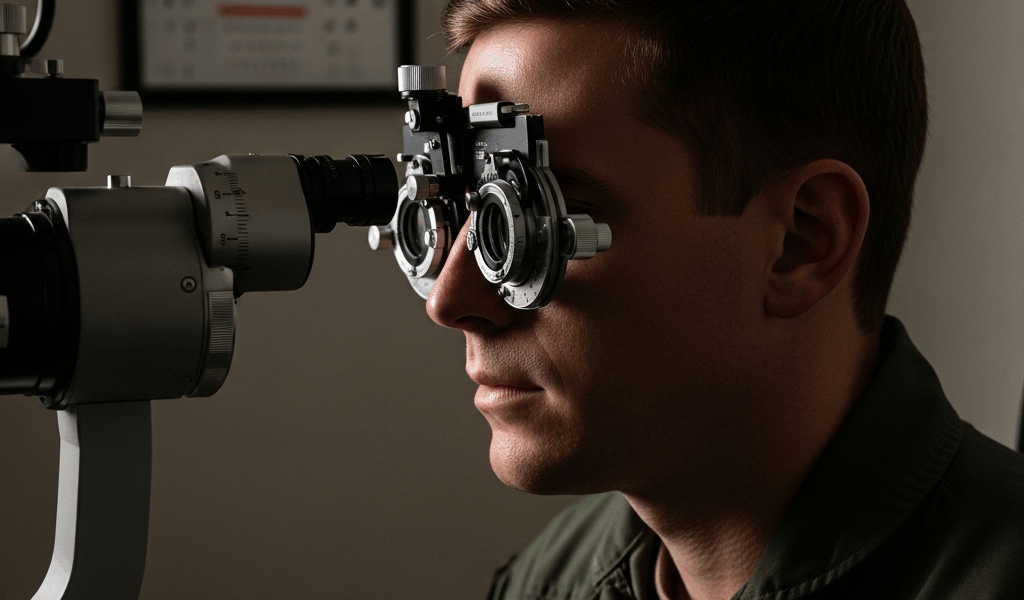
The exam takes about 25 minutes for the vision portion alone. You will cycle through distance acuity (the standard Snellen chart at 20 feet), near acuity, color vision testing, depth perception, peripheral field screening, and a motility exam where the examiner watches your eyes track a moving target. If you wear contact lenses, you will be asked to remove them and be tested without correction first. Bring your prescription documentation and your surgical records if applicable.
One mistake I watched candidates make repeatedly — showing up to their flight physical in contact lenses they had been wearing continuously for days, which can temporarily distort corneal shape and give artificially poor refraction readings. Remove contacts at least 72 hours before the physical. For rigid gas-permeable lenses, some ophthalmologists recommend two full weeks out before any refractive measurement.
How Waivers Work
A waiver is not a loophole. It is a formal medical review process where an aeromedical authority — either a branch-specific board or in some cases AETC or NAMI — evaluates whether a specific deficiency represents an actual flight safety risk. Waivers exist for marginal uncorrected acuity, minor refractive errors slightly outside limits, and certain corrective surgery cases that fall in gray zones.
Waiver approval rates vary significantly by branch and by condition. The Navy’s Naval Aerospace Medical Institute processes more waivers and is generally considered more liberal in its approach. The Army, particularly for warrant officer candidates going through WOCS at Fort Novosel, has a reputation for stricter initial adjudication — though waivers do get approved there too.
What Disqualifies You That You Can’t Fix
Probably should have opened with this section, honestly — because if something here applies to you, the rest of the article doesn’t change your outcome.
Color Vision Deficiency
This is the hard stop most people don’t want to hear. If you fail the PIP plates and fail the FALANT, you are disqualified from pilot training in the Air Force, Army, and Marine Corps with no waiver available. The Navy has a limited waiver process for specific rear-cockpit or non-tactical aviation roles, but for pilot candidates — no. There is no treatment for red-green color deficiency. Special color vision lenses like the X-Chrom or tinted contacts are explicitly prohibited during testing.
Conditions With No Waiver Path
Keratoconus — even mild, subclinical forme fruste keratoconus detected on corneal topography — is disqualifying with no waiver. This comes up more than you’d expect because pre-surgical LASIK screening catches topographic irregularities that candidates had no idea they had.
Monocularity is disqualifying. Loss of an eye or functional loss of vision in one eye ends the pilot candidacy conversation completely.
A history of retinal detachment or retinal surgery is disqualifying in most cases. There is a narrow waiver path in certain post-treatment scenarios, but the approval rate is low and the review process is extensive.
Glaucoma, optic nerve damage, and significant visual field defects have no waiver pathway for pilot training. Neither does a history of corneal transplant.
The standard I always heard flight surgeons repeat was this: the military is not trying to keep you out. It is trying to ensure that at 400 knots at night over water, your visual system will not fail the aircraft or the people depending on you. That framing doesn’t make a disqualification hurt less. But it is an honest way to understand why these standards exist and why some of them have no exceptions.

Stay in the loop
Get the latest milpilot updates delivered to your inbox.