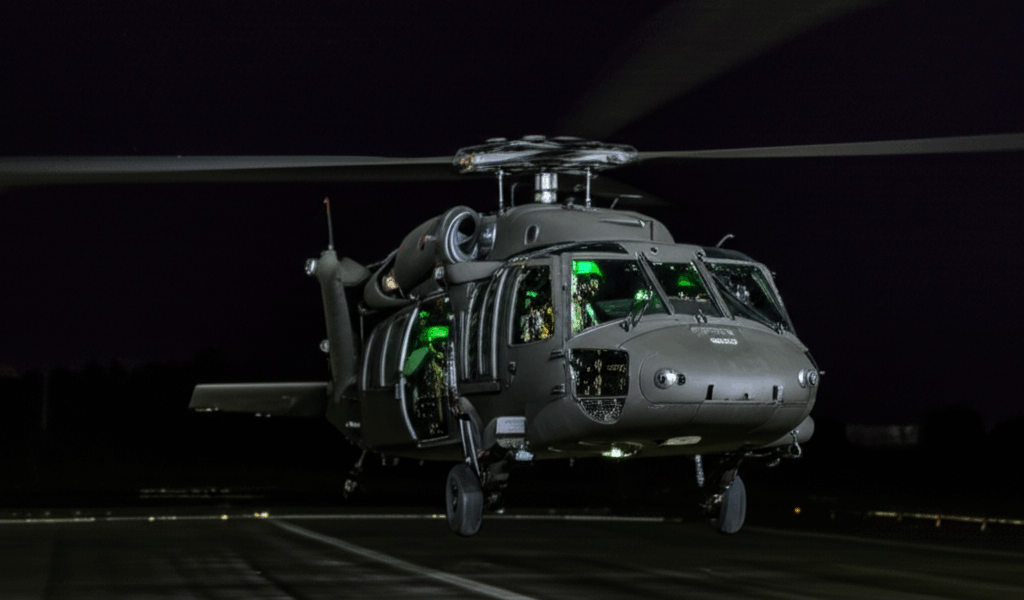
Night helicopter operations have gotten complicated with all the technology advances flying around in modern aviation. Today, I will share it all with you.
Before night vision goggles became standard equipment, helicopter operations after dark meant flying on instruments or simply not flying at all. That limitation defined decades of helicopter doctrine. NVGs transformed rotary-wing aviation into a 24-hour capability that adversaries genuinely struggle to counter.
Simple Technology, Complex Reality
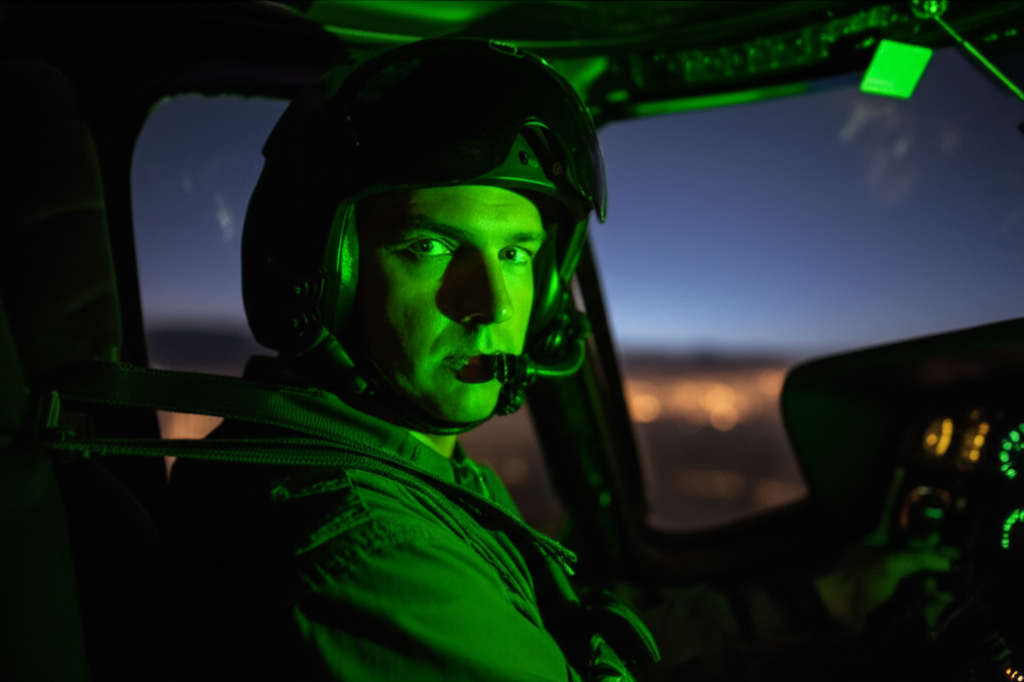
The technology seems simple when you describe it. Goggles amplify available light, letting pilots see terrain and obstacles that would otherwise be invisible in darkness. Point the goggles, see the world in green, fly the helicopter.
In practice, NVG flying demands entirely different skills and creates unique hazards that pilots must master over hundreds of hours. That’s what makes NVG qualification so difficult—the technology helps, but it also creates new problems you have to solve.
Depth Perception—Learning to See Again
Depth perception suffers under NVGs in ways that surprise new pilots. The two-dimensional green image lacks cues that daylight provides—shadows fall differently, textures flatten out, distances become harder to judge. Your brain is used to processing visual information one way, and NVGs force you to relearn basic perception.
Pilots learn to judge distances through experience and cross-reference with instruments. New NVG pilots often struggle with hover height and approach profiles until their brains adapt. I’ve watched students flare too high or too low repeatedly until something clicks. When it clicks, they describe it as their brain finally “getting it.”
The Tunnel Vision Problem
Field of view limitations create constant danger that never goes away no matter how experienced you get. Standard NVGs provide roughly 40-degree vision compared to human eyes’ 180-degree peripheral awareness. Imagine flying with toilet paper tubes strapped to your eyes—that’s the rough equivalent.
Pilots must actively scan to compensate, turning their heads continuously to check areas the goggles can’t see. This scanning becomes habit, but it’s exhausting. Miss one scan and you might miss the wire, the tower, the terrain rising on your left. That’s what makes NVG flying so demanding—you can’t relax your vigilance for a second.
Good Nights and Bad Nights
Illumination conditions change everything about NVG operations. A bright moon with snow cover provides excellent NVG conditions—the world lights up like a green version of daylight. Overcast nights with minimal ambient light degrade performance dramatically, turning the world into grainy darkness where obstacles hide until you’re nearly on top of them.
Pilots must understand these variations and adjust tactics accordingly. What you can do on a full-moon night over snow isn’t what you can do on a new moon over dark terrain. Planning every mission around illumination conditions becomes second nature.
The Training Investment
Training for NVG operations takes time and money that units constantly balance against other priorities. The goggles themselves cost thousands of dollars each. Training sorties require specific environmental conditions—you can’t practice NVG operations in daylight. Currency requirements mean regular flights to maintain proficiency even when other missions compete for aircraft hours.
Units must balance NVG training against other mission preparation constantly. It’s never enough time, never enough sorties. But the capability matters too much to let slip.
Why It’s Worth Every Penny
Despite all these challenges, NVG capability provides tactical advantages that justify the investment completely. Enemies who can’t see in the dark become vulnerable to forces that can. The night belongs to whoever owns it, and NVGs let us own it.
Medevac missions that would have waited for dawn now launch immediately—and that saves lives. Special operations rely heavily on darkness as concealment, and NVGs make their impossible missions merely difficult. That’s what makes NVG capability so essential—it turns night from an obstacle into an advantage.


Leave a Reply
You must be logged in to post a comment.